michael-dean-k/

← all books
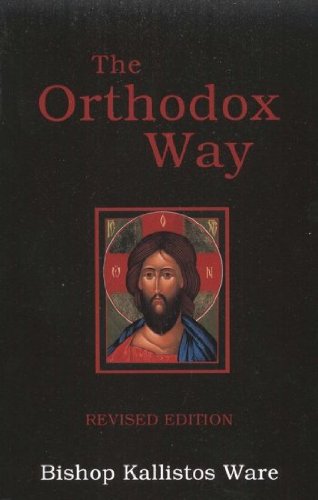
The Orthodox Way cover

The Orthodox Way

Author
Kallistos Ware
Highlights
99
Category
books
John 14:6 The Church gives us not a system, but a key; not a plan of God's City, but the means of entering it. Perhaps someone will lose his way because he has no plan. But all that he will see, he will see without a mediator, he will see it directly, it will be real for him; while he who has studied only the plan risks remaining outside and not really finding anything.1
Location 35
I am not sitting, I am on a journey. Every Christian may apply these words to himself or herself. To be a Christian is to be a traveller. Our situation, say the Greek Fathers, is like that of the Israelite people in the desert of Sinai: we live in tents, not houses, for spiritually we are always on the move. We are on a journey through the inward space of the heart, a journey not measured by the hours of our watch or the days of the calendar, for it is a journey out of time into eternity.
Location 43
One of the most ancient names for Christianity is simply “the Way”.
Location 47
There is only one means of discovering the true nature of Christianity. We must step out upon this path, commit ourselves to this way of life, and then we shall begin to see for ourselves. So long as we remain outside, we cannot properly understand. Certainly we need to be given directions before we start; we need to be told what signposts to look out for; and we need to have companions. Indeed, without guidance from others it is scarcely possible to begin the journey. But directions given by others can never convey to us what the way is actually like; they cannot be a substitute for direct, personal experience. Each is called to verify for himself what he has been taught, each is required to re-live the Tradition he has received. “The Creed”, said Metropolitan Philaret of Moscow, “does not belong to you unless you have lived it.” No one can be an armchair traveller on this all-important journey. No one can be a Christian at second hand. God has children, but he has no grandchildren.
Location 51
As a Christian of the Orthodox Church, I wish particularly to underline this need for living experience. To many in the twentieth-century West, the Orthodox Church seems chiefly remarkable for its air of antiquity and conservatism; the message of the Orthodox to their Western brethren seems to be, “We are your past”. For the Orthodox themselves, however, loyalty to Tradition means not primarily the acceptance of formulae or customs from past generations, but rather the ever-new, personal and direct experience of the Holy Spirit in the present, here and now.
Location 58
Betjeman draws attention here to much that an Orthodox holds precious: the value of symbolic gestures such as the lighting of a candle; the role of ikons in conveying a sense of the local church as “heaven on earth”; the prominence of martyrdom in the Orthodox experience—under the Turks since 1453, under the Communists since 1917. Orthodoxy in the modern world is indeed an “old tree”. But besides age there is also vitality, a “perpetual resurrection”; and it is this that matters, and not mere antiquity. Christ did not say, “I am custom”; he said, “I am the Life”.
Location 71
It is the aim of the present book to uncover the deep sources of this “perpetual resurrection”.
Location 75
My purpose in this book is to offer a brief account of the fundamental teachings of the Orthodox Church, approaching the faith as a way of life and a way of prayer. Just as Tolstoy entitled one of his short stories, “What men live by”, so this book might have been called, “What Orthodox Christians live by”.
Location 79
God cannot be grasped by the mind. If he could be grasped, he would not be God.1 Evagrius of Pontus
Location 98
The traveller upon the spiritual Way, the further he advances, becomes increasingly conscious of two contrasting facts—of the otherness and yet the nearness of the Eternal. In the first place, he realizes more and more that God is mystery. God is “the wholly Other”, invisible, inconceivable, radically transcendent, beyond all words, beyond all understanding.
Location 110
Advancing on the Way, each finds that God grows ever more intimate and ever more distant, well known and yet unknown—well known to the smallest child, incomprehensible to the most brilliant theologian. God dwells in “light unapproachable”, yet man stands in his presence with loving confidence and addresses him as friend. God is both end-point and starting-point. He is the host who welcomes us at the conclusion of the journey, yet he is also the companion who walks by our side at every step upon the Way. As St Nicolas Cabasilas puts it, “He is both the inn at which we rest for a night and the final end of our journey.”
Location 129
God as Mystery Unless we start out with a feeling of awe and astonishment—with what is often called a sense of the numinous—we shall make little progress on the Way. When Samuel Palmer first visited William Blake, the old man asked him how he approached the work of painting. “With fear and trembling”, Palmer replied. “Then you'll do”, said Blake. The Greek Fathers liken man's encounter with God to the experience of someone walking over the mountains in the mist: he takes a step forward and suddenly finds that he is on the edge of a precipice, with no solid ground beneath his foot but only a bottomless abyss. Or else they use the example of a man standing at night in a darkened room: he opens the shutter over a window, and as he looks out there is a sudden flash of lightning, causing him to stagger backwards, momentarily blinded. Such is the effect of coming face to face with the living mystery of God: we are assailed by dizziness; all the familiar footholds vanish, and there seems nothing for us to grasp; our inward eyes are blinded, our normal assumptions shattered.
Location 134
Abraham, living still in his ancestral home at Ur of the Chaldees, is told by God: “Go out from your country, and from your kindred, and from your father's house, to a land that I will show you” (Gen. 12:1). Accepting the divine call, he uproots himself from his familiar surroundings and ventures out into the unknown, without any clear…
Location 143
Abraham journeys from his familiar home into an unknown country; Moses progresses from light into darkness. And so it proves to be for each one who follows the spiritual Way. We go out from the known to the unknown, we advance from light into darkness. We do not simply proceed from the darkness of ignorance into the light of knowledge, but we go forward from the light of partial knowledge into a greater knowledge which is so much more profound that it can only be described as the “darkness of unknowing.” Like Socrates we begin to realize how little we understand. We see that it is not the task of Christianity to…
Location 149
Recognizing that God is incomparably greater than anything we can say or think about him, we find it necessary to refer to him not just through direct statements but through pictures and images. Our theology is to a large extent symbolic. Yet symbols alone are insufficient to convey the transcendence and the “otherness” of God. To point at the mysterium tremendum, we need to use negative as well as affirmative statements, saying what God is not rather than what he is. Without…
Location 157
Having made an assertion about God, we must pass beyond it: the statement is not untrue, yet neither it nor any other form of words can contain…
Location 165
So the spiritual Way proves to be a path of repentance in the most radical sense. Metanoia, the Greek word for repentance, means literally “change of mind.” In approaching God, we are to change our mind, stripping ourselves of all our habitual ways of thinking. We are to be converted not only in our will but in our…
Location 166
Destructive in outward form, the apophatic approach is affirmative in its final effects: it helps us to reach out, beyond all statements positive or negative, beyond all language and all thought,…
Location 171
This is implied, indeed, by the very word “mystery.” In the proper religious sense of the term, “mystery” signifies not only hiddenness but disclosure. The Greek noun mysterion is linked with the verb myein, meaning “to close the eyes or mouth.” The candidate for initiation into certain of the pagan mystery religions was first blindfolded and led through a maze of passages; then suddenly his eyes were uncovered and he saw, displayed all round him, the secret emblems of the cult. So, in the Christian context, we do not mean by a “mystery” merely that which is baffling and mysterious, an enigma or insoluble problem. A mystery is, on the contrary, something that is…
Location 173
When, on the other hand, I say to a much-loved friend, “I believe in you”, I am doing far more than expressing a belief that this person exists. “I believe in you” means: I turn to you, I rely upon you, I put my full trust in you and I hope in you. And that is what we are saying to God in the Creed.
Location 185
Faith in God, then, is not at all the same as the kind of logical certainty that we attain in Euclidean geometry. God is not the conclusion to a process of reasoning, the solution to a mathematical problem. To believe in God is not to accept the possibility of his existence because it has been “proved” to us by some theoretical argument, but it is to put our trust in One whom we know and love. Faith is not the supposition that something might be true, but the assurance that someone is there.
Location 188
Because faith is not logical certainty but a personal relationship, and because this personal relationship is as yet very incomplete in each of us and needs continually to develop further, it is by no means impossible for faith to coexist with doubt.
Location 192
Yet doubt does not in itself signify lack of faith. It may mean the opposite—that our faith is alive and growing. For faith implies not complacency but taking risks, not shutting ourselves off from the unknown but advancing boldly to meet it. Here an Orthodox Christian may readily make his own the words of Bishop J.A.T. Robinson: “The act of faith is a constant dialogue with doubt.” As Thomas Merton rightly says, “Faith is a principle of questioning and struggle before it becomes a principle of certitude and peace.”
Location 196
Faith, then, signifies a personal relationship with God; a relationship as yet incomplete and faltering, yet none the less real. It is to know God not as a theory or an abstract principle, but as a person. To know a person is far more than to know facts about that person. To know a person is essentially to love him or her; there can be no true awareness of other persons without mutual love. We do not have any genuine knowledge of those whom we hate.
Location 200
God, then, is the One whom we love, our personal friend. We do not need to prove the existence of a personal friend. God, says Olivier Clément, “is not exterior evidence, but the secret call within us.” If we believe in God, it is because we know him directly in our own experience, not because of logical proofs.
Location 234
A distinction, however, needs here to be made between “experience” and “experiences.” Direct experience can exist without necessarily being accompanied by specific experiences. There are indeed many who have come to believe in God because of some voice or vision, such as St Paul received on the road to Damascus (Acts 9:1 -9). There are many others, however, who have never undergone particular experiences of this type, but who can yet affirm that, present throughout their life as a whole, there is a total experience of the living God, a conviction existing on a level more fundamental than all their doubts. Even though they cannot point to a precise place or moment in the way that St Augustine, Pascal or Wesley could, they can claim with confidence: I know God personally.
Location 237
First, there is the world around us. What do we see? Much disorder and apparent waste, much tragic despair and seemingly useless suffering. And is that all? Surely not. If there is a “problem of evil”, there is also a “problem of good.” Wherever we look, we see not only confusion but beauty. In snowflake, leaf or insect, we discover structured patterns of a delicacy and balance that nothing manufactured by human skill can equal. We are not to sentimentalize these things, but we cannot ignore them. How and why have these patterns emerged? If I take a pack of cards fresh from the factory, with the four suits neatly arranged in sequence, and I begin to shuffle it, then the more it is shuffled the more the initial pattern disappears and is replaced by a meaningless juxtaposition. But in the case of the universe the opposite has happened. Out of an initial chaos there have emerged patterns of an ever-increasing intricacy and meaning, and among all these patterns the most intricate and meaningful is man himself. Why should the process that happens to the…
Location 246
The Dust and Stones of the Street were as Precious as Gold…The Green Trees when I saw them first through one of the Gates Transported and Ravished me; their Sweetnes and unusual Beauty made my Heart to leap, and almost mad with Exstasie, they were such strange and Wonderful Things…” Thomas Traherne's childhood apprehensions of the beauty of the world can be paralleled by numerous texts from Orthodox sources. Here, for example, are the words of Prince Vladimir Monomakh of Kiev: See how the sky, the sun and moon and stars, the darkness and light, and the earth that is laid upon the waters, are ordered, O Lord, by thy providence! See how the different animals, and the birds and fishes, are adorned through thy loving care, O Lord! This wonder, also, we admire: how thou hast created man out of the dust and how varied is the appearance of human faces: though we should gather together all men throughout the whole world, yet there is none with the same appearance, but…
Location 256
We find a second “pointer” within ourselves. Why, distinct from my desire for pleasure and dislike of pain, do I have within myself a feeling of duty and moral obligation, a sense of right and wrong, a conscience? And this conscience does not simply tell me to obey standards taught to me by others; it is personal. Why, furthermore, placed as I am within time and space, do I find within myself what…
Location 267
The boundaries of the human person are extremely wide; each of us knows very little about his true and deep self. Through our faculties of perception, outward and inward, through our memory and through the power of the unconscious, we range widely over space, we stretch backward and forward in time, and we reach out beyond space and time into eternity. “Within the heart are unfathomable depths”, affirm The Homilies of St Macarius. “It is but a small vessel: and yet dragons and lions are there, and there poisonous creatures and all the treasures of wickedness; rough, uneven paths are there, and gaping chasms. There likewise…
Location 271
What is the meaning of my conscience? What is the explanation for my sense of the infinite? Within myself there is something which continually makes me look beyond myself. Within myself I bear a source…
Location 278
For each of us—perhaps once or twice only in the whole course of our life—there have been sudden moments of discovery when we have seen disclosed the deepest being and truth of another, and we have experienced his or her inner life as if it were our own. And this encounter with the true personhood of another is, once more,…
Location 281
say to another, with all our heart, “I love you”, is to say, “You will never die.” At such moments of personal sharing we know, not through arguments but by immediate conviction, that there is life beyond death. So it is that in our relations with others, as in our experience of ourselves,…
Location 283
None of these “pointers” constitutes a logical proof. But what is the alternative? Are we to say that the apparent order in the universe is mere coincidence; that conscience is simply the result of social conditioning; and that, when life on this planet finally becomes extinct, all that humankind has experienced and all our potentialities will be as though they had never existed…
Location 288
But, while God's inner essence is for ever beyond our comprehension, his energies, grace, life and power fill the whole universe, and are directly accessible to us. The essence, then, signifies the radical transcendence of God; the energies, his immanence and omnipresence.
Location 305
By virtue of this distinction between the divine essence and the divine energies, we are able to affirm the possibility of a direct or mystical union between man and God—what the Greek Fathers term the theosis of man, his “deification”—but at the same time we exclude any pantheistic identification between the two: for man participates in the energies of God, not in the essence. There is union, but not fusion or confusion. Although “oned” with the divine, man still remains man; he is not swallowed up or annihilated, but between him and God there continues always to exist an “I—Thou” relationship of person to person.
Location 316
Through the apophatic way we smash in pieces all the idols or mental images that we form of him, for we know that all are unworthy of his surpassing greatness. Yet at the same time, through our prayer and through our active service in the world, we discover at every moment his divine energies, his immediate presence in each person and each thing. Daily, hourly we touch him. We are, as Francis Thompson said, “in no strange land.” All around us is the “many-splendoured thing”; Jacob's ladder is “pitched betwixt heaven and Charing Cross”: O world invisible, we view thee, O world intangible, we touch thee, O world unknowable, we know thee, Inapprehensible, we clutch thee. In the words of John Scotus Eriugena, “Every visible or invisible creature is a theophany or appearance of God.” The Christian is the one who, wherever he looks, sees God everywhere and rejoices in him. Not without reason did the early Christians attribute to Christ this saying: “Lift the stone and you will find me; cut the wood in two and there am I.”
Location 321
In the words of John Scotus Eriugena, “Every visible or invisible creature is a theophany or appearance of God.” The Christian is the one who, wherever he looks, sees God everywhere and rejoices in him. Not without reason did the early Christians attribute to Christ this saying: “Lift the stone and you will find me; cut the wood in two and there am I.”
Location 328
Think of a man standing at night inside his house, with all the doors closed; and then suppose that he opens a window just at the moment when there is a sudden flash of lightning. Unable to bear its brightness, at once he protects himself by closing his eyes and drawing back from the window. So it is with the soul that is enclosed in the realm of the senses; if ever she peeps out through the window of the intellect, she is overwhelmed by the brightness, like lightning, of the pledge of the Holy Spirit that is within her. Unable to bear the splendour of unveiled light, at once she is bewildered in her intellect and she draws back entirely upon herself, taking refuge, as in a house, among sensory and human things.15 St Symeon the New Theologian
Location 339
So it is with the soul that is enclosed in the realm of the senses; if ever she peeps out through the window of the intellect, she is overwhelmed by the brightness, like lightning, of the pledge of the Holy Spirit that is within her. Unable to bear the splendour of unveiled light, at once she is bewildered in her intellect and she draws back entirely upon herself, taking refuge, as in a house, among sensory and human things.15 St Symeon the New Theologian
Location 341
Anyone who tries to describe the ineffable Light in language is truly a liar—not because he hates the truth, but because of the inadequacy of his description.16 St Gregory of Nyssa
Location 346
Leave the senses and the workings of the intellect, and all that the senses and the intellect can perceive, and all that is not and that is; and through unknowing reach out, so far as this is possible, towards oneness with him who is beyond all being and knowledge. In this way, through an uncompromising, absolute and pure detachment from yourself and from all things, transcending all things and released from all, you will be led upwards towards that radiance of the divine darkness which is beyond all being. Entering the darkness that surpasses understanding, we shall find ourselves brought, not just to brevity of speech, but to perfect silence and unknowing. Emptied of all knowledge, man is joined in the highest part of himself, not with any created thing, nor with himself, nor with another, but with the One who is altogether unknowable; and, in knowing nothing, he knows in a manner that surpasses understanding.17 St Dionysius the Areopagite
Location 349
Love for God is ecstatic, making us go out from ourselves: it does not allow the lover to belong any more to himself, but he belongs only to the Beloved.21 St Dionysius the Areopagite
Location 371
And I know that I shall not die, for I am within the Life, I have the whole of Life springing up as a fountain within me.
Location 378
O Father, my hope: O Son, my refuge: O Holy Spirit, my protection: Holy Trinity, glory to thee.1 Prayer of St loannikios
Location 383
“I believe in one God”: so we affirm at the beginning of the Creed. But then at once we go on to say much more than this. I believe, we continue, in one God who is at the same time three, Father, Son, and Holy Spirit. There is in God genuine diversity as well as true unity.
Location 391
I believe, we continue, in one God who is at the same time three, Father, Son, and Holy Spirit. There is in God genuine diversity as well as true unity. The Christian God is not just a unit but a union, not just unity but community. There is in God something analogous to “society”. He is not a single person, loving himself alone, not a self-contained monad or “The One”. He is triunity: three equal persons, each one dwelling in the other two by virtue of an unceasing movement of mutual love.
Location 392
The final end of the spiritual Way is that we humans should also become part of this Trinitarian coinherence or perichoresis, being wholly taken up into the circle of love that exists within God.
Location 400
First, a “person” is not at all the same as an “individual”. Isolated, self-dependent, none of us is an authentic person but merely an individual, a bare unit as recorded in the census. Egocentricity is the death of true personhood. Each becomes a real person only through entering into relation with other persons, through living for them and in them. There can be no man, so it has been rightly said, until there are at least two men in communication. The same is true, secondly, of love. Love cannot exist in isolation, but presupposes the other.
Location 408
Hell is not other people; hell is myself, cut off from others in self-centeredness.
Location 413
A favorite analogy for the Trinity has always been that of three torches burning with a single flame. We are told in The Sayings of the Desert Fathers how a brother once came to talk with Abba Joseph of Panepho. “Abba,” said the visitor, “according to my strength I observe a modest rule of prayer and fasting, of reading and silence, and so far as I can I keep myself pure in my thoughts. What more can I do?” In answer, Abba Joseph rose to his feet and held up his hands towards the sky; and his fingers became as ten blazing torches. And the old man said to the brother: “If you wish, you can become completely as a flame.” If this image of the living flame helps us to understand man's nature at its highest, can it not also be applied to God? The three persons of the Trinity are “completely as a flame.”
Here’s an example of a personal note. Does it expand? Or does it not? Here’s an example of a personal note. Does it expand? Or does it not? Here’s an example of a personal note. Does it expand? Or does it not? Here’s an example of a personal note. Does it expand? Or does it not? Here’s an example of a personal note. Does it expand? Or does it not? Here’s an example of a personal note. Does it expand? Or does it not?
Location 422
God the Trinity is thus to be described as “three persons in one essence”. There is eternally in God true unity, combined with genuinely personal differentiation: the term “essence”, “substance” or “being” (ousia) indicates the unity, and the term “person” (hypostasis, prosopon) indicates the differentiation. Let us try to understand what is signified by this somewhat baffling language, for the dogma of the Holy Trinity is vital to our own salvation.
Location 438
Father, Son and Spirit—so the saints affirm, following the testimony of Scripture—have only one will and not three, only one energy and not three. None of the three ever acts separately, apart from the other two. They are not three Gods, but one God.
Location 446
Each of the three is fully and completely God. None is more or less God than the others. Each possesses, not one third of the Godhead, but the entire Godhead in its totality; yet each lives and is this one Godhead in his own distinctive and personal way.
Location 456
“Using riddles…”: St Gregory is at pains to emphasize that the doctrine of the Trinity is “paradoxical” and lies “beyond words and understanding”. It is something revealed to us by God, not demonstrated to us by our own reason. We can hint at it in human language, but we cannot fully explain it. Our reasoning powers are a gift from God, and we must use them to the full; but we should recognize their limitations.
Location 468
The first person of the Trinity, God the Father, is the “fountain” of the Godhead, the source, cause or principle of origin for the other two persons.
Location 473
is in and through the Son that the Father is revealed to us: “I am the Way, the Truth and the Life: no one comes to the Father, except through me” (John 14:6).
Location 486
But as Word or Logos of God he is also at work before the Incarnation. He is the principle of order and purpose that permeates all things, drawing them to unity in God, and so making the universe into a “cosmos”, a harmonious and integrated whole. The Creator-Logos has imparted to each created thing its own indwelling logos or inner principle, which makes that thing to be distinctively itself, and which at the same time draws and directs that thing towards God. Our human task as craftsmen or manufacturers is to discern this logos dwelling in each thing and to render it manifest; we seek not to dominate but to co-operate.
Location 488
While appreciating the inadequacy of neat classifications, we may say that the Spirit is God within us, the Son is God with us, and the Father, God above or beyond us.
Location 493
The Spirit is sent into the world, within time, by the Son; but, as regards his origin within the eternal life of the Trinity, the Spirit proceeds from the Father alone.)
Location 496
We cannot prove by arguments why this should be so, yet it remains a fact of our Christian experience that God has set his seal upon certain symbols and not upon others. The symbols are not chosen by us but revealed and given. A symbol can be verified, lived, prayed—but not “proved” logically. These “given” symbols, however, while not capable of proof, are yet far from being arbitrary. Like the symbols in myth, literature and art, our religious symbols reach deep into the hidden roots of our being and cannot be altered without momentous consequences. If, for example, we were to start saying “Our Mother who art in heaven”, instead of “Our Father”, we should not merely be adjusting an incidental piece of imagery, but replacing Christianity with a new kind of religion. A Mother Goddess is not the Lord of the Christian Church.
Location 513
The terms “generation” and “procession” are conventional signs for a reality far beyond the comprehension of our reasoning brain. “Our reasoning brain is weak, and our tongue is weaker still”, remarks St Basil the Great. “It is easier to measure the entire sea with a tiny cup than to grasp God's ineffable greatness with the human mind.”
Location 525
God the Father creates through his “Word” or Logos (the second person) and through his “Breath” or Spirit (the third person). The “two hands” of the Father work together in the shaping of the universe. Of the Logos it is said, “all things were made through him” (John 1:3: compare the Creed, “…through whom all things were made”); of the Spirit it is said that at the creation he “brooded” or “moved upon the face of the deep” (Gen. 1:2). All created things are marked with the seal of the Trinity.
Location 537
“Prayer is action”14 (Tito Colliander). “What is pure prayer? Prayer which is brief in words but abundant in actions. For if your actions do not exceed your petitions, then your prayers are mere words, and the seed of the hands is not in them”15 (The Sayings of the Desert Fathers
Location 593
“The most perfect rule of Christianity, its exact definition, its highest summit, is this: to seek what is for the benefit of all”, states St John Chrysostom. “…I cannot believe that it is possible for a man to be saved if he does not labour for the salvation of his neighbor.” Such are the practical implications of the dogma of the Trinity. That is what it means to live the Trinity.
Location 611
Believe me, there is one truth that reigns supreme from the fringes of the throne of glory down to the least shadow of the most insignificant of creatures: and that one truth is love. Love is the source from which the holy streams of grace flow down unceasingly from the city of God, watering the earth and making it fruitful. “One deep calls to another” (Ps. 42:7): like a deep or an abyss, in its infinity love helps us to picture to ourselves the dread vision of the Godhead. It is love that fashions all things and holds them in unity. It is love that gives life and warmth, that inspires and guides. Love is the seal set upon creation, the signature of the Creator. Love is the explanation of his handiwork. How can we make Christ come and dwell in our hearts? How else, except through love?22 Fr Theoklitos of Dionysiou
Location 654
The bodies of our fellow human beings must be treated with more care than our own. Christian love teaches us to give our brethren not only spiritual gifts, but material gifts as well. Even our last shirt, our last piece of bread must be given to them. Personal almsgiving and the most wide-ranging social work are equally justifiable and necessary. The way to God lies through love of other people, and there is no other way. At the Last Judgement I shall not be asked if I was successful in my ascetic exercises or how many prostrations I made in the course of my prayers. I shall be asked, did I feed the hungry, clothe the naked, visit the sick and the prisoners: that is all I shall be asked.23 Mother Maria of Paris
Location 662
Understand that you have within yourself, upon a small scale, a second universe: within you there is a sun, there is a moon, and there are also stars.2 Origen
Location 681
What is meant by this phrase “out of nothing”, ex nihilo? Why, indeed, did God create at all? The words “out of nothing” signify, first and foremost, that God created the universe by an act of his free will. Nothing compelled him to create; he chose to do so. The world was not created unintentionally or out of necessity; it is not an automatic emanation or overflowing from God, but the consequence of divine choice.
Location 700
If nothing compelled God to create, why then did he choose to do so? In so far as such a question admits of an answer, our reply must be: God's motive in creation is his love. Rather than say that he created the universe out of nothing, we should say that he created it out of his own self, which is love. We should think, not of God the Manufacturer or God the Craftsman, but of God the Lover. Creation is an act not so much of his free will as of his free love. To love means to share, as the doctrine of the Trinity has so clearly shown us: God is not just one but one-in-three, because he is a communion of persons who share in love with one another. The circle of divine love, however, has not remained closed. God's love is, in the literal sense of the word, “ecstatic”—a love that causes God to go out from himself and to create things other than himself. By voluntary choice God created the world in “ecstatic” love, so that there might be besides himself other beings to participate in the life and the love that are his.
Location 704
In God's heart and in his love, each one of us has always existed. From all eternity God saw each one of us as an idea or thought in his divine mind, and for each one from all…
Location 713
Existence is always a gift from God—a free gift of his love, a gift that is never taken back, but a gift none the less, not something that we possess by our own power. God alone has the cause and source of his being in himself; all created things have their cause and source, not in themselves, but in him. God alone is self-sourced; all created things are God-sourced, God-rooted,…
Location 717
In saying that God is Creator of the world, we do not mean merely that he set things in motion by an initial act “at the beginning”, after which they go on functioning by themselves. God is not just a cosmic clockmaker, who winds up the machinery and then leaves it to keep ticking on its own. On the contrary, creation is continual. If we are to be accurate when speaking of creation, we should use not the past tense but the continuous present. We should say, not “God made the world, and me in it”, but “God is making the world, and me in it, here and now, at this moment and always”. Creation is not an event in the past, but a relationship in the present. If God did not…
Location 721
As creator, then, God is always at the heart of each thing, maintaining it in being. On the level of scientific inquiry, we discern certain processes or sequences of cause and effect. On the level of spiritual vision, which does not contradict science but looks beyond it, we discern everywhere the creative energies of God, upholding all that is, forming the innermost essence of all things.
Location 734
Against dualism in all its forms, Christianity affirms that there is a summum bonum, a “supreme good”—namely, God himself—but there is and can be no summum malum. Evil is not coeternal with God. In the beginning there was only God: all the things that exist are his creation, whether in heaven or on earth, whether spiritual or physical, and so in their basic “thusness” they are all of them good. What, then, are we to say about evil? Since all created things are intrinsically good, sin or evil as such is not a “thing”, not an existent being or substance. “I did not see sin”, says Julian of Norwich in her Revelations, “for I believe that it has no kind of substance, no share in being; nor can it be recognized except by the pain caused by it.”7 “Sin is naught”,8 says St Augustine. “That which is evil in the strict sense”, observes Evagrius, “is not a substance but the absence of good, just as darkness is nothing else than the absence of light.”9
Location 747
Evil is always parasitic. It is the twisting and misappropriation of what is in itself good. Evil resides not in the thing itself but in our attitude towards the thing—that is to say, in our will. It might seem that, by terming evil “nothing”, we are underestimating its forcefulness and dynamism. But, as C.S. Lewis has remarked, Nothing is very strong.12 To say that evil is the perversion of good, and therefore in the final analysis an illusion and unreality, is not to deny its powerful hold over us. For there is no greater force within creation than the free will of beings endowed with self-consciousness and spiritual intellect; and so the misuse of this free will can have altogether terrifying consequences.
Location 759
First, there is the body, “dust from the ground” (Gen. 2:7), the physical or material aspect of man's nature. Secondly, there is the soul, the life-force that vivifies and animates the body, causing it to be not just a lump of matter, but something that grows and moves, that feels and perceives. Animals also possess a soul, and so perhaps do plants. But in man's case the soul is endowed with consciousness; it is a rational soul, possessing the capacity for abstract thought, and the ability to advance by discursive argument from premises to a conclusion. These powers are present in animals, if at all, only to a very limited degree. Thirdly, there is the spirit, the “breath” from God (see Gen. 2:7), which the animals lack. It is important to distinguish “Spirit”, with an initial capital, from “spirit” with a small s. The created spirit of man is not to be identified with the uncreated or Holy Spirit of God, the third person of the Trinity; yet the two are intimately connected, for it is through his spirit that man apprehends God and enters into communion with him.
Location 769
With his spirit (pneuma), which is sometimes termed nous or spiritual intellect, he understands eternal truth about God or about the logoi or inner essences of created things, not through deductive reasoning, but by direct apprehension or spiritual perception—by a kind of intuition that St Isaac the Syrian calls “simple cognition”. The spirit or spiritual intellect is thus distinct from man's reasoning powers and his aesthetic emotions, and superior to both of them.
Location 779
On the first level God formed the angels, who have no material body. On the second level he formed the physical universe—the galaxies, stars and planets, with the various types of mineral, vegetable and animal life. Man, and man alone, exists on both levels at once.
Location 794
Our human nature is thus more complex than the angelic, and endowed with richer potentialities. Viewed in this perspective, man is not lower but higher than the angels; as the Babylonian Talmud affirms, “The righteous are greater than the ministering angels” (Sanhedrin 93a). Man stands at the heart of God's creation. Participating as he does in both the noetic and the material realms, he is an image or mirror of the whole creation, imago mundi, a “little universe” or microcosm. All created things have their meetingplace in him.
Location 799
Being microcosm, man is also mediator. It is his God-given task to reconcile and harmonize the noetic and the material realms, to bring them to unity, to spiritualize the material, and to render manifest all the latent capacities of the created order. As the Jewish Hasidim expressed it, man is called “to advance from rung to rung until, through him, everything is united”.14 As microcosm, then, man is the one in whom the world is summed up; as mediator, he is the one through whom the world is offered back to God.
Location 810
“Do you not realize that your body is a temple of the Holy Spirit that is in you?” writes St Paul. “…Glorify God with your body…I beseech you therefore, brethren, by the mercies of God, that you offer your bodies as a living sacrifice, holy, acceptable to God” (1 Cor. 6:19-20; Rom. 12:1). But in “spiritualizing” the body, man does not thereby dematerialize it: on the contrary, it is the human vocation to manifest the spiritual in and through the material. Christians are in this sense the only true materialists.
Location 818
The separation of body and soul at death is unnatural, something contrary to God's original plan, that has come about in consequence of the fall. Furthermore, the separation is only temporary: we look forward, beyond death, to the final resurrection on the Last Day, when body and soul will be reunited once again.
Location 822
“The glory of God is man”, affirms the Talmud (Derech Eretz Zutta 10,5); and St Irenaeus states the same: “The glory of God is a living man.”15 The human person forms the centre and crown of God's creation. Man's unique position in the cosmos is indicated above all by the fact that he is made “in the image and likeness” of God (Gen. 1:26). Man is a finite expression of God's infinite self-expression.
Location 825
Each, being free, is unrepeatable; and each, being unrepeatable, is infinitely precious. Human persons are not to be measured quantitatively: we have no right to assume that one particular person is of more value than any other particular person, or that ten persons must necessarily be of more value than one. Such calculations are an offence to authentic personhood. Each is irreplaceable, and therefore each must be treated as an end in his or her self, and never as a means to some further end. Each is to be regarded not as object but as subject. If we find people boring and tediously predictable, that is because we have not broken through to the level of true personhood, in others and in ourselves, where there are no stereotypes but each is unique.
Location 836
The image, for those who distinguish the two terms, denotes man's potentiality for life in God; the likeness, his realization of that potentiality. The image is that which man possesses from the beginning, and which enables him to set out in the first place upon the spiritual Way; the likeness is that which he hopes to attain at his journey's end.
Location 842
All men are made in the image of God and, however corrupt their lives may be, the divine image within them is merely obscured and crusted over, yet never altogether lost. But the likeness is fully achieved only by the blessed in the heavenly kingdom of the Age to come.
Location 846
“We who are of the faith should look on all the faithful as but a single person…and should be ready to lay down our lives for the sake of our neighbor”19 (St Symeon the New Theologian). “There is no other way to be saved, except through our neighbor…This is purity of heart: when you see the sinful or the sick, to feel compassion for them and to be tenderhearted towards them”20 (The Homilies of St Macarius). “The old men used to say that we should each of us look upon our neighbor's experiences as if they were our own. We should suffer with our neighbor in everything and weep with him, and should behave as if we were inside his body; and if any trouble befalls him, we should feel as much distress as we would for ourselves”21 (The Sayings of the Desert Fathers).
Location 873
Made in the divine image, microcosm and mediator, man is priest and king of the creation. Consciously and with deliberate purpose, he can do two things that the animals can only do unconsciously and instinctively. First, man is able to bless and praise God for the world. Man is best defined not as a “logical” but as a “eucharistic” animal. He does not merely live in the world, think about it and use it, but he is capable of seeing the world as God's gift, as a sacrament of God's presence and a means of communion with him. So he is able to offer the world back to God in thanksgiving: “Thine own from thine own we offer to thee, in all and for all” (The Liturgy of St John Chrysostom). Secondly, besides blessing and praising God for the world, man is also able to reshape and alter the world, and so to endue it with fresh meaning. In the words of Fr Dumitru Staniloae, “Man puts the seal of his understanding and of his intelligent work onto creation…The world is not only a gift, but a task for man.”22 It is our calling to co-operate with God; we are, in St Paul's phrase, “fellow-workers with God” (1 Cor, 3:9). Man is not just a logical and eucharistie animal, but he is also a creative animal: the fact that man is in God's image means that man is a creator after the image of God the Creator. This creative role he fulfills, not by brute force, but through the clarity of his spiritual vision; his vocation is not to dominate and exploit nature, but to transfigure and hallow it. In a variety of ways—through the cultivation of the earth, through craftsmanship, through the writing of books and the painting of ikons—man gives material things a voice and renders the creation articulate in praise of God. It is significant that the first task of the newly-created Adam was to give names to the animals (Gen. 2:19-20). The giving of names is in itself a creative act: until we have found a name for some object or experience, an “inevitable word” to indicate its true character, we cannot begin to understand it and to make use of it. It is likewise significant that, when at the Eucharist we offer back to God the firstfruits of the earth, we offer them not in their original form but reshaped by the hand of man: we bring to the altar not sheaves of wheat but loaves of bread, not grapes but wine. So man is priest of the creation through his power to give thanks and to offer the creation back to God; and he is king of the creation through his power to mould and fashion, to connect and diversify. This hieratic and royal function is beautifully described by St Leontius of Cyprus: Through heaven and earth and sea, through wood and stone, through all creation visible and invisible, I offer veneration to the Creator and Master and Maker of all things. For the creation does not venerate the Maker directly and by itself, but it is through me that the heavens declare the glory of God, through me the moon worships God, through me the stars glorify him, through me the waters and…
Location 881
The doctrine of man's creation according to the image means that within each person—within his or her truest and innermost self, often termed the “deep heart” or “ground of the soul”—there is a point of direct meeting and union with the Uncreated. “The kingdom of God is within you” (Luke 17:21).
Location 912
“The greatest of all lessons”, says St Clement of Alexandria, “is to know oneself; for if someone knows himself, he will know God; and if he knows God, he will become like God.”25 St Basil the Great writes: “When the intellect is no longer dissipated among external things or dispersed across the world through the senses, it returns to itself; and by means of itself it ascends to the thought of God.”26 “He who knows himself knows everything”, says St Isaac the Syrian; and elsewhere he writes: Be at peace with your own soul; then heaven and earth will be at peace with you. Enter eagerly into the treasure house that is within you, and so you will see the things that are in heaven; for there is but one single entry to them both. The ladder that leads to the kingdom is hidden within your soul. Flee from sin, dive into yourself, and in your soul you will discover the stairs by which to ascend.27
Location 915
Thomas Merton: At the center of our being is a point of nothingness which is untouched by sin and by illusion, a point of pure truth, a point or spark which belongs entirely to God, which is never at our disposal, from which God disposes of our lives, which is inaccessible to the fantasies of our own mind or the brutalities of our own will. This little point of nothingness and of absolute poverty is the pure glory of God in us. It is so to speak his name written in us, as our poverty, as our indigence, as our dependence, as our sonship. It is like a pure diamond, blazing with the invisible light of heaven. It is in everybody, and if we could see it we would see these billions…
Location 924
What is my true self? Psychoanalysis discloses to us one type of “self”; all too often, however, it guides us, not to the “ladder that leads to the kingdom”, but to the staircase that goes down to a dank and snake-infested cellar. “Know yourself” means “know yourself as God-sourced, God-rooted; know yourself in God”. From the viewpoint of the Orthodox spiritual tradition it should be emphasized that we shall not discover this, our true self “according to the image”, except through a death to our false and fallen self. “He who loses his life for my sake shall find it” (Matt. 16:25): only the one who sees his false self for what it is and rejects it, will be able to…
Location 935
In Dostoevsky's greatest novel, The Brothers Karamazov, Ivan challenges his brother: Suppose that you are creating the fabric of human destiny with the object of making people happy at last and giving them peace and rest, but that in order to do so it is necessary to torture a single tiny baby…and to found your building on its tears—would you agree to undertake the building on that condition?30 “No, I wouldn't agree”, answers Alyosha. And if we wouldn't agree to do this, then why apparently does God? Somerset Maugham tells us that, after seeing a small child slowly die from meningitis, he could no longer believe in a God of love. Others have had to watch a husband or wife, a child or parent, lapse into total depression: in the whole realm of suffering there is perhaps nothing so terrible to contemplate as a human…
Location 942
Pain and evil confront us as a surd. Suffering, our own and that of others, is an experience through which we have to live, not a…
Location 952
First, the Genesis account begins by speaking of the “serpent” (3:1), that is to say, the devil—the first among those angels who turned away from God to the hell of self-will. There has been a double fall: first of the angels, and then of man. For Orthodoxy the fall of the angels is not a picturesque fairy-tale but spiritual truth. Prior to man's creation, there had already occurred a parting of the ways within the noetic realm: some of the angels remained steadfast in obedience to God, others rejected him. Concerning this “war in heaven” (Rev. 12:7) we have only cryptic references in Scripture; we are not told in detail what happened, still less do we know what plans God has for a possible reconciliation within the noetic realm, or how (if at all) the devil may eventually be redeemed. Perhaps, as the first chapter of the Book of Job suggests, Satan is not as black as he is usually painted. For us, at this present stage in our earthly existence, Satan is the enemy; but Satan has also a direct relationship with God, of which we know nothing at all and about which it is not wise for us to speculate.
Location 959
besides the evil for which we humans are personally responsible, there are present in the universe forces of immense potency whose will is turned to evil. These forces, while non-human, are nevertheless personal. The existence of such demonic powers is not a hypothesis or legend but—for very many of us, alas!—a matter of direct experience. Secondly, the existence of fallen spiritual powers helps us to understand why, at a point in time apparently prior to man's creation, there should be found in the world of nature disorder, waste and cruelty. Thirdly, the rebellion of the angels makes it abundantly clear that evil originates not from below but from above, not from matter but from spirit. Evil, as already emphasized, is “no thing” (see p. 47); it is not an existent being or substance, but a wrong attitude towards what in itself is good. The source of evil lies thus in the free will of spiritual beings endowed with moral choice, who use that power of choice incorrectly.
Location 968
the Genesis account makes it clear that, although man comes into existence in a world already tainted by the fall of the angels, yet at the same time nothing compelled man to sin. Eve was tempted by the “serpent”, but she was free to reject his suggestions. Her and Adam's “original sin” consisted in a conscious act of disobedience, a deliberate rejection of God's love, a freely-chosen turning from God to self (Gen. 3:2,3,11).
Location 976
Why has God allowed the angels and man to sin? Why does God permit evil and suffering? We answer: Because he is a God of love. Love implies sharing, and love also implies freedom. As a Trinity of love, God desired to share his life with created persons made in his image, who would be capable of responding to him freely and willingly in a relationship of love. Where there is no freedom, there can be no love. Compulsion excludes love; as Paul Evdokimov used to say, God can do everything except compel us to love him. God, therefore—desiring to share his love—created, not robots who would obey him mechanically, but angels and human beings endowed with free choice. And thereby, to put the matter in an anthropomorphic way, God took a risk: for with this gift of freedom there was given also the possibility of sin. But he who takes no risks does not love. Without freedom there would be no sin. But without freedom man would not be in God's image; without freedom man would not be capable of entering into communion with God in a relationship of love.
Location 981