
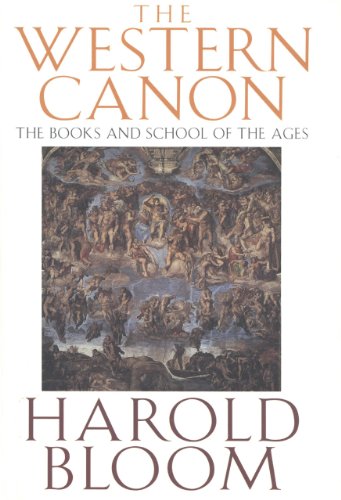
Montaigne as the front door into the canon
One way to consider him, though he knew nothing of Shakespeare while Shakespeare knew something of him, is as the largest-scale of all Shakespearean characters, huger than Hamlet as a questing self. Montaigne changes as he rereads and revises his own book; more perhaps than in any other instance, the book is the man is the book. No other writer overhears himself so acutely as Montaigne perpetually does; no other book is so much an ongoing process. I cannot make myself familiar with it, though I reread it constantly, because it is a miracle of mutability. The only equivalent reading experience that I know is to reread endlessly in the notebooks and journals of Ralph Waldo Emerson, the American version of Montaigne.
Location 2319How would the western canon be different if Montaigne were at the center, instead of Shakespeare?
First, it's worth noting Shakespeare was influenced by Essais, but the extent is debatable. Montaigne was translated into English in 1603, and it's undeniable that The Tempest borrowed a line almost verbatim from "Of the Cannibals." From this, there are different camps. Maximalists think that he shaped the entirety of Shakespeare's outlook and psychology. Moderates think Tempest and Hamlet were influenced, but otherwise it's just a shared self-derived psychology of passing (ie: characters audit and change their beliefs in real-time); much of Shakespeare pre-1603 already had this Montaignean quality. Skeptics say that both emerged in a late-Renaissance climate that drew from the classics and Stoics, and thus, were independently rederived.
It is fascinating to consider that Montaigne might be the real-life person that all Shakespearean psychology is based on—not that they were all like the French nobleman, but that the full array of characters, each with their own unique flaws, each embodied his particular characteristic of a mind coming to know and contradict itself—but I lean more towards the moderate/skeptic camp.
But, I still find it worth pondering the what-if. Of course, Shakespeare had a bigger influence, but if Montaigne were properly canonized and cast down, might he be even larger than today's Shakespeare? I consider this because essays are more participatory than plays. Drama has it's own arc of ebbs and flows, from the mid 16th century into the age of screens, and even movies do not eviscerate plays, they just upshift them into a new medium, but that whole genre is in the realm of production and consumption. It takes resources, a cast, a location—and in the end, it's something to watch. One does not casually organize a play, while all essays are written casually, for free, by oneself, independent of place. Where Shakespeare is a canon to consume, Montaigne is a verb to embody. Montaigne is the very verb inside of Shakespeare (I assume...)! And so if Montaigne were the man and meme at the center of it all, it would bring a contact high that turned all reads into essaysists of their own.
Since this did not happen, the essay as conceived by Montaigne was not at all integrated into mass education, and it became a mechanical beast that churns out obedient workers and only postures at intellectualism and aesthetics by forcing underprepared children to read Shakespeare. At 17 I was nowhere near ready to appreciate Hamlet or Othello, not because I wasn't smart enough, but because I wasn't mature enough, and probably because even though I was being forced to write 5-paragraph essays, I had not truly written, from a place of curiosity and autonomy, an essay. Only by becoming Montaigne can I see Hamlet in myself.
How would Bloom react to this? He'd probably argue that it's wrong to want to organize a canon by imitability. The canon is an ancient closet of aesthetic strangeness, not something you try to recreate. Like all closets, there is limited space. There is a cross-generational ritual to experience the same set of great works for the sake of experiencing them, and to argue what goes within it. If the central canonical figure were a solitary introspective writer, then might there be a culture of creation instead of criticism (for better or worse)? Would this lead to a monastic civilization instead of a theatrical one?
It makes sense that Shakespeare should be the center of literature's canon, but perhaps Montaigne needs to be resurrected as the patron saint of Education. Kinds are not ready to appreciate a museum of complicated objects, objects that they are unable to compile, before they themselves have self-initiated themselves into a tradition of practice. And so if there were to be a canon of essayists, the point isn't to see them as timeless works of literature, embodying strangeness or other aesthetic values, but to see them as methods of assaying into your own mind.
Yet, if Montaigne is himself in the canon according to Bloom, then maybe Shakespeare is still the king, but he the front door.