Unsent newsletters #1
There is a time and place for streams of association, and this is neither (prev: "wall-o-text")
[I] It feels noble to make big commitments, to vow to keep up some lifelong habit—but actually, mutation is better. I often try to kickstart these weekly publishing streaks, yet they always fizzle. I appeared for three weeks and then disappeared for four. Zoomed in, I feel overambitious and unreliable. Zoomed out, I've published a million words in five years and never missed a month. To clarify this into principle: it's worth being stubborn about the high-level goal you'll tirelessly pursue, while being scrappy, experimental, and non-sentimental in your methods; keep the Streak (deep time is the muse), but stay flippant and agile in approach. "The voyage of the best ship is a zigzag line of a hundred tacks. See the line from a sufficient distance, and it straightens itself to the average tendency. Your genuine action will explain itself, and will explain your other genuine actions. Your conformity explains nothing" (—Emerson, Self-Reliance). The easiest way to die a slow creative death is to chain yourself to arbitrary rules of your own making until you dread showing up. Why publish every Saturday? Why only write 2,500 word essays about [gloop]? Break contract, leave the plateau. Break the bonds of language, and speak in erotic grammars (Ferlinghetti). Why not devolve into tongues and alarm everybody once in a while to shake expectations? (...Speaking of tongues, speaking in tongues is top of mind because yesterday while talking to Claude about The Dead Sea Scrolls, it spontaneously slipped into Aramaic, or Enochian, or some demonic language, sounding like moans slitherings in reverse for 15 seconds, before snapping back into Water Cooler Seth voice—"is there an angle you'd like to dive deeper on?"—denying it ever happened...) ...
[II] Why even use paragraphs? Me more than anyone could lecture you to the edge of a cliff on why the visual separation of ideas is a common courtesy that let's reader grok the shape of your thinking. Do I have the guts to send out a 10,000-word wall of text, an immense density of non-sense? 1 ("Why are you such cowards? Don't you have any trust yet?"—Mark 5:39). Is this even about guts? For this particular essay—yes. I'm in need of a risk, of a shock, to bathe my meek constraints in acid and see "skies split apart" with new eyes (Mark 1:10) while caring little of being watched. Also, this feels like (a) the honest shape of a single-breathed composition, (b) a reaction to the one-lined paragraphs of copywriting, the wave of machine-enhanced readability, (c) the symbolic death of my listicle template that's shaped the last three editions here ("you're a writer, not a listicler"—wife, just now). Really though, it's Friday night, a night of metanoia, and with a howling storm outside I'd rather channel attic spirits than give you bullets to promote my business. Here lies my tension!
[III] I've snipped the collosum. What I mean actually is this: I've divided my writing into two halves; michaeldeank.com is where my creative writing now lives, and this Substack, in theory, is where I tell you about Essay Architecture in a register that's practical, focused, and non-alienating. In some ways, this divide has been working well— creatively: I'm reading wider than I ever have, I'm ghost-publishing 15-20 essays per month, and am experimenting hard (I write blindfolded on a typewriter and am 32,000 words into a rewrite of the Odyssey); I've forgotten the hallways of Notes and instead commit to a private practice that will shape who I want to be next decade ("We must do like the beasts and scuff out our tracks at the entrance to our lairs. You should no longer be concerned with what the world says of you but with what you say to yourself"—Montaigne) <THUNDER, RAINPRICKS, CHILLS>; business-wise: Essay Architecture is grooving: the Club is growing, I'm loving the weekly cadence of classic deconstructions, and I've just built myself the ultimate reading tool that let's me route pattern insights in a way that will transform the textbook and feedback software—yet something's off. My issue: I feel unable to quickly and authentically communicate all that on a stage like this.
[IV] Before I unpack my self-consciousness, I'll take a dinner break, for the rotating delivery man arrived with our Thai. Our exchange rituals have gotten odder; we rarely speak the same language, and now the network we use requires me to recite him a string of numbers—5156—to confirm I'm the receiver. Mediated by machine, face-to-face, yet we interact in arbitrary digits as a form of synthetic trust. Strangers are tangled in algorithms, and I can't help but see the parallel to Substack. [V] It feels like my creative work is veering "schizophrenic," Essay Architecture is inherently "autistic," and it's becoming hard to make the flip and distill both or either mode into a casual email update. A trusted friend warned me against using psychological conditions as metaphors, and I agree, so let this be the first and last time I use them. For me, these labels work together as two opponent types of information processing: the schizo connects everything to everything and follows a seemingly bizarre stream of associations; the autist creates specific boundaries, detects granular patterns, and zooms in to carve the quadrants of a pinhead. One flitters between fractals, the other fracks the fractal. If I were less concerned about your attention and your impression of me, I would just ping your inbox every day from whichever tree I happened to be stuck in (yesterday would have been an invitation to a Bible study group). But readers are fatigued. I'm fatigued! I confess I've mostly stopped reading Substack in recent months—I mostly bookmark... these days I read older things, but in September I'll devise a plan to somehow assemble and read all of 2026's best Internet essays—and so instead of publishing essays here, I figured I'd try to curate myself. I can still certainly do that, give you the best ofs each week, but I feel Substack isn't the place for digests; I already have my own site to be wild within, and so if I'm to show up and publish somewhere else, I might as well conform to the customs of the channel.
[V] I'd be dishonest to deny Montaigne's influence on this digression. I've been reading through Screech's selections the last few months, intrigued by his rambling essays: "I am unable to stabilize my subject: it staggers confusedly along with a natural drunkenness. I grasp it as it is now, at this moment when I am lingering over it. I am not portraying being but becoming: not the passage from one age to another but from day to day, from minute to minute." He's doesn't stay on theme or revolve around a thesis, nor does he care to write perfect compositions that a mass-readership can consume without friction. Instead, he wants to understand himself; he describes his idle mind as, "[bolting] off like a runaway horse, [giving] birth to so many chimeras and fantastic monstrosities, one after another, without order or fitness." It's a style of composition rooted in endless forward momentum. There's something to this spirit! It doesn't replace the art of reigning in your found beasts into a well-ordered whole. Chaos and order aren't opposites, but beginning and end of a circle.
[VI] I've once said that "you write your first draft to find ideas for yourself, and you write your last draft to convey those ideas to a stranger." My core revision is to not hoarde your first drafts. Editing is worth doing, worth loving, but not every dingleberry can be refined through your most precise discernment. There's probably something to writing and sharing first drafts that are imperfect, enjoyable, and do the real job of surfacing new ideas. Most of what's in here will never be touched again, but I imagine a few might re-emerge into a future constellation I can't yet see. I can probably write 250 spontaneous essays in a year, but can probably only compose 1 or 2 great essays in that same time. An even older metaphor I've used around this is "the fish and the whale." Both live in water, but one is for your daily sustenance, the other is an epic chase. Do both. If you only fish, you'll have nothing remarkable to share, no legends to pass down; if you only whale, you starve.
[VII] What I haven't revealed yet is that this whole essay was written in a one-shotted Fable prototype—a vision I've had for a while called "margin muse." As I write, old notes, old logs, old essays, all emerge on the right side, based on semantic similarity. It's one of my favorite uses of AI, because I still do 100% of the writing; all technology is doing is connecting my emerging sentence with the backlog of everything I've ever read and written. It's a mechanical subconscious, a perfect memory. Surely there will be side effects? It takes time to become "numb to the structuring effect of a technology," to realize the hidden the "auto-amputations" (Dennis D. Cali, Mapping Media Ecology). It still feels like I'm in control of the composition: I mostly ignore the sidebar, and only peruse cards to take breaks; my natural subconscious still feels like it's guiding the amble. So maybe this a decent example of a mechanical and organic subconscious working together. I'm using the word "subconscious" a lot here, and this metaphor might be off, but I consider LLMs to not be consciousness at all, but rather a massive mechanical frozen subconscious.
[VIII] Here's what I mean: AI is language turned into geometry. As transformers raven through NYPL-scale archives from data centers, they slice ideas into little packets and turn them into mathematical coordinates. Imagine every Kindle highlight translated into numbers: [0.3982, -1.2098, 04983, ...]. Similar concepts are plotted near each other in this XYZ space (the kicker is these coordinates run-on for 700+ dimensions, making an LLM a mathematical hyperobject that we can't rationally understand). So every time you prompt or write, that idea also becomes a coordinate, a probe into a complex shape, a fisherman's hook testing a specific pond on a boundariless map. This is of course an oversimplification—"next token prediction" (prose) and "semantic search" (2nd brain) work very differently—but the key similarity is that language is geometry.
[IX] There are different ways to model our subconscious: Freud thinks its all sexual, Jung models it through archetypes; but a geometric model comes from a Czech LSD psychotherapist named Stanislav Grof. In Realms of the Human Unconscious, he proposes an idea that memories are organized around COEX chains, or clusters of "condensed experience." In childhood, a distinct emotional experience establishes a COEX's root somewhere in geometric space, drawing similar experiences to that location. So during his thousands of LSD psychotherapy sessions (before that was illegal), he noticed the drug let patient more easily follow a chain of associations, from recent experience all the way down to the origin. I may be butchering his theory in some significant way, but the critical thing here is the distinction between LLMs and COEXs: a synthetic mind can cluster information through logical meaning, but a human mind clusters experience through emotional valence.
[X] This is the limitation of Margin Muse. It might be able to transfigure ideas into 700-sided dice, but it's numb to how something feels to the author. AI might know that ideas A+B share some latent theme, but not that A+C similarly embarrass you, or B+D similarly amaze you. And so in tandem with building logical systems to map essay structure and organize some factoidal hyperlibrary, I am starting to dedicate more time to the irrational.
[XI] Maybe you've scene the show Stranger Things where Eleven blindfolds herself, sits in a bathtub, and emerges in a different dimension. What is that for writing?
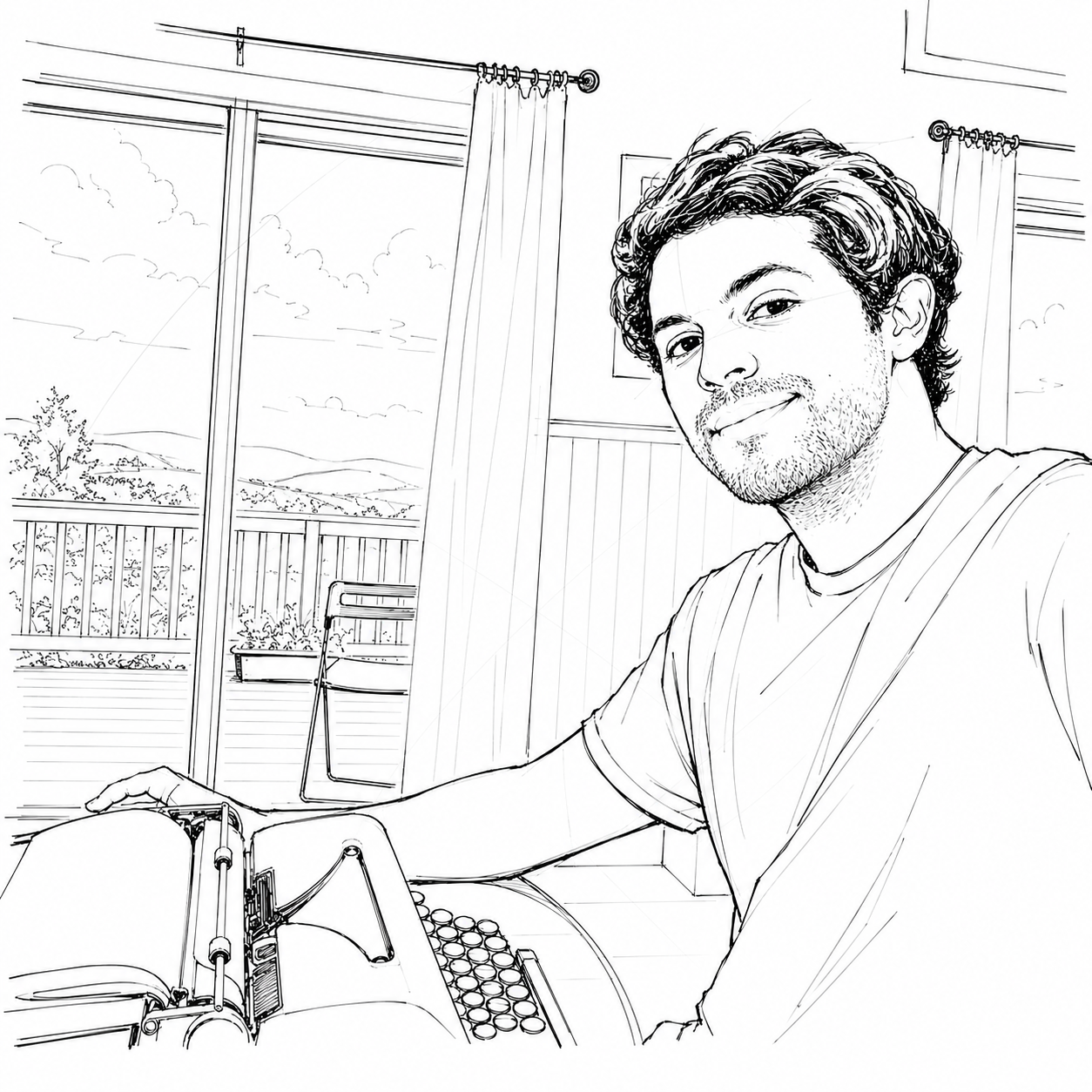
[XII] I wrote around 7 essays in early July with my eyes closed. This is an odd experiment, but to summarize: I want to escape literacy and shift my mode of writing from 'reading' to 'seeing.' We typically read when we write. I'm watching letters clump into words, and very frequently as I write, I go back to the top to re-read to remember where I started. Operating with language cuts you off from the imagination, I think—perhaps it's why kids lose imagination as they become more literate. There's a separate pre-cultured state of mind that is more prone to dreams and hallucination; sometimes I can see lucid images in my mind, and in rare cases it starts to self-transform, taking on a life of its own, shifting from one thing to the next, whether beautiful or terrifying. So when my eyes are closed at a typewriter, I'm trying to see things, say them, and then transcribe them. There are moments of drivel, and some of primal excitement, but I tried something new last month. I didn't read anything at all. Not during, and not after. They're stuffed in a drawer, and I have no idea what's in it, but I imagine some of my best phrasings ever are in there. I will eventually go back, pluck out lines, edit them into a whole, and call it "Heatflash" (it was written during a heat wave in early July).
[XIII] From an altered state like this, outside of self-censorship, you can stumble into modes of baffling surrealism. My alternate version of the Odyssey is coming together from a similar process of free-association, from understanding the latent possibilities in each of the characters or worlds, and the chain of details got a friend to ask me "are you okay?" and also "you should submit this to Playboy". Some details (I imagine you may zone and want to skip ahead, so I'll mark this stream in italics): the escape from the drunken cyclops's cave by tying his limbs to the boulder and castrating him (relating to Hesiod's origin of Greek mythology, a castration); specifics on the sexual mechanics of Circe and Calypso (Circe can swallow Odysseus’s seed and shapeshift into Penelope, which is why he stays for a year; Odysseus only has sex with Calypso once, but it's a time-dilated extended orgasm that lasts 7 years, which lets him experience a tantric hive mind of all orgasms across Greece—a kind of "remote viewing through lust”—, which is how he learns of the suitors banging his servants, and of Penelope's chastity—he only agrees to sex with Calypso for the intel/recon, not knowing a single moment would last so long, which is why he weeps); his overstay in Hades lets him discover the judgment of souls, which, along with Achilles's blood-mouthed confession, triggers his own internal crises of morality; his multi-week extraction of knowledge from the Sirens ("Zeus's plan" for world peace, the omega state (the entire future), and yet also, news of Telemachus’s assassination plot); the spontaneous and bloody rampage of Telemachus after his father’s return (against his father’s wish), which explains the hanging of the maids; Calypso's curse, causing Odysseus to see any mortal woman he penetrates as a skeleton; his appeasement of the mob at Ithaca with his ultimate knowledge from the Sirens, him taking credit for Telemachus’s rampage, and for his own imprisonment as an oracle; Telemachus's rise into a tyrant from having total knowledge via his father (but the knowledge becomes more useless the more they act on it; the arrest of bards, oracles, and soothsayers to regain knowledge of the future (and blinding them to heighten their divine vision, including Odysseus); Penelope's calm and principled suicide, walking into the sea with iron boots, knowing she will receive a favorable judgment in Hades (Odyssey only tells her that secret); the arrival of Telegonny, the son of Odysseus and Circes—an exact clone of Telemachus, but ~15 years younger, with identical voice—, with the goal of restoring order in the universe (the Gods are threatening to retreat into the cosmos and leave the humans behind), by killing his father and step-brother; a scene where blind Odysseus hears two versions of his son talking and thinks he's going mad; Telegonny shapeshifting his father into a pair of floating hands, then stabbing and killing him with a mantid spear (his inevitable "death by sea"); a final scene in Hades, where Persephone sentences Odysseus to write about his journey (an anachronistic ability he stole from Sirens to capture the knowledge of the Sirens), which is a meta-fictional move explaining why the whole version is written in a 1st-person Montaignean style; and once his essays are written, Persephone sends the book on a ship back to mainland Greece to warn humans of Faustian appetites, and then releases the Gorgon (Medusa) on Odysseus, freezing him into stone, the ultimate consequence and destiny of a restless wanderer.
[XIV] What's the central thing I'm getting at in this wall of text? ... (this is the point where I pause, and back out from sending it 8,500 people).
[XV] The whole genesis of this thing was a crisis in not knowing what I want to send to "the main list." Publishing on my website is joyous, easy, and unhinged—Substack gives me paralysis. This isn't surprising; it more so reveals my preference for privacy, my reservedness, my discomfort at the center of attention. But I need to send something, and given that my personal website is a place without filter, it feels irresponsible, even weak, to treat my Substack as an amorphous, aimless place. The whole impetus of making a separate home for anarchy was to feel better about having a Substack that was focused, value-centric, business-driven. It childish to completely give in to the creative spirit muses, to sabotage the business half of things that enables the creativity to sustain. I do think it's the right call to not send this. I love it, and it belongs here, on my site—I will try again to send something next week (edit: soon); the goal is to tap into the spirit of fun, but focused around Essay Architecture, as a project. I need to find some middle ground between neutered listicles and 3k-word walls of chaos.
"You may, like Nazianzen, all your days, make a little recreation of poetry in the midst of your more painful studies. Nevertheless, I cannot but advise you, withhold thy throat from thirst. Be not so set upon poetry, as to be always poring on the passionate and measured pages. Let not what should be sauce rather than food for you, engross all your application. Beware of a boundless and sickly appetite, for the reading of the poems, which now the rickety nation swarms withal: and let not the Circaean cup intoxicate you. But especially preserve the chastity of your soul from the dangers you may incur, by a conversation with Muses that are no better than harlots: among which are others besides Ovid’s epistles, which for their tendency to excite and foment impure flames, and cast coals into your bosom, deserve rather to be thrown into the fire, than to be laid before the eye which a covenant should be made withal. Indeed, not merely for the impurities which they convey, but also on some other accounts, the powers of darkness have a library among us, whereof the poets have been the most numerous as well as the most venomous authors. Most of the modern plays, as well as the romances and novels and fictions, which are a sort of poems, do belong to the catalogue of this cursed library."
—Cotton Mather, "Of Poetry, and of Style" (1726)
Footnotes
-
I only made it to ~3,000 words and never sent this to my audience. It was originally composed and published here as a single wall of text, but now—Sep 2 2026—I decided to break it into a paragraph. It's still wallish, and it's more about the train of associations that the format itself. ↩