Out of your head, dance with the dead
When I found out my pregnant wife had a weeklong business trip in South Korea, I realized I had a chance for one last solo trip—at least the last one in a long time—and so for $249 on Ticketmaster plus the cost of flight, I went to see Dead and Co. at Golden Gate Park. It’s the 60th anniversary of The Grateful Dead playing there. I have been in a deep listening binge of “Dick’s Picks” a 36-volume, 150-hour archive of top G.D. shows (with honestly subpar mixing), but I’m becoming attuned to the variations in songs, saving them to a playlist, with the intention to re-listen and find my definitive favorite of each (eventually resulting in “Dean’s Dick’s Picks”). I am not yet autistic, but will be soon. I already have some date-specific recall, like how the canonical live version of China Cat Sunflower/I Know You Reader in Veneta in Oregon on 8/27/1972 is now my second favorite compared to 6/26/74 at the Providence Civic Center in Boston, MA because of its introduction. There is a sub-culture of a sub-culture, deadheads immersed in graphs, stats, lyricism, musical erudition, and more… but if you see them live, you will inevitably have to dance.
I grew up an uneasy dancer, and when I look back on it, all occasions involved pre-packaged moves to memorize. Greek folk has its 12-step circle dance. The cha-cha-slide is self-explanatory, high concept, and atop the Bar Mitzvah dance canon. Then there’s the middle school grindfests to Lil Jon and Co. all across dimly-lit American middle school cafeterias, where undeveloped minds come to learn the kit of moves in hopes of action. Now the popular moves of today stem from video game animations, like the Fortnight floss. I have learned not to be outed as a stiff “sitter,” and have acquired the bare minimum arsenal of moves to participate in wedding circles. At some point though, I realized the problem was the music itself. If you give me 7 beers and my wife and a live band playing music I like (which has only happened a handful of times, usually at the weddings of bandmates), I will run in circles and invent my own moves. Alas, there is no wife in GGP, and I’m abstaining from beer—for that would activate the bladder, and I’d have to push through 60,000 stoners to retreat to the porta potty and never get my spot back. I don’t quite know what to expect. Last time I saw Dead & Co. was at the Sphere, a seated arena. And now in our phone-addled culture, people mostly record concerts through their phone. But this, I expected, would be far different; this band comes from a counter-cultural history that mainstreamed American freeform ecstatic dance, and seeing them outdoors is where you’ll find the remnants of that tradition.
An early thought upon entering the venue is that I’ve found myself in possibly the gayest place on Earth. I mean this not in terms of sexuality at all, but in the etymology of gay: happy. Skipping is the dominant form of locomotion here. Drugs or not, it’s gushing in jubilance. It was an intergenerational affair, where you’ll see grandparents bopping, and parents with 4-year-olds on their shoulders wearing headphones; yet also on the way in you’ll find the druggies and balloon huffers and on the JFK promenade I saw a toothless man flash me DMT crystals in a bag. You hear “Mushrooms. Tabs. Mushrooms. Tabs.” And then across your other shoulder “GOO BALLS! GET YOUR MUSHROOM GOO BALLS!” in a cracker-jack cheer coming from a woman in an SFPD uniform selling mushroom goo balls out of an orange ice cooler. Even before the music started, you could find a few people spinning in place.
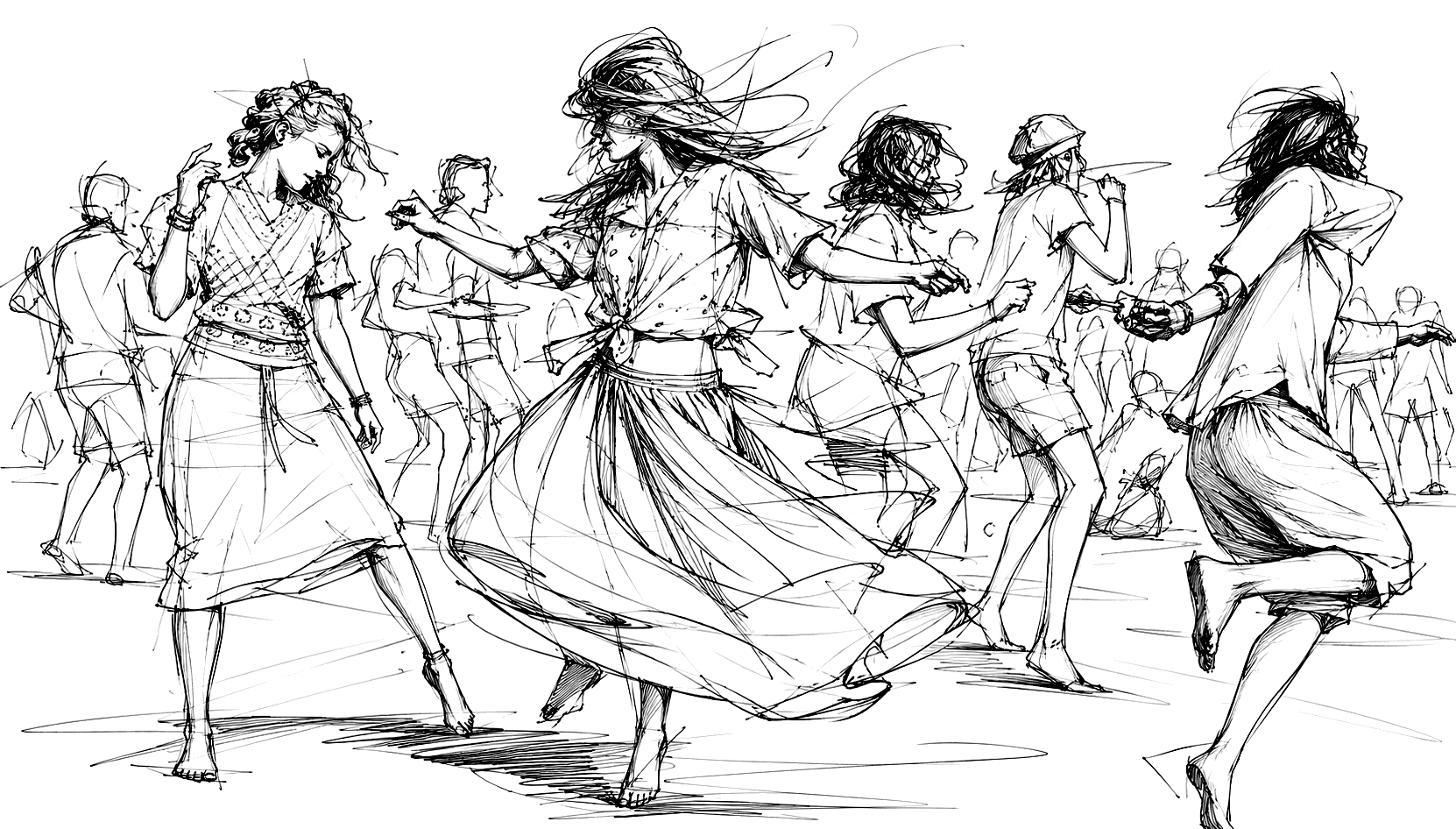
The “spinners” are the most legible archetype of the deadheads (as a sidequest beyond listening to the music itself, I figured I’d document what I see of the culture). The idea of spinning in circles for minutes until your dizziness takes on a quasi-mystical experience is already a Sufi religious ritual (perhaps this is just the natural way to dance to modal eastern gypsy folk music). I recently watched home videos of myself as a kid, where I’d spin in circles for minutes and then crack up as I’d wobble around dizzy. Even four-year-olds know that spinning is a cheap and natural way to get high. A whole spinner religion, a cult within the cult, formed around this practice in the late 1980s: “the family,” or more formally, “The Church of Unlimited Devotion.” From what I know it was led by Joseph (described as a monstrous man, a “post Touch of Gray douche bag trust fund dude”) and consisted of women who spun at shows and saw Jerry as a kind of Hindu voice-of-God avatar (they did not spin to Bob Weir songs). In reply to his deification, Jerry said, “Well, I’ll put up with it till they come for me with the cross and nails.” The cult operated on a Hare Krishna farm, 166 acres in northern California, where the main headquarters, featuring a geodesic dome packed with spiritual writing from Kabir to Rumi, was funded by Joseph for $108,000.
There is comprehensive work on the spinners at the Princeton University Archives, 262 pages long, written in 1990, called “In the Strangest of Places: A Study of a Religious Movement within a Subculture,” by Jennifer A. Hartley. But here’s a more grounded Reddit summary:
“So here’s the deal, there’s been spinners around for years before any official group formed. Out in the halls of shows or on the fringes of the crowd you could always find young deadheads spinning around the music. It wasn’t really my scene because I would just get dizzy and fall on my face, but it sure was fun to watch especially if you’re tripping because some of these kids could really move their bodies in exquisite ways to the music.”
Of course the “spinners” are the main marketing image of Dead & Co.; their websites and show posters feature a bare-footed girl in a grassy field venue, uninhibited, twirling in place with her hair wild, achieving liberation from the shackles of her possibly square life outside the show (who knows). I’m sure there are all types of spinners, but the quintessential Spinner is female liberation made flesh. The male version of this (also in The Materials) is a guy in a motorcycle jacket, convincing SAAS marketers that they too can join Hell’s Angels.
The Sunday opener, the Trey Anastasio Band, had just finished, and so now it was my job to move my way up to the front. I had seen King Gizzard & the Lizard Wizard just two nights before, also outdoors; the sound was bad at Forrest Hills, the view not great, and so I was operating under the assumption that my vantage point here could make all the difference. It was tight, but not too tight, and so I maneuvered myself pretty close, to the point that with good eyes you could make out everyone on stage without needing jumbotron assistance. What I didn’t realize was that I had invaded claimed territory. The ground was plastered in picnic blankets, and apparently if you get there early and lay out a sheet, you own that sliver of Earth for the rest of the show. A ridiculous rule. But slowly people started filtering back from snack lines and bathrooms, and I’d get passive-aggressive comments like “we have some friends coming back…”, and also, “can you get your crotch out of my face?” until I was slowly wedged into a 9”x9” sliver of grass, a gap that existed at the corner of four picnic blankets. No place to spin.
As you might imagine from the situation, I was now firmly inside my head—contemplating how much water to drink, how much drugs to take, and how everyone around me is annoyed by my presence—which is not the place to be when everyone breaks out dancing. Where concerts usually feature a sea of head-bobbers, I found myself alone among 60,000 heads, but directly surrounded by Dave (the guy who asked me “are you cool?”), his disinterested sister Annie, and their very cool friends, including a lanky model in a crop top who mostly looked up at the sky for minutes at a time and swayed with hair-dangling and eyes closed as she’d drag her cigarette, including another dude (pronounced “derrrrd”) with resting stankface and a backwards hat and piledriving neck, with rapidly flopping elbows at 90 degrees to look like a chicken, including a guy walking around in a Tarzan costume with his girlfriend on his shoulders dousing the crowd with a massive bubble gun. There’s a world in which all of these moves were spontaneous forms of self-expression, and I’m just a guy in my head, an obvious intruder, unsure of what to do with my hands. But I couldn’t help but consider everything around me to be a LARPfest (live action role playing), where the moves are out of sync to the music, and instead, recitals of how one thinks you’re supposed to dance to the Dead. Well, how are you supposed to dance to anything?
There is that old line “dance like no one is watching,” and considering I was entirely among strangers, there was no reason not to, but that didn’t unfreeze me. So I just continued the non-commital headbob, focusing on the music, until I realized that dance instructions should come from the music itself. It’s not about signalling exuberant moves for the sake of looking and feeling liberated; it’s about getting actually possessed through the music.
The only way forward is to become a ragdoll controlled by John Mayer and friends. This turned out to be something I really enjoyed, because you’re not in your head, but locked into the song at the depth that your perception can permit, coordinating a sequence of body spasms that animate the music in real-time; any note from any instrument is an input that can control your head, neck, arms, legs, and toes. It’s dance as synaesthesia: sound turned to image through the medium of your body (is this what interpretative dance is?). This requires hand-eye coordination, but it helps that I’m a life-long rhythmist—playe drums since 3rd grade, aced level six snare drum at NYSMA, achieved general limb independence, and learned every other instrument since college. This type of dancing feels a lot more like jamming than dancing, because your full attention is set on synthesizing the musical fragments coming from the individuals in the band. One of my favorite Grateful Dead ideas is that they saw improvising as telepathy, where they’d guess where their bandmates were going three seconds into the future and try to meet them there. With enough weed, you can join the band; if you are at the level of mild sonic hallucination, you are hearing your own guitar riffs, drum fills, and polyrhythms to augment the jam—the things you’d contribute if you were actually on stage—and then dancing becomes a means to translate what you hear, in your ears and in your mind’s ears.
If I learned and practiced this, I could probably be a technically-proficient dancer, a liberated instigator, but for now I am just seizuring in place with my neck and hands shaking erratically within my 81-square-inch plot, probably a strange and troubling sight, but for the first time ever I felt it.
A heartbreaking anecdote to all this is that, on the day I learned to dance, someone died dancing. He was 52 years old, with his girlfriend in presence, and his kids at home. During “They Love Each Other,” he fell down and turned grey. Everyone signaled the medics, and they came quickly, but in a crowd of 60,000, not quick enough. They were in the front, so possibly relatively close to me, but I hadn’t noticed at all. People processing the news of this on Reddit said, “well, at least he went out doing something he loved,” and eventually, “actually, this is the way to go! Dancing to the band you love!” before they all exchanged what song they’d want to die to at a concert.
Another point that became clear to me (now that I finally learned how to dance): the decision to do it was conditional and non-obligatory. If the music wasn’t peaking or climaxing, and if I wasn’t completely attuned, I could simply stand there or walk away. After the first set finished, I decided to retreat from the Territory, get some food, and explore the back of the venue. From the bathroom, they started set two with Scarlet Begonias, the nostalgic first song I ever heard by them, and so I skipped from the bathroom to a new spot, less crowded, and way friendlier (the guy next to me offered a joint). Scarlet/Fire was the peak of the night, maybe a peak of music generally for me, where you could feel John & Trey properly locked in, and I thought that this 10 minutes of a Dead & Co. show is probably what a full 4-hour Grateful Dead set at its peak might feel like. And so for Scarlet/Fire I seizured, but the next few songs were far milder.
Set two ends with the “Drums/Space” intermission, which most people tune out. No one dances to Drums, which is weird considering it’s the most rhythmic and shamanic part of the show. I decided to sit, from exhaustion, but also to let loose and enthusiastically and unembarrassingly and quite seriously drum across my laps, again visualizing the sounds of what I was playing overlaid on the band. This was perhaps, my moment; a moment where I was so invested in fusing with the band, so in my uninhibited behind an imaginary drum set that others must have assumed I was tripping. In a different phase of life, or a different life entirely, I could imagine smuggling a sack of 50 second-percussion instruments into the venue to reinvigorate the Drums segment with a proper drum circle (if this hasn’t existed in the GD’s 60-year history, I’d be surprised).
After Drums, every time, comes Space. This is Mickey Hart playing conductor of the cosmos. It reminds me of Phil Lesh’s interest in abstract sound collages, but with a New Age religious connotation and AI-augmented visuals. Everybody talks through church. I’m sure this would piss of those who see this as their ideal “DMT segment” (which is a thing). I’d imagine that younger Deadheads might not know that the non-typical non-rhythm songs require complete concentration, and use the moment to talk, piss, or act a fool. At the Sphere we had drunks gurgling, burping, and giggling through Space. This show, surely, there was a guy on the floor within earshot yelling “MICKEYYYY! … MICKEYYY! … MICKEYYY! …” with 10 second pauses between each, on loop. Unbelievably he never stopped, and so thankfully at outdoor shows you can walk away from the menace.
The closing song was “Touch of Grey,” which I’m not a fan of, and so I decided to leave early, not realizing I’d walk out on Bob Weir’s last ever performed song. As I get towards the back, I notice the back quarter of the venue is filled with what must be 500 spinners, maybe double. To properly dance to the dead, you need ample space, which makes sense why the back of the venue is filled with the fans who get it. On the route to get my t-shirt, I had to navigate through a sea of limbs, ducking and dodging arms, remembering the rumor that walking through a crowd of spinners is dangerous, because their LSD-infused sweat might get on you and cause you to trip without knowing. I earnestly considered joining them. Why not participate in this old folk tradition? Because I don’t love the song.