michael-dean-k/

On Monday 6/15, I'm hosting a workshop to kick off a reading group for classic essays: RSVP here.

Topic

music

18 pieces

White Christmas

· 110 words

Our last meal as pre-child adults was at Panera—something quick and light on the way to the hospital (plus she craved it)—and as we ordered our “pick twos” on a digital menu, I was struck by the beauty of a jazzy Christmas song that would have otherwise been extremely ordinary. It was “White Christmas” by Booker T and the M.G.s. My guess is that the stakes of an extraordinary moment—in this case, one of anticipation—can totally rewire musical taste (or preference in anything, really). Works that we attribute meaning to sometimes have nothing to do with objective qualities of the art, but in the circumstance in which you experience it. 

Led Zeppelin as Birth Plan

· 159 words

My wife and I joke that when the obstetricians ask her, “what is your pain management strategy?” she’s going to say “Led Zeppelin,” which cues me to blast “Immigrant Song” at 100% through her BOSE speakers. In all my baby-book reading, when they’ve mentioned “music” during labor, I imagine soothing, meditative music—like Enya or flukes—to calm the screaming mother; but maybe the other direction is more productive? The experience is so intense that Zen garden music could potentially feel toyish and tone deaf to the experience at hand. If you’re experiencing the extremes of pain, it might help to have blaring technical instrumentation in your ear, to moan in harmony with Robert Plant. I mean, the whole strategy is to distract your mind from pain by focusing on specific things, and it does in fact require 100% of your bandwidth to really listen to Bonham fills of Page riffs. She wants me to make her a hard rock playlist.

New Geese album

· 104 words

On the new Geese album: I’m definitely a fan of the vocals, melodies, instrumentation, layering, song structures—basically everything except the lyrics. I wondered if after multiple listens, they would eventually click. Individual lines have, but none of them are coherent as a song. They’re generally vague, cryptic, and dramatic, kind of like some of Thom Yorke’s lyrics, which work if I’m in a particular mood and willing to interpret and make my own meaning from it. Subject-wise though, pretty hard to relate to (bombs, avoiding taxes, suicide, Maria’s bones?). FWIW, I do like the sailor/car lyric lol, but not the rest of the song.

Shower rock operas

· 160 words

It is commonly reported that ideas come to people in the shower; sometimes, musical operas comes to me when I shower: imagine a 7-part rock opera, a single riff in different tempos and tones, where part 6 is some Jim Morrison dialogue from “The End,” where the drummer has eighth notes on the ride and is doing jazz fills on tom with his left hand, the bassist is in the pocket, guitar is 12th fret and up playing non-sense at volume 1 with a wah pedal, and there’s dialogue like: “Aeschylus, my son, did you find 17 gummies under your pillow?” “Yes, father.” “Aeschylus, did you know those were all intended for the gummy fairy?” “Yes, father.” “And you ate them?” “Yes, father.” “And you saw the mystery?” “Yes, father.” “Aeshcylus, my son, you know what happens when children see the mystery?” (instrumental freakout ensues) and by this point I am naked and thrashing and have completely forgotten about soap.

Vinyl as Parenting Tool

· 67 words

Tempted to get a vinyl player because it would be a form of analog media my daughter could engage with. The core feature is not sound quality (the typical justification), but the fact that each album is an object, and a young mind can associate media with physical things. You can also, display your favorites on a wall, as a constant reminder of the ones you like.

St. Stephen Is Neal Cassady

· 381 words

I should make a case in r/GratefulDead that “St. Stephen” might be heavily inspired by the death of Neal Cassady.

Robert Hunter, their lyricist, confessed not knowing of the Christian “St. Stephen” until after the lyrics were shared with the band. So it’s not literal. Also, Neal died earlier in the same year (February 1968) that the song was first played (June 1968). The middle of the song is abstractly about death, but all the surrounding verses paint a portrait of Neal that, after reading 5 years of his letters, is now unseeable. Hunter knew Cassady well. Cassady was Weir’s roommate. Cassady was a “sacrificial muse” for much of that generation, so it’s conceivable. True inspiration or not, it will forever change the way I hear these lyrics.

  • verse-1: He steals a roses (Neal stole many things, like 500 cars), and “wherever he goes the people all complain.” The verse doesn't explictly say St. Stephen was a thief, but he “had a rose,” he “goes in and out of the garden,” (as a theft might), and everyone is annoyed.
  • v2: “Stephen would answer if he only knew how” relates to how, in Neal’s letters to Kerouac and Ginsberg, both masterful writers, he would excessively express how he couldn’t put words to his feelings.
  • v3: About death.
  • Bridge: “Speeding arrow, sharp and narrow” taps into Neal’s speed. On the road has the line, “the road ran straight as an arrow.” Also, “what a lot of fleeting matters you have spurned” ties to his range of chaos. “Several seasons with their treasons” refers to his shifting moods, and how he would predictably betray people (Carolyn, Kerouac) in search of something new.
  • v4: “Talk about your plenty, talk about your ills, One man gathers what another man spills,” Neal spilled everything, and Kerouac/Ginsberg saw immense value in what Neal thought was worthless confession.
  • v5: “Saint Stephen will remain, All he’s lost he shall regain,” maybe talks to the enduring influence of his spirit. And then “been here so long he’s got to calling it home,” speaks to his nomadism. (This is prob the weakest link).
  • v6: “Can you answer? Yes I can, But what would be the answer to the answer man?” speaks to their desperation, follow-up letters when their friend hadn’t answered them.

Telepathic hivemind

· 139 words

There was a particular moment last night in Fire on the Mountain that felt authentic to the spirit of the Grateful Dead. I think Dead & Co. is generally guilty of ego-driven power solos, where they go in a circle and just take turns riffing over a backing track that is “in the pocket.” But there was this moment where you could tell John & Trey were intensely focusing on each other, and they were harmonizing and playing into each other. Less about “here’s the genius coming form my head,” and more like, you’re locked in to the other one, adding to them, and even seeing ahead of them, and dancing back and forth. In the best moments of the original Dead, the whole band locked into a telepathic hivemind, totally unpredictable. High risk, but magic when it works.

The CVS Test

· 156 words

I heard "Lost in My Mind" by The Head and the Heart and said they sounded like “CVS-brand Fleet Foxes” to my wife. She chuckled. We were in Kohl’s. Maybe in another context I’d appreciate the band, but there is something about department souls that kills the soul of music.

The tinny EQ plays a role, but I guess pop’s original sin is something like its ability to be “CVS-ready.” I couldn’t imagine Fela Kuti or jazz or Brian Eno when shopping for deals. There’s something about chorus structure and harmony that leads to something that is ultimately listenable.

I wonder if a good filter for a song is to have at least a 15-second segment that is “unlistenable” to the person who approves shopping playlists. Consider Karma Police, maybe Radiohead’s hookiest song; it gets disqualified by the noise/effects in the last 20 seconds. No one wants to shop to the sound of a broken computer.

Songs are dedications

· 434 words

I realize that—for basically all the years I’ve considered myself a “songwriter” (18?)—I may have neglected the most obvious part of the craft: songs are for someone. It’s a whole different thing to actually present a song to someone, in person, probably on an acoustic guitar. That’s not what I mean. I mean that lyrics might only come out as authentic when there’s a real person on the other end of them. I’m sure it’s possible to write lyrics from an abstract, archetypal, or linguistic origin—but that’s how I typically start and I’m almost never excited by them.

Instead, I’ve been liking the prompt, “here’s the uncomfortable thing I want to say to X.” In terms of generating potential images and phrases, there’s a whole well of real experience to draw from. Perhaps the reason I’ve never approached this is because there’s a sense of dread, cringe, or risk in considering that this very person might somehow find the song and make the connection. The chances of that are low, and with some minor smoke and mirrors (the Beatles switched genders all the time) you can make sure no one ever knows what a song’s really about. By translating some of the specific into the general, they’ll see themselves in the song too (maybe good lyrics are a two-way mirror). And even if they catch you (1) half the songs might be good songs anyway, and (2) maybe a confrontation could actually help a relationship? There could be lessons from memoir writing in here.

As I’m listening to Ryan Sambol’s “A Friend of the Show,” I find myself interpreting the lyrics and trying to understand his life in rural Texas, and I wonder if the tethering of song to real stakes is what makes lyrics most alive.

Maybe the demotivating angle of all this is that no one has any time to stop everything they’re doing and listen to the lyrics of a song with their undivided attention. The rate of listeners:listeners is probably 100:1. Mostly everything turns to background music. But if I were to make an eventual expansion from essay writing to songwriting, and distribute songs through Substack, I get the sense there would be a higher ratio of people who read between the lines.

If I really wanted to have a lyric-driven songwriting project (sometime in the next 0-5 years), I’d have to (1) make sure words are coherent in the mix—I can’t understand 40% of what Ryan Sambol says, (2) make sure Spotify tracks have lyrics uploaded, and (3) make music videos with lyric captions (Jesse Wells style).

Guitar as Life Philosophy

· 327 words

The foundation of western music is the major scale; this is easy to learn on piano because all the notes are arranged on a singular linear run—but guitar has "six pianos." You only have a single hand to hit notes simultaneously across strings, so it helps to memorize key-specific shapes in each regions of a guitar neck.

Where beginner guitarists (including myself) go wrong is they memorize shapes, both scales and chords, without knowing the specific notes they’re hitting (relative to the root). We lean on shortcuts and tricks. My whole frame for learning guitar was “shape recognition,” but what’s really worth knowing is the landscape of notes and intervals, beneath all shapes, relative to the root.

If we’re in the key of G, in the A-shape pentatonic position (10th fret), and it shifts to an Am chord, the goal is to not shift to your Am shortcuts, but to know that an Am is 2-4-6 in the key of G. Instead of defaulting to a stale Am shape, you want see the entire fretboard as chord tones (2-4-6), know how to spice it (3s/7s), and what to avoid (1s/5s).

I’m trying to get to the place where I’ve internalized all 7 chord/pentatonic combos in all 5 CAGED shapes (35 total). And once that locks I can start playing with modes (ie: Dorian is the Am pentatonic tones over the G chord.)

So guitar theory is something like the spatial memorization of numeric patterns. It’s tempting to learn piano because it’s more straightforward, but I wonder if guitar plays into my strengths.

More broadly, guitar can mirror a life philosophy: don't fixate on shapes, see the numbers behind all shapes as an integrated field; always start from an idea in your head, never do the same thing twice.

Sonic Patience

· 67 words

When someone says the Grateful Dead are boring, it shows to me that they might not know how to listen to music. I don’t think it’s a taste thing. I think people have sonic attention spans, and most people are conditioned to specific patterns in pacing (ie: verse/chorus). A good band will expand your conception of what music can be, and they demand your full attention.

Hendrix as Force of Nature

· 175 words

What makes Hendrix a special guitar player? It’s not his speed or technical proficiency, but the way he translated ideas from his imagination through an instrument. When you watch him play, you see him vocalizing with his mouth, as if a singular force is animating his fingers and head in a kind of possession state. It feels like a kind of body language that makes a performance genuine (vs. staged showmanship, which Hendrix also did a lot of). He describes states of synesthesia, where he seems images and colors and tries to give form to them. To me Hendrix represents the chaotic force of the imagination, an actual force of nature unchained in real-time.

Sort of related, here’s a stream-of-consciousness surrealist story that Jimi seems to make up on the spot. The plot mutates, he spontaneously shift accents, delivery, and facial expressions, and makes sound effects with his mouth, as if he’s just attempting to translate the thing coming across his mind with the tools he has (his mouth and face).

New affordances at the Sphere

· 490 words

The Sphere can trigger peak/mystical/transcendent experiences and the corresponding reflection that comes from that. When a concert is able to trigger that 10x in a single show, it’s special. But also, you become aware of the variance, and your expectations rise. You are so attuned to what a peak is, that the average moment is boring or flat, like a planetarium+.

My review/critique of the Dead & Company of the Sphere is relative to what's now possible in a venue. It's less interesting to compare the Sphere to a traditional venue to the new affordances of what a show could actually be. Even though the whole thing is generally mind-blowing, it’s worth it to be critical and imaginative of the experience (after seeing it in its fullness). Instead of just saying “it was insane” or “the visuals are distracting” we should give specific feedback that might even improve the future of shows in that venue. It’s an entirely new medium, and it could be up to fans to articulate what’s working and what’s not.

The Grateful Dead ethos brings a challenge to the sphere, because it's not a pre-determined set; each night is its own arc, and it's also semi-unpredictable if they'll stay in a segment for 3 minutes or 7 minutes. The video DJ is something like a live band member, the interface between the band and the audience. When it's done well, it's sublime, and it's worst it feels like tacky CGI that retracts from an otherwise performance (I felt this about the skeleton motorcycle during "I Know You Rider").

A peak experience at the Sphere would require procedural synesthesia. Procedural means you generate the effects live; there is some of that, but it's mostly stitching 2D video into fixed 3D CGI sequences. Instead, a Sphere "background" should be like an environment of "receivers" that get animated and modulated by the sound itself. A basic example would be a snare drum triggering a ripple. There was little of this! There were some accidental alignments, and those moments were when it felt special. A real-time link would give the experience of being inside the music. It's all about the conversion of sound to shape. This is hard on many levels—design and engineering—and there's a possibility that the Sphere couldn't handle something that was entirely real-time.

Some scattered notes:

  • Warping 2D objects into 3D spaces (like they did with the Mars hotel—it was great, but only used once).
  • Faster pacing: don’t dwell on a sequence for 3 minutes, but undergo subtle shifts and transformations every 3 seconds.
  • Use effects to “green screen” out the musicians and embed them in digital environments (vs. putting them on screens)
  • Spherical camera rigs (multi-angle)
  • Fan footage (filter for anonymity)
  • Lyrics, song name, text
  • First person drum cam
  • Tracers/looping — distortions in time
  • More use of haptics (just drums/space, hit)

The telepathic spirit of jamming

· 134 words

John Mayer and Phil Lesh have opposite sensibilities, and that accounts for the biggest difference between Dead & Co. and the Grateful Dead. In the original Dead, it was less about the band keeping a backing track while people took turns with over-the-top heroic solos; instead, they were all soloing at the same time. At their best, there was no focal soloist; they were all listening to each other discerningly, warping forward in an unpredictable direction. They were not trying to compose a solo, but predicting where their bandmate would be in 5 seconds, and trying to augment that. The original spirit was more “telepathic” and unpredictable, where the worst of Dead & Co. feels like a literal circle jerk (John's orgasm face is not the problem; the problem is they should all have that face).

(VR) Arcades vs. Albums

· 130 words
  1. On route to In'N'Out, we walked past the storefront of a VR arcade, and through the window you could see an overweight man in a headset, fully reclined, probably experiencing a roller coaster. As someone who has given a thousand VR demos, I know the vulnerability in being watched. We found that people were more open to try it if they were in a private room. This is the exact opposite. Hundreds will walk by and see a human vegetable, eyes occluded; he’ll never know you saw him, and you’ll never know what he saw.
  2. An article with Jerry Garcia talking about virtual reality in 1989.
  3. While the Vision Pro made my skeptical about the future of VR, the Sphere gave me hope. I could imagine albums evolving into multimedia experiences that layers performance, music videos, and lyrics on top of the song.

Robert Hunter on Songwriting

· 1,260 words

Robert Hunter on how musicianship and songwriting are two different mind states:

“In flipping through the draft pages of this book, I was surprised at the number of early lyrics by Garcia and by Ron "Pigpen" McKernan, songs that got an airing or two but apparently rang no bells for them. Both writers show distinct lyric promise. Their skills would have developed in proportion to the effort they exerted in songwriting, though both were first and foremost musicians. Words tend to be a chore when your first love is the performing of music. Penning and chord-combing don't have the same charge. I know from personal experience that when I perform much, my writing dwindles. In my opinion, most bands could benefit from a lyricist able to devote full time to the task. Musicianship and lyric acuity seldom dwell in the same body-different brain configurations, I figure. There are, of course, profound exceptions to this rule.”


Robert Hunter on how lyrical interpretation warps a song’s power:

“You can swallow a song like "UJB" whole for what it evokes in you, mystery and all—or you can track down the resources I selected while stumbling through the dark of composition, toward some kind of light, and achieve a gnostic synthesis of the song that may forever change the way you hear it. It may deepen the experience, or just explain it away. As with the language of love, the meaning of a song often lies less in what is said than in how it's said, the scan of the rhythm relative to counterweight of color and image. And mystery has a color all its own. But there's something other than those retrievable devices that's necessary: a uniqueness of overall character-that the song be that song, borrowings and all, and not any other. Not a copy of anything. A representative example of a genre that doesn't even exist, if it comes to that! A China Cat Sunflower. Avoidance of popular genres does not make for a commercially successful music; there's no formula for the cultural froth to fix on, but it does invite a long-term following. With only one hit in thirty years, I'm not even sure the Grateful Dead belong in the pop music section of the record store. But it definitely found its domain in the tape machines of an army of bootleggers.”


On lyrics balancing the specific and the general:

“A lyric that places its situation too restrictively in a particular time and place may fail in this regard but, on the other hand, might just redouble in such associative power to the ears of those from the same time and place. Usually New York City in the not-too-distant past. Mostly it's the trusty love song, specifically new love and love disappointed, that takes you there. When the parallels get a little too exact, it's just uncanny, and there's not much more to say about that. It's a bit more difficult to find subjects other than romantic love that partake of the particular and the universal at the same time, which is what a song must do to make any difference in the life of the listener. By report, I've done this with a few songs, such as "Ripple" and "Box of Rain" (neither love songs in the conventional sense), but I can't tell how it's done, only how it feels: like I've just spoken clearly to myself and survived the experience. Exalted. Satisfied.”


On allusion:

“An apt allusion can act like a magnet among the iron filings of a verse, making them all coalesce and decisively point north.”


On songs outliving the writer:

“There are songs of such enduring stature that they have become part of the common mind, from "Row, Row, Row Your Boat" to "Happy Birthday to You," from "Stardust" to "Auld Lang Syne," from "Subterranean Homesick Blues" to "(I Can't Get No) Satisfaction." They seem like natural forces (as indeed they are)—unequivocal as the moon and perennial as grass—but in each case, oddly enough, somebody wrote the piece, wrote it or made it up, and passed it along, always around a fire-somebody whose name has come down through the ages along with his song, somebody like King David or Cab Calloway, or, more commonly, somebody forgotten. I like to acknowledge some of these works (it's called allusion), borrowing a bit of their pizzazz or charm, certain of their authority if not my own.”


On the power of the bands’ name:

“The Grateful Dead was, is, the master metaphor for our group situation. And yes, the shoes have run away with the feet at times. The evocative power of that strange, not at all comical name is considerable, for grace and ill. I know that my own input into the scene, my words, were heavily conditioned by that powerful name. It called sheaves of spirits down on us all. It expressed a deep and mystic hope about the nature of eternity. Our shows were ceremonies and our people, celebrants, in the most archaic sense of the term. There was no place else on God's green earth that I, for one, fitted. Now that it is gone, there is no place else I fit so exactly as to shape.”


On metaphor:

“The juxtaposition of one metaphor to another yields relation; a juxtaposition of relations, a situation. A juxtaposition of situations provides narrative.”


On the modes of a song:

“Ontology is an examination of causative factors, of intent. What was the impulse that seemed to require certain images to be duly expressed? Love, carnal or spiritual? Irony? Sentiment? Contempt? Patriotism? Existential devaluation? Self-advertisement? Revenge? Paranoia? Romance? Annoyance? Deconstruction? Revolution? Peer status? Exuberance? Broken-heartedness? Grief? Indomitability? Salvation? Sales? Sacrilege? Inanity? Responsibility or the lack of? Need of another song for the album?? Discontent? Protest? Inspiration from another song? Disaster, personal or worldwide? There are prime models for each of these impulses in the literature of song, in the musical mean in which we swim.


It seems like lyricists never want to reveal the meaning behind their songs. Robert Hunter says a song is a naked, amorphous living creature. Its meaning evolves, and is unique to each person. The book of annotated lyrics I have is about scatology, which objectively describes the external references and allusions. I appreciate this, but it would also be neat to know a range of interpretations from those who have a ton of context. I think there’s a way to differentiate and label analysis/interpretation, and if done right, it would help the curious break into their own idiosyncratic interpretation.

“Well, yes, I know exactly what every line of my work was meant to mean, its sources or lack of them, and what it's trying to prove—if not the subconscious motivations all artists keep hidden from themselves, the tinder to ignite their dreams. So why don't I say it al for once and for good, and fatten this book up a bit? I'll say it again: The songs themselves say everything I personally want to say about them. The melodies of the unstrung harp are meant to be felt, not heard.”


What does it mean to “internalize” a song? Is it about memorizing the lyrics, or the insight it triggered in music theory, or the memory of the place when you first heard it, or the person who recommended it, or your perceived ideal/ethic/meaning/message behind it, or the liner notes on its writing/recording, or all of the above put together?

Dreams of Broken Spheres

· 102 words

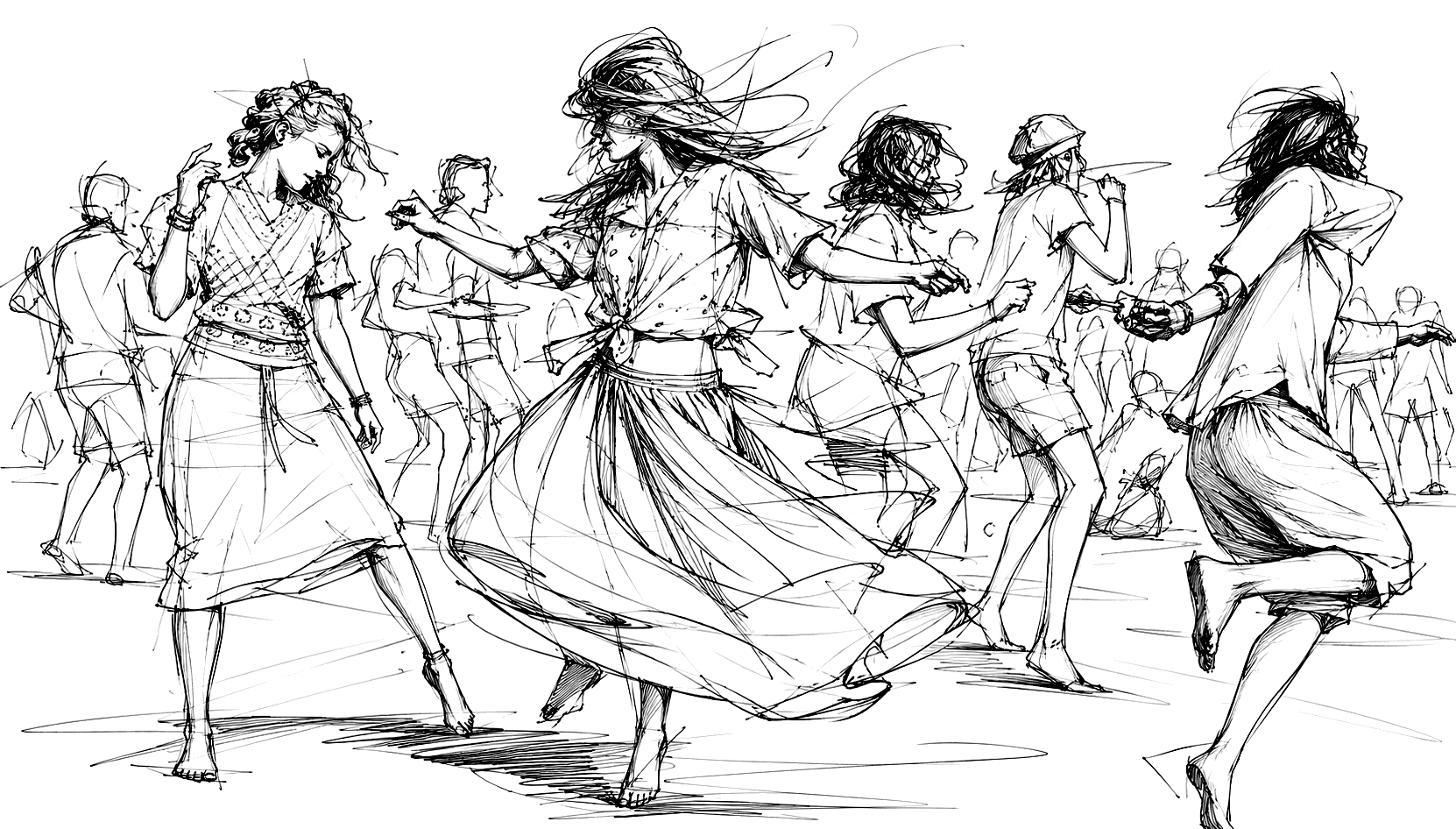
I had multiple, connected dreams about the show last night. Jerry is back and no one cares. Set 1 is only 3 songs that no one has ever heard, and the visuals are effectively a Windows screensaver (just black with a dim purple swirl). They cut it short for an intermission. You guys leave, thinking it resumes the next morning, but I stay and see set 2 which is also only 10 minutes. The band walks through the crowd to exit. I shake their hands and John Mayer tells me “good job.” We realize the Sphere broke and are expecting a refund.