michael-dean-k/

On Monday 6/15, I'm hosting a workshop to kick off a reading group for classic essays: RSVP here.

Topic

counter-culture

8 pieces

VR undergrounds

· 143 words

Reply to Visa (Visakan Verasmy) on X: "Check out NeosVR. It shut down a few years ago, but it was crowdfunded and led by a single Czech developer for $150k/yr or so, and it had a community of a few hundred VR furries, roleplaying and shapeshifting, living and coding their own engine from the inside, basically all day. I went in there a few times, and it was countercultural and totally shocking. Digital drugs and currencies and 3D coding and alien norms. I felt something like a child around wizards. Felt like the actual vision of the metaverse, for prob 100,000x less cost. Sucks that it shut down, but seems like they shifted to something else called Resonite. Makes me believe, though, that different Metaverses exist right now, but they have <100 hardcore hobbyists each, and they don't necessarily want to be found."

The p(doom) of higher education

· 777 words

A few months ago I saw a YouTube video titled something like, “A child born in 2025 is more likely to get killed by AI than graduate college.” What a ridiculous claim. I assumed it was clickbait and didn’t click, but it has jingled around my head enough to the point where I think I can make sense of it’s argument:

  • The average p(doom) of an AI engineer is 16%, meaning there’s a 1 in 6 chance of human extinction (put another way, companies have morally rationalized the need to play Russian Roulette—if we don’t do it the bad guys will—, without acknowledging that if they survive and win, they get the consolation prize of comandeering the whole economy).

  • 40% of US adults, age 25-34, today, have a bachelor’s degree. If there’s massive job automation and employment, a college degree would be both unaffordable and an unreasonable cost if it were. It’s not unthinkable that <15% of next generation gets a college degree, which makes that sensational claim, weirdly, plausible.

I still think it’s a shaky comparison, confusing two different types of probability, and assuming extreme ASI turbulence. But as someone with a daughter born in 2025, it has gotten me to think about how the societal backdrop to her upbringing could be especially weird. Our circumstance already gets slightly weirder with each generation. Except, maybe next loop will be an unavoidable and disorienting flurry of change that will confuse parents and rewrite all of the conditions for the typical coming of age moment (all the teen movies will be sci-fi, the popular memoirs could be written by transhumanists who have upgraded in unimaginable ways, like they no longer need to sleep because of a new pill, or they can control the genitals of their peers with an app, who knows).

And so now, I find myself drawn to a 2045 forecasting project. Trying to predict the future is typically a huge waste of time (unless you’re gambling and win), which is why I’m going to have AI write the whole thing. This is a rare exception where a writing project makes little sense for a human to do. All I’m going to write are the upfront origin documents, and then Claude Opus 4.5 will read 25,000 sources, write a million words or so, and then organize it all into an interactive, oatmeal-looking website called 2045predictions.com (got it).

Before I run it, here’s something I’m currently thinking through:

What is the omega state? When I look at the popular AI forecasts from 2025, it reads to me like they have a pre-determined end state, only to then use detailed forecasting to make it seem convincing. The AI-2027 forecast seems like they came to their conclusion from very detailed calculations on how a hivemind of 200,000 autonomous coders would evolve month-by-month, but I also suspect that they picked the year 2027 because the following year, 2028, is a US election year, and they want the next administration to take AI safety far more seriously (instead of just insisting we have to beat China). I don’t think there’s anything wrong with this. You kind of have to start with an omega state. The future is so boundless that you need to begin with a guess, a bold outline on the general direction of things.

Here’s my omega: let’s assume humanity survives, and let’s assume technology does unlock hyperabundance that leads to a post-scarcity world, HOWEVER, it’s not utopian because it simultaneously unlocks a new cascade of moral, social, and spiritual crises, dilemmas that will test the timeless primitives of humanity (sex, life, death, consciousness, religion, home, etc.). This omega state makes sense for me because (1) we already know that ethical dilemmas scale with technology, and (2) according to the Strauss-Howe generational theory (from the same guys who coined “milennalis,” “Gen-Z,” etc.), this already tends to happen every 80 years (the length of a human lifespan). A new techno-political order creates a spiritual crises that generates an Awakening, a new value system that shapes society for the next century or so. You know what’s 80 years before Kurzweil’s “singularity” of 2045? The counter-cultural revolutions of the 1960s. What I’m getting at is that the 2040s might have echos of the 1960s, where demographics are divided on core issues and LSD is replaced with consciousness-altering machines (Terence McKenna said that computers are drugs, you just can’t swallow them yet).

We currently define the singularity as “the moment when a computer is smarter than all humans combined,” but that effectively means nothing, and it’s far more useful to have some guesses on how we all might freak out about that happening.

A beat in the Suburbs

· 734 words

In SF I bought a book of letters from Neal Cassady written to Jack Kerouac. Cassady was the real-life companion to Kerouac on his road trips, the real-life Dean Moriarty. He is little known outside a certain circle, but a legend with it. Recently read an article that referred to him as a “sacrificial muse”; he enabled others to make their best works, but struggled to make anything meaningful himself.

Why might I be so inspired by him? In many ways, he’s a terrible role model, but I asked GPT-5, based on what it knew about me, why I might be inspired by him":

Assumptions: you’re attracted to catalytic energy, improvisational intelligence, and scene-making; you want wildness harnessed by form; you value unfiltered truth, high throughput, and culture-building more than polite careerism. Cassady is the archetype of kinetic mind-as-engine: he didn’t just write—he ignited rooms, cross-pollinated tribes, collapsed life and art into one continuous performance, and served as a human router connecting Beats → Acid Tests → Dead. You’re drawn to that throughput: the low-latency cognition, the riffing monologue that finds shape in motion, the willingness to live at the edge where new forms appear. As a builder of Essay Architecture, you also recognize the meta-lesson: Kerouac’s “spontaneous prose” needed Cassady’s voltage to spark but also needed editing, constraint, and a chassis—the exact dialectic you’re formalizing (flow vs. grid, spiral vs. structure). You like him as a role, not a role model: the driver, spark plug, transmitter; the person who turns a private idea into a public scene. And you’re repelled by his collateral damage (self-immolation, chaos, irresponsibility), which sharpens the prescription: steal the engine, not the wreck.

After reading more, by them and from them, I'm realizing that Kerouac and Cassady are moral failures and tragic stories, nothing to aspire to without extreme caution … I really ought to figure out what I ever saw in them, and see if it’s separable from their painful lives, or if they just inevitably come together … (I think this as I look at the inside of my right foot in my dark living room—almost midnight, still on SF time—and how the light from the kitchen illuminates 13 separate bulging veins and I simultaneously wonder if I’m fooling myself with this whole writing dream, and also, if I will die young from hypertension.)

Cassady’s mom died when he was young, his dad was a drunk, homeless hobo, so from 10 years old and on, he was alone and un-parented. He stole over 500 cars, and spent many years in prison. Apparently what others saw in him as enthusiastic energy, he later confessed was extreme anxiety.

Kerouac’s brother died young when he was 4. His father hated his writing, and he was tight with his mom but she was extremely Catholic and made him terribly guilty and resentful of her.

Ginsberg’s mom was a paranoid schizophrenic, in and out of psych wards, and often trying to kill herself.

They all had troubled childhoods, and that probably messed with their emotional regulation. They all seemed to dabble with mental breakdowns and suicide. There’s a letter Neal wrote where he kept drinking and had a gun to his head for 14 hours but couldn’t do it, and then his wife came home and he asked her to do it.

Their specific energy might have come from extreme psychic trauma. Worth thinking how to channel a genuine intensity of enthusiasm, without accidentally emulating their specific flavor (which you can’t fake because it’s rooted in pain).

What is a “beat in the suburbs”? ie: What is the distilled spirit of the Beat Generation without nomadic self-destruction and the romanticization of chaos? I say “in the suburbs” because that image is antithetical to “being On the Road,”; it helps clarify that what I see in the Beats is something different from the spirit of adventure.

Values to keep:

  • authentic experience > social performance
  • deep friendships > shallow acquaintances
  • questioning conventions > agreeable
  • singular destiny > societal cog
  • madness in creative work > productivity
  • spiritual focus > material focus

Differences:

  • Stable home, stable family; but mindful travel
  • Not about spontaneous output, but showing up regularly
  • Editing isn’t antithetical; it actually aids future streams
  • Consciousness expansion doesn’t have to be through drugs

I like this AI-summary:

“It’s Beat ideals with adult emotional regulation and an understanding that you can be countercultural without being self-destructive.”
The bus came by and I got on

· 172 words

I got into friendly conversation on a public bus in San Francisco, almost entirely due to the friendliness of the deadheads, and that, once you can tell, it’s an instant invitation to chat. I got tips for the show (ie: avoid the JFK promenade), and tips for the bus. Thanks to them I took a different route that went through Haight Ashbury, ground zero, which included a counter cultural museum, dozens of pop-up vendors, a rock band, and a nudist with a red sock on his cock. 

To what degree did this movement 60 years ago affect culture? I look to my left and see a white-haired woman in tie-dye furiously swiping through a feed on her phone. 60 years ago, it was edgy to wear tie dye to a concert. Now, the truly counter-cultural thing would be to wear a full suit and tie to a Dead and Company show. That might be the only way to actually feel the discomfort and community judgment that original hippies felt from straight society.

Shakedown Street

· 136 words

From the Venetian, we walked in 98-degree heat for twenty minutes to go to Shakedown Street, a Grateful Dead themed street fair in the parking lot of the Tuscany, which features, I imagine, some remnants of the original Deadhead culture (ie: people willing to camp in RVs in Vegas for 2-3 months at a time to sell merch during a Sphere residency), selling shirts and trinkets to tourists like us (just here for the weekend). Part of that culture is pranks (ie: the merry pranksters), and as we walked in, I heard two guys behind me saying, “let’s go fuck with some people.” Then I saw them run ahead, turn around, and greet us as boisterous trolls: “Make me rich! Make me really, really rich!” I guess they worked there. We collectively spent hundreds on merch.

Hippy Yearnings

· 193 words

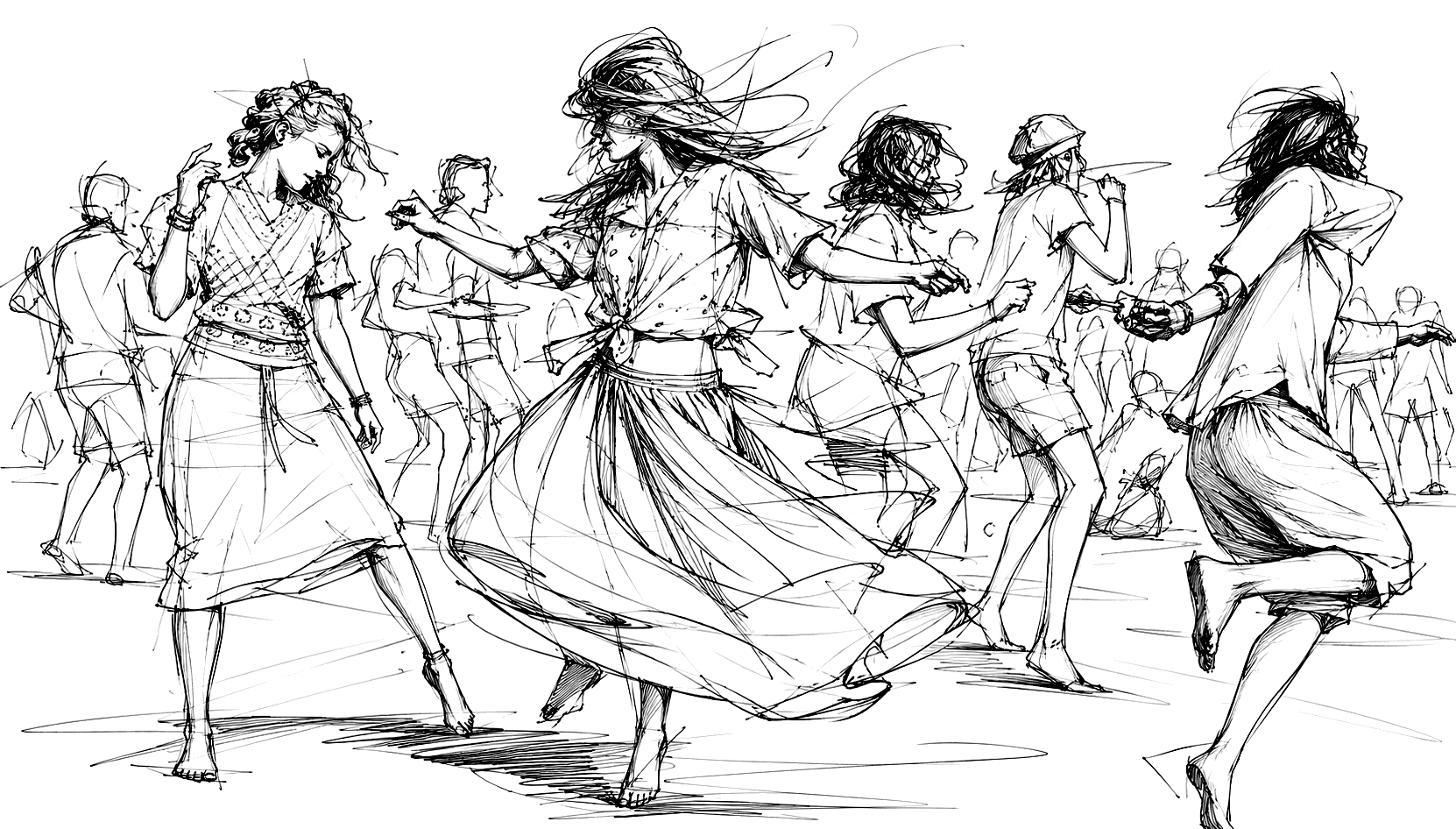
The Dead & Co. poster features hippy girls and a motorcycle man. The girls are dancing, twirling, with hair wild, barefoot in rags, liberated and free. The guy’s in a leather jacket. A rebel. These images are on their website, on the outer sphere, in glass windows in a mall that looks like plastic Venice. It’s the official Residency 2 image, and they are auctioning signed posters of it for $5k and up. These symbols are obviously tied to the history of the band, but even as standalone images with no context, I wonder if the hippie/motorcycle have a psychological power that taps into the troubles and desires of 2025 people? Might also explain some of the Dead’s rising popularity (the brand of the dead feels aligned with the “touch grass” catalyst of always-on computer culture).

(At the official Dead & Co. merch store, I noticed that the VIP tickets are branded as the “Vibee” tier, with 2 Es, and those customers should head to the “Vibee Check-in.” I know that “vibes” is a 60s word that has regained popularity today, and I wonder to what extend that word is correlated with Deadhead culture.)

Strangers Meeting Strangers

· 632 words
  1. In JFK there are several tie-die shirts, which is the long-distance way to signal to someone (from 100 yards away) that you are, a Deadhead, and going to the concert, again. If you look closer, there’s less obvious, less multi-color, less standoutish merch (a black shirt with a skeleton as a casino dealer, which tells you they went to the ’24 Sphere residency). The mutual noticing of each other’s merch is something like an unstated invitation to begin a conversation, which if not undertaken, is sort of rude. “Strangers talking to strangers” (isn’t that in Scarlet Begonias?). This taps into some old Tim Leary interview I saw, where his vision for the counter-culture was for instant immersion in real conversation—it was about the transcendence of elevator talk / keeping to yourself; about breaking out of default scripts and internal monologues and to take a risk in creating an interaction with an unknown person for an unknown result.
  2. Dead & “Company” has a triple meaning; the first impression is that company refers to the new band members. The cynical impression is that it’s the legal entity that John Mayer owns 51% of. The open impressions is that company refers to all the fans.
  3. Unrealistic goal this trip: Talk to 100 strangers. Not every interaction counts (ie: small talk). It only counts if you personally make an effort to extend the conversation one level beyond banter.
  4. From the gate you could tell this was a flight of Grateful Dead fans: an older man had a ’90 blue and orange (Mets colored) hat from their garden show (sold out on Amazon). Someone with dreadlocks loudly asked him “how many shows?” I couldn’t hear his reaction, but based on his eyes I wouldn’t be surprised if it were 100+. A man in a bucket hat with his wife brought up “idiots talking,” (during the show) and “Disney Dead.” In first class, I saw a GD sweatshirt, along with a white "Phil Lesh & Friends" hat. On the tram in Vegas: “How many under your belt?” She answered that her dad’s a deadhead, she’s been to 10-12, and she’s going all 3 nights this weekend.
  5. My Uber driver has lived in Vegas for 16 years. He hasn’t taken his kids to the Sphere yet (but wants to, and asked me about pricing). We estimated how long it would take for James Dolan to make his money back (he said 10 years, I said 4). He used to be a trucker in New York and South Dakota, found it way too cold there, and is grateful he overcame his smoking addiction.
  6. On the ride from Harry Reid airport to the Venetian, somebody graffiti’d the bear on a wall and wrote “dance like Jerry’s watching.”
  7. On my first impression of the sphere, it took the form of an obnoxious, 300’ tall yellow emoji. I notice this from the middle of the bridge I’m currently standing on with a homeless man. Now it’s a tie-die riverish 3D lava lamp. Now it shows hippies dancing.
  8. I landed a few hours before my friend, so I wanted to walk up and down the Venetian/Palazzo to get my bearings. This place is designed to be a maze (like Venice, except for different reasons). At some point I was walking outside, using my phone, and passed by what looked like two showgirls dressed in fluffy bird suits (insane for 80-90 degree weather), and one of them said “Are you texting us?” I gave a sheepish laugh and kept moving, but this was the first interaction that felt like VR Chat (absurd characters in an absurd place with little inhibition). The next VR chat moment was when I saw a guy walking around with blockish, red, knee-high shoes.