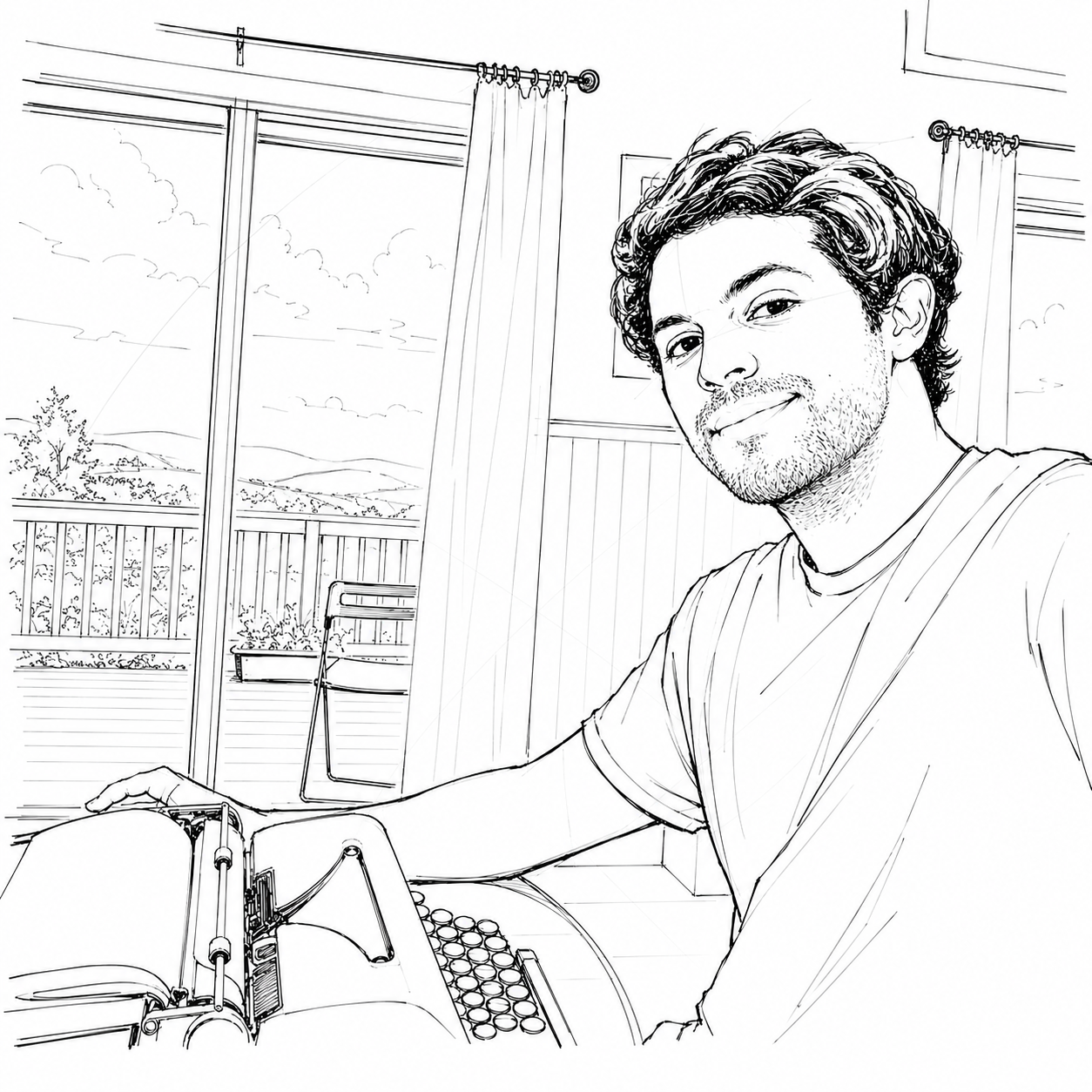
A beat in the Suburbs
In SF I bought a book of letters from Neal Cassady written to Jack Kerouac. Cassady was the real-life companion to Kerouac on his road trips, the real-life Dean Moriarty. He is little known outside a certain circle, but a legend with it. Recently read an article that referred to him as a “sacrificial muse”; he enabled others to make their best works, but struggled to make anything meaningful himself.
Why might I be so inspired by him? In many ways, he’s a terrible role model, but I asked GPT-5, based on what it knew about me, why I might be inspired by him":
Assumptions: you’re attracted to catalytic energy, improvisational intelligence, and scene-making; you want wildness harnessed by form; you value unfiltered truth, high throughput, and culture-building more than polite careerism. Cassady is the archetype of kinetic mind-as-engine: he didn’t just write—he ignited rooms, cross-pollinated tribes, collapsed life and art into one continuous performance, and served as a human router connecting Beats → Acid Tests → Dead. You’re drawn to that throughput: the low-latency cognition, the riffing monologue that finds shape in motion, the willingness to live at the edge where new forms appear. As a builder of Essay Architecture, you also recognize the meta-lesson: Kerouac’s “spontaneous prose” needed Cassady’s voltage to spark but also needed editing, constraint, and a chassis—the exact dialectic you’re formalizing (flow vs. grid, spiral vs. structure). You like him as a role, not a role model: the driver, spark plug, transmitter; the person who turns a private idea into a public scene. And you’re repelled by his collateral damage (self-immolation, chaos, irresponsibility), which sharpens the prescription: steal the engine, not the wreck.
After reading more, by them and from them, I'm realizing that Kerouac and Cassady are moral failures and tragic stories, nothing to aspire to without extreme caution … I really ought to figure out what I ever saw in them, and see if it’s separable from their painful lives, or if they just inevitably come together … (I think this as I look at the inside of my right foot in my dark living room—almost midnight, still on SF time—and how the light from the kitchen illuminates 13 separate bulging veins and I simultaneously wonder if I’m fooling myself with this whole writing dream, and also, if I will die young from hypertension.)
Cassady’s mom died when he was young, his dad was a drunk, homeless hobo, so from 10 years old and on, he was alone and un-parented. He stole over 500 cars, and spent many years in prison. Apparently what others saw in him as enthusiastic energy, he later confessed was extreme anxiety.
Kerouac’s brother died young when he was 4. His father hated his writing, and he was tight with his mom but she was extremely Catholic and made him terribly guilty and resentful of her.
Ginsberg’s mom was a paranoid schizophrenic, in and out of psych wards, and often trying to kill herself.
They all had troubled childhoods, and that probably messed with their emotional regulation. They all seemed to dabble with mental breakdowns and suicide. There’s a letter Neal wrote where he kept drinking and had a gun to his head for 14 hours but couldn’t do it, and then his wife came home and he asked her to do it.
Their specific energy might have come from extreme psychic trauma. Worth thinking how to channel a genuine intensity of enthusiasm, without accidentally emulating their specific flavor (which you can’t fake because it’s rooted in pain).
What is a “beat in the suburbs”? ie: What is the distilled spirit of the Beat Generation without nomadic self-destruction and the romanticization of chaos? I say “in the suburbs” because that image is antithetical to “being On the Road,”; it helps clarify that what I see in the Beats is something different from the spirit of adventure.
Values to keep:
- authentic experience > social performance
- deep friendships > shallow acquaintances
- questioning conventions > agreeable
- singular destiny > societal cog
- madness in creative work > productivity
- spiritual focus > material focus
Differences:
- Stable home, stable family; but mindful travel
- Not about spontaneous output, but showing up regularly
- Editing isn’t antithetical; it actually aids future streams
- Consciousness expansion doesn’t have to be through drugs
I like this AI-summary:
“It’s Beat ideals with adult emotional regulation and an understanding that you can be countercultural without being self-destructive.”