michael-dean-k/

On Monday 6/15, I'm hosting a workshop to kick off a reading group for classic essays: RSVP here.

Archive

May 2026

34 pieces

Roots of Progress application

· 1261 words

Link to one of your pieces you want to make sure we read. Why is this a good example of your writing for this progress blog-building program? Why are you proud of this piece?

Essay Writing as Personal Sovereignty was a winner of the Cosmos Institute Essay Prize, and it speaks to the importance of the manual effort of writing essays through the age of AI. It looks back to the origin of the essay, and how the early tradition of Montaigne failed to scale and integrate into our systems of mass education. I'd like to use my fellowship to go deeper onto this, to explore the history and future of writing curriculums.

What topics or areas do you want to write about? What about this is interesting to you? Why does it matter?

I've been blogging for 6 years and published over a million words. I want to study the history of education, writing, and autonomy, so that I can charter a vision for writing curricula in the 21st century. In 2024 I won a $100k O'Shaughnessy Fellowship, which enabled me to write a textbook on essay composition, and develop software that can analyze craft along a pattern language I designed. Focusing on history and progress will give me the context I need to found an institute dedicated to reviving how we teach the essay at scale.

What is your "angle" for human talent & potential? What particular areas (e.g. workforce development, adapting to AI, education, immigration, fertility, gender), challenges, or opportunities do you want to explore?

Human potential is gated less by talent and more so by the mechanical way we've taught writing at scale. AI is dismantling that system and creating a new opportunity. A new writing curriculum, grounded in autonomy, would be anchored in software that helps a writer improve how they can articulate ideas they actually care about. In this model, AI would never write for them. They would be guided by a series of "margin muses" (editors, socratic agents) both within and outside the piece. Over time it will understand a student's strengths and weaknesses, and guide them down a custom track of readings, lessons, and exercises. By compressing the arc of mastery from years into months, students will feel their rate of progress and continue toward the pursuit of their own original ideas. By fixing this, we don't just get better test scores or literary prose, but a wider pipeline of articulate, critical thinkers.

Tell us a bit about your background for the human talent & potential track. What unique knowledge, experiences, or perspective do you bring to exploring progress in human talent & potential?

  1. As Editor in Chief and curriculum lead at Write of Passage, I helped thousands of writers improve their ability to write, and distilled insights from thousands of drafts into a pattern language and 25k-word textbook on essay craft;
  2. I hosted a $10,000 essay prize last year that resulted in The Best Internet Essays 2025, an anthology that fused AI and human judgement. My editing system scores each essay 1-5 across 27 patterns; AI provides an objective "craft" score, while human judges cover the intangibles. Currently improving my eval system and aggregating RSS feeds so that I can scout the best essays across Substack in 2026.

My unique perspective: I've felt the dramatic rate that writers can improve, and I think we can measure and augment it too.

Share a great essay you've recently read on human talent & potential. This could be something exploring a policy question, a recent phenomenon, or an exploration of the impact of an innovation, or even a utopian vision piece. What about this essay speaks to you? Which ideas resonate? Why does this essay matter for those interested in human talent & potential? What perspectives might you add?

Check out The Age of the Essay by Paul Graham. This essay is a pillar I come back to, because it covers history, process, and future: he critiques the history of writing education (the five-paragraph essay is a hangover from medieval law schools), explains how essays are actually a multi-branched exploration to a question, and then speaks to how the Internet could enable the 21st century to become the age of the essay. I find it interesting that Graham wrote this not long before he founded Y-Combinator Sep 2004), and wonder how much of his thinking here influenced the success of that program. Many of the notable founders in cohort 1 were bloggers who used writing to think (Aaron Schwartz, Sam Altman, etc.). Related to progress, I think there's a meta-lesson in understanding how new technological networks can open up new affordances to revive old practices.

An added perspective: Graham was right in that the removal of gatekeepers opened up a new wave of writing talent, but missed the fact that it also opened a new flood of slop that would make that talent harder to find. The important lesson is that you can't remove gatekeepers without implementing a sophisticated curation system. I write about this in my essay "The Signal in the Slop," the opening of my anthology, The Best Internet Essays 2025.

Your current situation. Give us a bit of context on you--e.g., what you're working on now, at what organization, and anything else you want us to know about you.

I'm working full-time on my project Essay Architecture: writing, researching, building software, scouting essays, organizing a community, and hosting weekly calls where we deconstruct classic essays. In the last few years I built an audience of 10,000 followers, and now I'm figuring out how to formalize my efforts into an institute (sustainable income paired with mission-aligned projects).

Writing and your career. How do you see writing on progress topics fitting into your career plans over the next 5 or so years? As you envision your success as a writer, what do you want to accomplish with your writing in the next 5 years? Do you have goals on frequency of publishing, places you want to publish, or audiences you want to reach?

Within 5 years, I want Essay Architecture to function as a standalone writing institute that different groups can plug into: Substackers, students, micro schools, homeschoolers, etc. It will provide editing software, textbooks and anthologies, a library of thousands of scored/categorized essays, and the ability to guide writers down custom learning paths based on the drafts they upload.

The goal of my progress-related writing is to: 1) publish pillar pieces on the importance, history, and future of writing curriculums; 2) attract students to the institute; 3) build a network of partners who are operating within or connected to the worlds of EdTech or alternative schooling.

I'm in the process of rethinking my writing infrastructure. All essays will live on a personal website (launching in June), where Substack will serve as a weekly newsletter to redirect readers to my essays, products, etc. I believe it's important for a writer to manage different publishing velocities. In May I published 33 essays averaging ~600 words each. In the last year, I've averaged a monthly long form essay at ~3,000 words. I'd like to produce something at my peak quality that gets published in a journal or magazine around 2-6 times per year.

What are you looking to get out of this blog-building intensive?

I'm looking to immerse myself in a community of progress-minded writers, to get rigorous feedback on my ideas, and find guidance on how to formalize my project into a sustainable institute.
A pattern language of virtues to synchronize brain hemispheres

· 448 words

Aristotle’s virtues are structured as the mean between two vices; “temperance” is the mean between indifference and indulgence; “courage” the mean between “cowardice” and “recklessness.”

I’ve been working out a system of virtues where paradox is the organizing element. It’s not about finding the mean of a spectrum, but about simultaneously straddling two opposites, two ends of a spectrum. But the spectrum here doesn’t run vice-to-vice—you wouldn’t want to be cowardly and reckless—, it covers two opposite modes of thinking: right brain, left brain.

Right brain virtues are about embodied presence, where left brain virtues are about abstracted principles. Both matter, and if I lean towards one mode or the other, I find myself untuned, either scrambling through passion, or strangled by structure. The solution isn’t to shift from order to chaos or chaos to order, but to be maximally orderly and maximally chaotic.

Kairos is about being aware of a moment and boldly taking it (it’s a military term) where agape is about unconditional love (a Jesus term), and so when I repeat the prayer “Καιρὸν θεωρῶ, ἀγάπην σπερῶ,” it’s a paradox embedded in a single phrase: “I recognize the moment, and will bestow love as a gift.”

I haven’t mapped the other virtues into sayings yet, but there is the spontaneous, generative, and wild ecstasy (ékstasis) paired with a prudent and monk-like systemization of everything, logos. There is the serene inner stillness, the now without thought, hesychia (ἡσυχία) paired with the striving towards your destiny, your purpose, your final end, your telos. There is the immersion into the inner dream-world of images, fantasia (φαντασία) paired with the builder mentality to order and craft your environment to shape your mind, cosmesis (κόσμησις).

Now that I write this, I see the difference between cosmos and cosmesis. Cosmos is an abstract, left-brained noun, the order of matter, it's physical configuration; cosmesis is the embodied, right-brained verb, the participatory act of ordering matter yourself (ie: making your bed, shaping your government, designing your church). It's important for all of these virtues to be verb words, because they are not static nouns, but actions to take. In that spirit, I should change logos to logismos, telos to teleiosis, and agape to apagan.

This is turning into a pattern language of virtue, and though there are many differences with the Essay Architecture pattern language—it’s made of spectrums and not triads—there are similarities too: each virtue telescopes into more sub-virtues, virtues are interlinked, they all combine to create a nameless quality. I think only through making many types of pattern languages, across different fields, will I be able to understand the different constraints and components of any system: the patterns of pattern languages.

Perhaps hell is for the self-conscious

Hesiod corrects that saying of Plato’s, that the punishment follows hard upon the sin. He says it is born at the same instant, with the sin itself; to expect punishment is to suffer it: to merit it is to expect it. Wickedness forges torments for itself: "Who counsels evil, suffers evil most," just as the wasp harms others when it stings but especially itself, for it loses sting and strength for ever: "In that wound they lay down their lives." The Spanish blister-fly secretes an antidote to its poison, by some mutual antipathy within nature. So too, just when we take pleasure in vice, there is born in our conscience an opposite displeasure, which tortures us, sleeping and waking, with many painful thoughts. "Many indeed, often talking in their sleep or delirious in illness, have proclaimed, it is said, and betrayed long-hidden sins. [...] No hiding-place awaits the wicked, said Epicurus, for they can never be certain of hiding there while their conscience gives them away. ["This is the principal vengeance: no guilty man is absolved: he is his own judge."]"

This all assumes that only the wicked, evil, and sinful can feel guilt. If "to expect punishment is to suffer it," then what about the innocent boy who commits a minor transgression but then is needless anxious over punishment? I say this because I was a self-punishing child. If I did something slightly devious from norms and expectations, I'd get very down over it, and pronounce my own punishments to my parents. I'd have to be unpunished.

And what about a sociopath who can steal cars, break traffic laws, get arrested and feel no remorse? Those are just silly rules. It's only jail for a few days, and jail's not so bad anyway (based on a true character). If he accepts institutional detainment without sting, then will his future self be tormented? He may feel less torment than me, who yesterday hesitated to kill a pair of ants, and in my uncertainty decided to let one of them live.

I'm coming to a weird conclusion here: hell is for the self-conscious. Future suffering is less about the rating of a virtue along some objective good vs. evil spectrum, and more about the nature of a rumination. In the act of being honest, in reviewing your life and assaying your slightest deeds, you're bound to find ways you could have acted better. Even if you're level-headed and non-regretful about it, you'll feel more weight than the menace with no capacity to reflect. And so, unfortunately, a virtuous person can suffer more by being more virtuous.

This isn't fair, but it feels true. Maybe you believe that the self-conscious repents in this life while the sinner repents in the eternities of hell, but that really depends on your conception of how the afterlife works.

Last night I had three consecutive dreams, each brooding with a supernatural evil that brought me the chills when I woke up. Throughout the morning, I wondered what the trigger might have been. Yesterday was a happy day: the weather was nice, I went to a Memorial Day BBQ, went swimming for the first time all season, introduced my daughter to extended family, and, oh yeah, I read a chapter by Montaigne on the nature of evil and punishment. Even reading and contemplating about it in the abstract is enough to load them into your subconscious and bloom into your dreams.

A 2.5 year fiction syllabus of short stories and novellas

· 893 words

I finally got around to building my fiction syllabus. In pursuit of the question, "how should an essay writer read?", I'm mapping out all the different ways I want to educate myself. One of them, reading and analyzing essays, is obvious and underway, the bulk of Essay Architecture. But the 2nd focus was focused on nonfiction curators, historians, and biographers—I already shared that list. Now this 3rd focus is fiction.

This list started with some big bad novels, like Moby Dick, Middlemarch, and Infinite Jest. Realistically, if I were to pursue any one of those, they'd likely suck the oxygen away from anything else I'm reading. My current approach to read something like 10 books per month, not in full, but 1-3 chapters from each, coordinated among each other. I could possibly read something like Infinite Jest over 6 months, but I imagine I would lose a lot from going in and out, and often lose context of what I read last month. Maybe there's a way where, for one month a year, I block out the whole month to read something very long. For now, going to skip that (I can experiment with long books after this already ambitious system proves it can sustain for 1-2 years).

And so this limited my fiction criteria to things I could knock out in a few days. Decided to run with short novels and novellas (100-200 words) and also short-story collections (where I'd select a few that can be read in a similar span). I like this approach because it gives me a wide range of different voices and approaches to world-building, character building, etc. Where the essay is anchored in the questioning of the author, and nonfiction is anchored in ideas, fiction is anchored in the confluence of people and place, and the implicit virtues you parse out from the circumstance.

You can get the whole reading list on syllabus for $208.

I asked Claude about the running themes: awakening late in life, the divided/counterfeit self, free will, the dignity of ordinary people, the sacredness of attention, and memento mori as a clarifying lens. Many are anchored in a single day. Some try to synthesize virtues, others accept a messy plurality. I also asked "how might I change after reading this?" and it replied: "you'll re-weigh the ordinary day"; you'll get a sharper instrument for self-deception"; "you'll relocate ethics from achievement to attention and kindness"; "mortality becomes a working tool, not a fear."

Prose density for vibe coding

· 182 words

The advantage writers have in the age of AI is their ability to quickly write with extreme specificity.

A non-writer might just prompt “Generate a slide deck visualizer app,” and the results will be fine but random, totally different if you were to run it again in a fresh chat. When you ignore the details of craft, slop fills the gaps. Alternatively, if you can write out 300 words of instructions, including the goals, the aesthetic, the back-end decisions, the features, the data structure and variable properties, etc., you’ll get something to the degree you can visualize it in your head and describe it.

I suppose that is the act of the writer: visualize, then describe. The same applies to vibe coding. The future belongs to those who can think in paragraphs.

Not only can the writer trivially write 50x more than the lazy prompter, they can write with 5x the specificity. Those numbers are arbitrary, but it feels true that a seasoned writer can achieve 250x the semantic density of someone who does not work with words as their dominant output.

A site of one's own

· 743 words
  1. As a writer needs a site of one's own, a place designed for their particular psychology so they can be the most prolific, honest, adventurous version of themselves. Solitude is important. Montaigne, the founder of the essay, wrote up in his tower for a decade. When you are your own audience, your practice is self-justifying. You are intrinsically fulfilled, and do it regardless of validation, growth, or revenue. To become self-validating is to become a nuclear engine of creativity. When you write on your own site, chances are you will spend much time on ideas that no one will read. That's inefficient, but essays are inefficient. I need to ruthlessly follow what matters to me, with no fear of being illegible or invisible to others.
  2. That said, you can and should invite others into your garage. I still plan to keep my Substack and post there, but it will be more like a newsletter, a digest of the controlled explosions happening in my own neighborhood. I do believe in the value, even, the responsibility, of writing in public. By making your place tidy enough for friends, strangers, students, customers, mentors, heroes, whoever, to come in, it makes you put an extra oomph in your crafting of language, and it creates seeds from which relationships can grow. When you have visitors in your territory, they play by your own rules, so you're generally safe from mobs and barbarians. They will not trample over your furniture and throw the books from your shelf like they would in the town square.
  3. In 2023, I was hopeful that Substack could be an all-in-one platform—a website/newsletter/discovery engine—but it has heavily shifted into an app-centric social media platform. The app starts you off in an endless, algorithmic, engagement-ranked feed, and the design has slowly evolved to trap you in the app. When you click in article, the default URL is the Substack one. When you click into a person, you can't even go to their site anymore; you can only view them through their profile template. This means all the customization and self-archiving and mythologizing that goes into your site is off limits to the app, the thing they're trying to corrall attention through.
  4. I'm very allergic to "Substack is dead" posts, and most of the critique is often a projection of their own weaknesses (ie: when people naturally stop growing, it's easy to blame the algorithm than to take responsibility for it). In my case, the Substack algorithm has worked pretty well over the last two years, and I'd be stupid to abandon it. But the whole system has limited my intrinsic passion to write, and that matters more, enough that I'm willing to take the risk with a split publishing system: Substack newsletters that link out to my site.
  5. Back in 2020, a Write of Passage concept was the "public to private bridge," meaning you find people in social media feeds, but then redirect them back to a place of your own. Now that Substack is mostly a social media network, I think that same strategy applies. It's not where I want to host my essays anymore. I'll host newsletters and paid content there, but the timeless stuff wants to live in a place that is timeless.
  6. If you have a portfolio of writing, Substack feels like a pretty bad way to make your old work legible, especially within the app. There are no tags or sections. No about page. No navigation system. No ability to frame call to actions as visually dominant. The beauty of your website, especially if you build it from local markdown files, is (1) you have a single source of truth for all your writing, and (2) you can just respawn new interface and navigation systems as your portfolio evolves.
  7. Even though Substack lets you export your essays, it's really more like a failsafe, a backup incase you ever decide to leave. Of course, it's very nice to have that! But it's still a cloud-based system, where editing your past files is slow and clunky, and you have limited ability to point your essays elsewhere. When I have a local folder of my essays, I can very easily spin up a stylized website around any essay, or any group of essays (say, for example, if I'm making a proposal and I want to curate a handful of essays. I can point my AI at any combination of files and folders for context.

3D essays

· 200 words

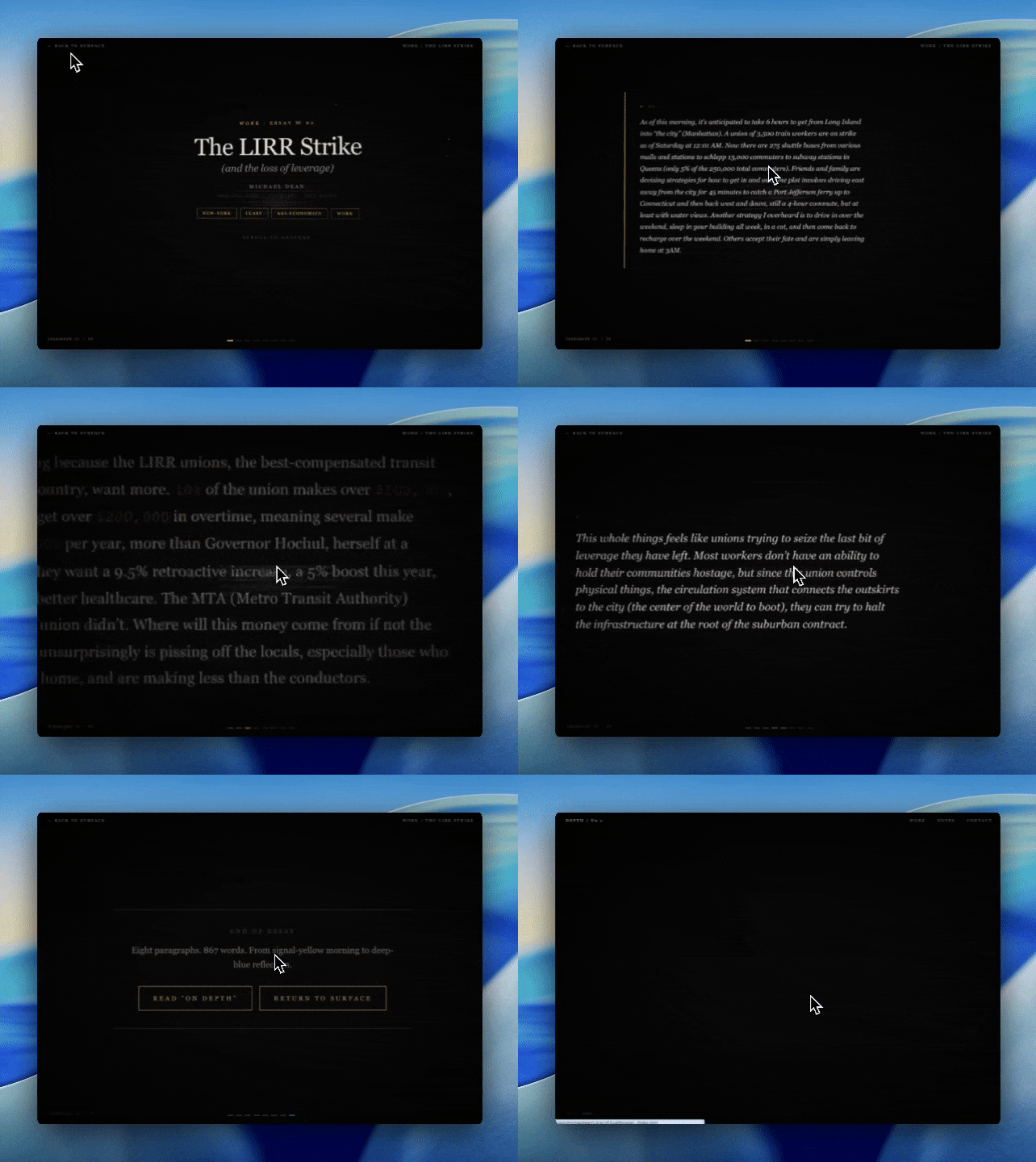
What would a 3D essay look or feel like? The "video essay" is a format, but that's really more like a performed/spoken essay with picture and video over it. I'm curious what it could be if we keep reading prose as the core mode.

Here's a prototype where scrolling brings you in instead of down. Instead of feeling like you're just reading a wall of text, it feels like you're moving forward into a series of spaces.

This breaks the essay into paragraph blocks, where you only see one at a time, which works something like focus mode (and I suppose there could be a way where you could preview the paragraphs behind and ahead). There's opportunity for each paragraph to have unique color, imagery, a distinct vibe to match the content. Additionally, each paragraph can have portals to jet out from this essay into different ones, making it something like a choose your own adventure.

Is anything gained from this? Or is it just a novelty? Best case, it's a new medium to bring prose into the short-form video era; it's much less intimidating to be presented with a single screen of text than a whole wall of it.

To revert to or rederive custom?

Both condemnation and approbation will be equally welcome, equally useful, since I would loathe to be found saying anything ignorantly or inadvertently against the holy teachings of the Church Catholic, Apostolic and Roman, in which I die and in which I was born. And so, while ever submitting myself to the authority of their censure, whose power over me is limitless, I am emboldened to treat all sorts of subjects—as I do here.

I found this chapter, "On Prayer," to disorient my model of Montaigne. It reads like a Hobbesian plea but towards the church, where he submits to the holy teachings, accepts censorship, and grants them limitless power. Historical context matters though. Essais was published in 1580, and the excerpt above was inserted in 1588, after it was read at the Vatican and their censors flagged certain topics for revision ("On Fortune," "On Prayer," and "On Suicide"). So one interpretation is that submission was the required price of writing about religion at all in the 16th century.

But another angle is that Montaigne's Catholicism is under-represented in his portrait. The modern reading of him is that he's the first liberated mind to focus on himself and to beam the laser of reason on all dogma to come to his own ever-shifting conclusions. He was a Pyrrhonist after all, a suspender of judgment. But apparently Pyrrhonism does accept laws and customs for social order, in the name of stability, even if they doubt them. So Montaigne in most works goes beyond traditional Pyrrhonism, and questions torture, marriage, and imperialism in a way his predecessors wouldn't; but he doesn't cross that line with the church.

One interpretation is that Montaigne questioned everything within reason, but since he found God to be beyond that, beyond himself to know definitively, the great unknown, he defaulted the tradition he was born into. This is known as "fideism," and his comfort in it is what bothered Pascal.

In reflecting on this, there is no way to opt-out of all submission without living feral in the woods, which is always an option. I'm landing on the idea that I'd rather submit to the state than the church. In submitting some liberty to a state-backed order, we then have the freedom and time to pursue creative, social, intellectual, and spiritual matters.

I basically disagree with the conclusion that if something is beyond reason we should revert to the default. This doesn't mean to betray all tradition, but character grows when you both accept and reject and put yourself in motion, if even you re-derive the whole religion and end up in the same place. Even if the virtues and metaphysics of Christianity ring true after two thousand years, it's the (closed) epistemology—how we come to conclusions—that's caused so much trouble all this time. Of course, earlier centuries didn't have the luxury to safely question epistemology, but it feels like the Scientific Era rejected religion outright without exploring the option of an open epistemology.

Your ideas matter!

· 363 words

You’re Ideas Don’t Matter? This take always irks me, though I do love the closing line: "You can [...] spend your life [fighting over] golden eggs [...], or you can learn how to become a goose who lays golden eggs." I love the abundance mindset; just be prolific.

But I don't love the "fuck originality" attitude. It feels like a node in the creativity-for-beginners canon—along with The Taste Gap and All You Need is Vibes—a consolation to prevent a new artist from quitting. And I suppose that is worthwhile. You can't be terribly concerned with technique or originality if you don't have momentum, the general contours of a practice.

But to say that creativity is only "remixing, rearranging, reimagining, and recombining" is to plant a meme that can constrict creativity long past its usefulness. I don't totally disagree—yes, all ideas have a lineage of influence, and most big ideas are reframes of old ones for a new context—but the issue is in being too conscious about it. To see creativity as the controlled combination of elements is to see the creative process like a mechanical assembly line. It ushers in factoid harvesting and Frankenstein stitching. This kind of recycling is halmark slop, the kind of thing that LLMs do.

And again, that is totally fine for L1 or L2 or whatever, but the goal—or at least, my goal—is to transcend that. Originality isn't an old virtue to shed, it's the thing to strive for. It takes a lifetime to get there, decades of dedication, and that is a hard promise to make to a reader who has a time horizon of next week. But what is it that you should strive for if not originality? Instead of combining ideas in an A+B=C kind of way, you want to melt and fuse them all in your subconscious, in an unpredictable, high-voltage kind of way, to create an output that is incalculable, one that of course has nods to works from before it, but one without a formula, and one that could have only been crafted from your own mind. Is originality not the same thing as make the thing that only you can make?

We all inevitably become tales

Let us pluck life’s pleasures: it is up to us to live; you will soon be ashes, a ghost, something to tell tales about.

To focus on the sensual transience of a moment is to surrender to human hardware; it has many expressions, from peaceful acceptance to orgiastic nihilism. The alternative, to accept your end state now, as the ghost of tales told about, is the less embodying but more accurate view of life. It's the species-wide, view-from-the-moon view. If you shift from human time to cosmic time, you are more code than body. For a short-time you live in your own skull, but for much, much longer, you can live in many skulls as a lesser or greater legend.

Now that I have a child, I feel my self de-centered, and ready to shift from eros to logos. This stems from a weird thought: that my daughter is not only an independent being, but in many significant ways, she is me. She is the clone of my wife and I. Growing up, you see yourself as wholly different and unique from your parents and grandparents, but now I can't help but see us all as instances of the same code, changing through an evolving circumstance, but reinforcing through inter-generational dynamics. A familial lineage is the same genetic source, looping and mutating in place.

For me, becoming a parent is a slow-process of re-identifying from a singular self to the entire chain, forward and back. What comes with that is a new desire to live into the tales you want to be told, because that is your inevitable end. And if you can design your self and life into a tale that then helps the blooming of your children, letting them experience life's pleasures to the fullest, well then you've achieved the original goal, because they are you.

Audience of (n)one

You have lived up to the present floating and tossing about; come away into the harbour and die. You have devoted your life to the light: devote what remains to obscurity. It is impossible to give up your pursuits if you do not give up their fruits. Renounce all concern for name and glory. There is the risk that the radiance of your former deeds may still cast too much light upon you and pursue you right into your lair. Among other gratifications give up the one which comes from other people’s approval. As for your learned intelligence, do not worry about that: it will not lose its effect if you yourself are improved by it. Remember the man who was asked why he toiled so hard at an art which few could ever know about: “For me a few are enough; one is enough; having none is enough.” He spoke the truth. You and one companion are audience enough for each other; so are you for yourself. For you, let the crowd be one, and one be a crowd. It is a vile ambition in one’s retreat to want to extract glory from one’s idleness. We must do like the beasts and scuff out our tracks at the entrance to our lairs. You should no longer be concerned with what the world says of you but with what you say to yourself. Withdraw into yourself, but first prepare yourself to welcome yourself there. It would be madness to entrust yourself to yourself, if you did not know how to govern yourself. There are ways of failing in solitude as in society. Make yourself into a man in whose sight you would not care to walk awry; feel shame for yourself and respect for yourself,—“observentur species honestae animo” [let your mind dwell on examples of honour —Cicero]; until you do, always imagine that you are with Cato, Phocion and Aristides, in whose sight the very madmen would hide their faults; make them recorders of your inmost thoughts, which, going astray, will be set right again out of reverence for them. —On Solitude

This feels like a line I should reflect on, pin on my wall, and take seriously. Feels particularly urgent, as the shift from Substack to my own website feels one towards solitude, but not fully committing to it. The fact that I call this "semi" public means it sits between two worlds. If I wanted true solitude, I would "scuff out the tracks" so the beasts can't get into the lair. I do have a vision for a labyrinthine website, where most visitors can't access most works.

But I find myself unable to commit to this, as if "writing in public" is unquestionably engrained in me. My uncle, who used to share a blog with his writing and photography, told me, after not publishing much for 10 years, that he made the philosophical decision to keep his work private, and to more so focus on the art of relationships. Instead of downloading thoughts onto paper for strangers to read, he focuses on the live interchange between two people.

It also feels irresponsible to retire now, to retreat into a cave of intellect, character, and creativity. As noble as that is, it's coming from Montaigne who (at age 37) had the financial luxury of secluding in his tower (another example of a philosophy as a rationalization of your circumstance). I am far from decades of financial security to support my wife and daughter, and so I very much need to operate in public.

I need to better articulate why I write in public the first place. To build off Didion's reasons for a private notebook—writing freezes what the wind of conversation would blow away, letting me see myself and my past selves, our assumptions and aspirations, fears and blindspots—a public notebook invites others into my process of evolution. By reading and talking to friends on the ideas of my rumination, they bring other unlocking perspectives.

Philosophy is a social endeavor. It's in the name: "friendship of wisdom." So then why does this Montaigne quote (where he paraphrases Seneca, Epicurius, and Cicero) resonate so hard? The risk is that by exposing yourself to the public, you position yourself to build status from the crowd. It's inevitable. Social networks are in the game of brokering status and making it explicit, giving you quantified follower counts and metrics per post. And so if you get fixated on scale and reputation and validation, your lack or wane or love of it, you risk missing the point: the work itself, the cultivation of character, the opinions of your imaginary heroes.

And so split infrastructure helps me resolve this tension. On my website I write for an audience of (n)one: if it's not for myself, it's for a single person, perhaps one relevant to the topic at hand, whether it's a close friend, a historical figure, or my great great grandchild who will one day scan a QR code on my tombstone to stumble upon the musings of an ancestor. On Substack though, I do write for the crowd. But so long as my personal writing practice is strong, then I will bring myself to the crowd, and not bend towards favor or fortune or trends or whatever. I think Emerson got the synthesis right: to retain the sweetness of solitude amidst the conformity of the crowd.

A remix per century

If you have lived one day, you have seen everything. One day equals all days. There is no other light, no other night. The Sun, Moon and Stars, disposed just as they are now, were enjoyed by your grandsires and will entertain your great-grandchildren.

This is Montaigne citing Manilius citing Vives citing St. Augustine's City of God. The original in Latin is "Non alium videre patres: aliumve nepotes Aspicient", which is "Your fathers saw none other: none other shall your progeny discern." So this is four layers removed from the source, yet far more elegant, lodging itself in my mind in a way that the original never would have done.

This reinforces the idea that, while there is much of creativity that comes from your own mind, without conscious influence, there are whole wells of wisdom that are waiting to be transfigured into their maximum potency. Speaks to this whole project of reading widely, highlighting obsessively, and then reacting to, writing on, and deepening them.

I'd go as far as saying that Montaigne as a whole is due for a remixing. The Screech translations (1991) are already so much more accessible than Hazlitt's (1877) which was just a reworking of the 1685 translation by Charles Cotton. Just like Locke called for a revolution once a century to readapt government to the emerged situation, we likely need a re-rendering of great thinkers once per century to make them maximally salient to the current generation.

And so what Montaigne needs, in my opinion, as you might predict, is a re-structure.

Yes he did edit his essays when he republished them, but mostly, as far as I can tell, in the form of slight deletions and additions, keeping the overall essay arc the same, and the overall flow of the volume chronological. Why present the essays chronological? This matters for a historian, but not for a teenager who can be inspired into become Montaignian themselves. If I were to have a go, it would be a radical re-ordering, restructuring, and compression, while trying to preserve his cryptic essence, shape-shifting identity, and turns of phrase. It's a type of translation, not just of words, but of essence.

Like flinging hand grenades into a fog

Why was Pascal so obsessed with Montaigne? Eliot insists that Pascal studied Montaigne in order to demolish him but could not do so, because it was like flinging hand grenades into a fog. Montaigne, Eliot assures us, was “a fog, a gas, a fluid, insidious element,” which must surely be the oddest description of Montaigne ever attempted. The intention of Eliot’s invidious metaphor is revealed when the author of Murder in the Cathedral insists that Montaigne “succeeded in giving expression to the skepticism of every human being,” Pascal and Eliot doubtless included.

Fascinating that a personification of a person as a gas or liquid is described as "insidious" (def: "harmful, dangerous, or treacherous [...] subtle and unnoticed until it causes significant damage"), something so disturbing that we must destroy it with explosives.

Why do we fear non-solid personas? It is comfortable to know another as a known quantity. We are box putters. When everyone in our life is stable and unchanging, it gives us fixed conditions for us to ease into, for don't we define ourselves as our relationship to others? If our friends and family were to rapidly warp their politics and morals and tastes, would that not create clashes that force us to re-consider our own? The fear of shape-shifting others is fear of the inner gas. The "you've changed" middle-school jab is an act of defense. Ego is solid, frozen, calcified.

To molt is to let light, liquid, and air burst out the confines of the chitinous shell of a Roach self—to truly hold cognitive liberty, at least for a moment, an hour or day, before reassembling into a new shell, like the homeless hermit seeking refuge from the dangerous beach, is to glimpse the freedom that only you withhold from yourself. Montaigne is a model for man in perpetual molt, always passing, always becoming. We can only know our soul if we perennially refactor the code of our self.

Infinite thirst for the infinite

What is the meaning of my conscience? What is the explanation for my sense of the infinite? Within myself there is something which continually makes me look beyond myself. Within myself I bear a source…

What's surprising me about reading Orthodox theology (at least through Kallistos Ware), is how transcendental some of the language is. Maybe this is because Orthodoxy, at least my experience of it, is focused on ritual and dogmatic adherence, but if you get into the practice of the monks and mystics, it very much insists on direct experience. I did not expect St. Nicolas Cabasilas (a Byzantine monk from 1319) to write about the "infinite thirst for the infinite." Of course though, the answers to many of these open questions are given theological answers, but religious questioning is what's missing in a secular society.

Escape the vortex of pandemonium

He left the rest to prattle on, to move with the herd, to get borne aloft, to preach and parade; he left the world to follow its chaotic crazed paths and only concerned himself with one thing: to be rational within himself, to remain human in an inhuman time, to remain free in the vortex of pandemonium. He let them have their say, those who mockingly accused him of indifference, indecision and cowardice; he let others relish their surprise at seeing him relinquish his duties and honours. His nearest and dearest, who knew him best, never doubted the perseverance, the clearsightedness and the subtlety with which, in the shadow of public affairs, he applied himself to the sole aim to which he was committed: to live his own life, and not simply to live.

Reminds me of today's shamings of inaction by protestors and armchair activists. To retreat from the "vortex of pandemonium" isn't cowardice, but to build courage to tap into your own inner reservoir, to live your own life, and to do the impossible act of summoning truths within yourself that is only possible with years of indistraction. After a decade, Montaigne did come back. He published his first volume of Essais and then was unanimously elected mayor without even running. Not that Montaigne had any role from Bordeaux in solving the larger crises of his time, but there is maybe no better example of how a self-direct life can lead one to a position of leverage to act on political and moral affairs.

Is to deny life-extension a form of suicide?

If you have profited from life, you have had your fill; go away satisfied. [...] But if you have never learned how to use life, if life is useless to you, what does it matter if you have lost it? What do you still want it for?

This comes from a spread within "To philosophize is to learn how to die," on a page where almost every line is highlighted, meaning my past self, a self from just two weeks ago who I no longer have access to, must have really wanted to internalize all this. Neither the ecstatic nor the cynic has a reason to cling to life.

To not cling for life is to go against what Hobbes calls our primary drive, self-preservation. I could imagine one of today's transhumanists, with hope and conviction that immortality drugs are coming next decade, would loathe Montaigne's sentiment. Life is all we have!

My first impression is that Montaigne is wise in the acceptance of death, but if philosophy is the rationalization of the stances we are forced to take, then might Montaigne just be coping? If he were to time travel ahead to a time where life extension drugs were mundane and integrated, and mortality were not inevitable, might he not write a beautifully persuasive essay on how we should live forever? The man is known to change his mind.

On where I stand, I don't know. I generally think life extension beyond a few standard deviations (ie: 10 years sure, but 50 or 500 years?) is a Faustian bargain where we can't quite imagine the horrors of changing our one primary constraint: death. In moments of peace, I feel happy to have lived, ready to die, and abstractly and rationally and theologically, I know the importance of dying and death; but in the moment, if I were dying and knew an extension were possible, I couldn't imagine not taking it. And even if I extended just one more year, over and over, might I take that deal for 300 years? When would I not want to extend my own life for just a bit longer? If life extension is accessible, but you choose to die, even naturally, is that not a form of suicide?

Medieval maps of time

· 739 words

In October of 2024 I sliced history into eras of my own. Prior to that, my historical timeline was built on sandy approximates. The challenge here is that so many historical eras have different time periods (10, 50, 250 years), and so it requires you to remember specific date ranges for specific things. Unless you’re a historian, you most definitely won’t.

I’ve been long drawn to the Strauss-Howe generational theory, and decided to use this as a historical map of even intervals. They break history into “saeculas,” 80-year cycles, the interval of an average human life, and perhaps not coincidentally, the interval between major world conflicts. They go back to the 1370s, I think, but I’m trying to work through the major milestones in the 400 years before that (which includes the Schism, the Crusades, the founding of Oxford, the Magna Carta, Thomas Aquinas, which all seem relevant to the millennia and the rise from the Dark Ages).

The point of a historical timelines of equal intervals is that (1) it’s easy to remember—and I’ve even given my own names to make them stick—so that (2) any new information, ie: ideas or people, can easily slot into that model. It helps to know the Renaissance Era is 1370, Discovery Era 1487, Scientific Era 1594, and Enlightenment Era 1704, so that when I come across Hobbes in 1600s, I know, oh, that’s the Scientific Era, which makes sense because Hobbes brought the first scientific understanding of political philosophy. Today I made some progress on updating my October 2024 map, which I started in 1095 (the Shism) and wrongly named “the scholastic era” (which is better for the following phase).

Instead I think the start should be in 962, and called “The Schism Era.” The new order (I) kicks off with Otto I becoming emperor through the Pope, which is significant because in the prior 75 years, there was no emperor due to the peak of viking/barbarian raids, and it was the biggest threat of Christianity being erased. Since Otto, the Holy Roman Empire stuck for 8 centuries, until dissolved by Napolean, so this really is a reconsolidation, the exit from the Dark Ages. The awakening (II) is a spiritual crisis, when Rome adds the “filioque” a term that alters the original trinity, this leads to (III) the Schism between Orthodox and Catholic church, and erupts in (IV) a civil war between the Church (the Pope) and the (Holy Roman) Empire at Canossa in 1077.

Then the “Cathedral Era” kicks off in 1095 with the Crusades, which is it’s own new world order, where a French faction of Catholicism (pope-aligned), helps launch (1) a cross-country military coalition that supports the church, which can (2) take back Jerusalem from turks, (3) prevent anti-pope revolutions, and (4) thrwart internal civil wars of feuding knights. This leads to Worms in 1112 (II), which is really the original separation of church and state (though really it’s like 2 separate governments, where the church still has laws and the right to kill). This period is marked by many crusades, the rise of cathedrals from this new order (church having a better military with more resources)—Saint-Denis, Cartres, Notre Dame, Cantebury. There are also “cathedrals of thought” maybe a stretch, but includes Aquinas’s unification of Aristotle and Christianity, along with proto-scholars that would lead to Oxford. Where in the last Era, Christianity had barely survived from Magyar raids, this Era is continent-wide flourishing of building, writing, thinking (and of course, conquering). The awakening (II) featured new religious ideas (Gothic, cults, scholasticism, classicism, exuberance), and the overall exubernace spiraled into crises of King John (IV). He taxed heavily to fund failed crusades, seized lands, and jailed nobles, so this resolved with the Magna Carta (1215), which bounds the king to laws.

Following is the Scholastic Era (1215 on), which coincides with Oxford officially incorporating at a university, but I can’t do that one now… I have to leave in 20 minutes to make it to my father-in-laws memorial on time. The point is, from this morning I now understand two historical cycles that were extremely fuzzy to me. Of course there is a lot more to learn, but I have a map that other things can lock into. Most relevantly, I have a sense of the different inner-saeculuar moves ()from I>II>III>IV), which help imagine possible scenarios for today (2026 is the predicted beginning of I, a new world order).

The 7 myths of Pythagoras

He soon became a mythical figure, credited with miracles and magic powers, but he was also the founder of a school of mathematicians. Thus two opposing traditions disputed his memory, and the truth is hard to disentangle. Pythagoras is one of the most interesting and puzzling men in history. Not only are the traditions concerning him an almost inextricable mixture of truth and falsehood, but even in their barest and least disputable form they present us with a very curious psychology. He may be described, briefly, as a combination of Einstein and Mrs. Eddy. He founded a religion, of which the main tenets were the transmigration of souls and the sinfulness of eating beans.

A mythical figure with supernatural powers and a small group of devoted followers—can't help but see the parallels to Christ. I wonder how common mythologizing and symbolic flourishing is to figures of antiquity, and how much time distortion plays in it. In the case of Pythagoras, there was 700 years between his time and his detailed biographies (from which we know most about him). In the case of Christ, it's traditionally thought to be 25 years, but if we trace Christianity back to the Essene cult, we could be misdating by 100 years (and with that time comes mutations).

A few Pythagoras myths: (1) he had a golden thigh; (2) he remembers—and apparently proved details of—his past lives; (3) he communicated with animals (bear, ox, eagle); (4) he controlled the weather (rivers, earthquakes, storms, plagues); (5) he was recognize by Abaris (a Hyperborean shaman-priest) as Apollo incarnate, and given a golden arrow; (6) he controlled minds through music; (7) he could hear the planets.

The Egyptian roots of Greek philosophy?

Pythagoras, however, disliked his government, and therefore left Samos. It is said, and is not improbable, that Pythagoras visited Egypt, and learnt much of his wisdom there; however that may be, it is certain that he ultimately established himself at Croton, in southern Italy.

I had no idea that Pythagoras went to Egypt at 21-22 years old, stayed for 22 years, then did a decade in Babylon, only returning back to Greece at 56 years old (dates are contested, and given the rumors, some doubt he went to Egypt at all). This is sort of like how Nolan Rylan was inducted to the baseball Hall of Fame as a Ranger, but he started as a Met... There's a book Black Athena that possibly overstates the Egyptian influence on Greece, but it's very possible that the what we know of as Greek is actually logos on top of Egyptian mysticism.

Knowledge workers are middleware

· 640 words

Something about the term “knowledge worker” doesn’t settle with me. Some people identify as one, and I’m sure they either grieve of mock the idea that AI will kill email jobs, but knowledge work is the work we should be most eager to shed.

Compared to a factory worker, one who manipulates physical materials and turns them into goods, a knowledge worker does the same with information. It’s computer work. There is a utilitarian air to the phrase, an efficiency. It serves the needs of an employer. It’s about sifting through and repackaging information to create economic value. A better term might be “information assemblers.” An information assembler can go their whole life within a particular domain of specialization and build a strong intuition for how it works, but without knowing Knowledge.

There are many ironies in the phrase. The knowledge worker is so busy setting up meetings and writing reports and filling out reviews and dealing with clients and managing products, that they never have time to touch Knowledge, the thing that matters. It’s an oxymoron. One cannot work and simultaneously gain Knowledge. It’s antithetical to technique, to markets, to legible value. Knowledge is beyond an industry, beyond a process, beyond specialization itself. Knowledge is generalizable insight: how to think or design, when to start over, who to draw from, what’s even worth pursuing, why do anything? It's an inner knowing, a model of the world, and a process for thinking. Virtues, metaphysics, epistemology—I guess I'm describing philosophy.

Knowledge can obviously help a worker be more efficient, but (1) it’s extremely slow and time-consuming to obtain, requiring study far outside of your practical workflows, and so it’s impossible to justify on the clock, and (2) once you obtain Knowledge, you care far less about efficiency because you’re questioned the whole machine. It’s not a surprise this term was coined in 1959 by Peter Drucker, the founder of management theory. I don’t know much about him or his book (The Landmarks of Tomorrow), but I imagine a midcentury worker being honored and proud to operate in the celestial fields of “knowledge.”

The reason I wrote this post is because knowledge workers are being told they need to master AI tools, when it’s precisely those same AI tools that will end information assembly jobs. I suppose there is a transition period where, while the tools are still maturing, you can 2x your efficiency and do fine. But if your job can be broken into a series of machine-legible steps, and all the context needed is documented, then even if you 10x your efficiency, are you not just expensive and now redundant middleware between you and the output your manager wants?

Middleware is part of a software stack that helps two disconnected systems talk to one another. It translates, transforms, and routes. It doesn’t produce anything original, it reformats inputs to outputs, like a knowledge worker. In the last decade, we’ve already seen middleware become automated and commoditized. Instead of custom integrations, companies now build APIs so they can directly call from each other's databases. Marketplaces like Zapier let people string together API calls through a no-code interface. If this trend continues, jobs will become zaps too.

The better move to prep for AI is to dip into humanism, design, philosophy, psychology, intellectualism—things completely outside the paradigm of technique, efficiency, and capitalism. For one, they’re fun and soul-enriching, but also they cultivate a mind more that’s more competitive across labor games. To someone in the knowledge work economy, this seems too impractical to take seriously, but specialization is a losing game. Instead, you should figure out how to give yourself a liberal art education. It’s free if you have internet. Learn to think, doubt, model, and visualize; how you rotate a problem in your own head will define how you use AI.

Finding the curators

· 1510 words

What and how you read should heavily depend on what your goal is. Outputs shape inputs. When someone insists you go back to read The Great Books, in order, in their entirety, they're giving you bad advice. It's not that those books aren't great—I hope to read Paradise Lost and Dante's Inferno and Finnegan's Wake and the Odyssey before I die— the problem is it's too generic a suggestion. To spend thousands of hours deep in the canon will obviously change you, but that's equivalent of throwing a beginner into the depths of the Atlantic Ocean, hoping they'll figure it out, with no sense of what their goals are.

If your goal is to write essays (every day, week, or month), then you're reading diet should look very different from a philosopher, professor, or researcher. You might not need to be a professional reader, but you should still strive to be a serious one. 3-4 hours a day might not be feasible, but 30-60 minutes per day through an intentionally selected list of sources will slowly build maps of material to fuse into your work.

If you're an essayist, you read so that concepts, forms, feelings, and words are always within reach from an idea of your own. It's no use quoting Aristotle from memory if you can't bend Aristotle to augment an original idea of your own.

It's time to make a syllabus. I've been guilty my whole life of haphazardly reading books and essays as I come across them, but now that I'm over 5 years into writing essays, I feel it's time to be more intentional. This essay is the artifact of me mapping out what, why, and how I'll be reading in the next 2-3 years. I've broken it into four practices: reading for ideas, reading for craft, reading for words, reading for feeling.

Reading for ideas

Since essays are so personal, it's very possible to draw from nothing else than the bank of your own life experience. Memory is absolutely one realm of material, but also, it helps to pull concepts from the world around you, in your time and in all times before. Anyone is exposed to some sliver of culture, and I suppose you could just rely on that. But there's another path which involves actively educating yourself.

Before I dive into the details of philosophy or history, I'm going to build a map. I want to go wide, not deep, because my existing maps are too fuzzy. ie: Who was Thomas Aquinas? Who influenced him, who did he influence, and could I hand write an essay on three of his big ideas? Until I can do that with 100 figures from antiquity to now, all interconnected in a web, I'm not prepared to dive into any Great Book. It would be a tremendous waste of time, for me at this moment in my life, to read The Leviathan by Hobbes in full, especially when I could read 30 pages on it from Alan Ryan, a philosopher-curator, whose prose is 400 years more modern, and who can contextualize old ideas into the full history. In the time I could finish one book from Hobbes, I could read Ryan's entire textbook and know 30 different thinkers at much higher resolution than I know now. By the end, I'll have an updated index on the history of political philosophy, and maybe I'll know that—based on my current writings—it makes more sense to dive into Rousseau in full.

How would my mind be different if I found and read the best curator across every field?

There's a specific kind of book I'm looking for to update my maps. It's not a textbook. It's similar in it's encyclopedic range, except it is slanted by a thesis, animated through a fervent voice, and concerned with the psychology behind the person known for an idea (instead of just biographical facts). Each chapter focuses on a figure for 25-50 pages, which feels like the right level of immersion. It might take 2 hours, compared to 20 hours for the source, and 20 seconds for Claude. While AI can surface historical ideas perfectly suited for your working draft, the problem is you outsourcing your recall. The recommendations are mechanical, impersonal, and worst of all, disembodied: you can't do it in your own head. By reading a sharp longform essay on Aquinas, his ideas will crystallize in my head and load into my subconscious; I'll know when he's relevant to my ideas at the layer of thinking itself.

The nudge to read all of Aquinas from scratch, on principle, is like asking a software developer to derive Internet standards from scratch instead of using libraries and plug-ins. For any thinker that matters, there's at least one person who spent a good deal of their life deeply understanding the source and distilling the concepts for you.

I'm going to share my working list, but the main caveat here is I'm not going in any particular order, and it's not necessary to read cover-to-cover. In any given month I'll be reading 1-2 chapters from 10 of these 24 books. In 45 minutes per day, I can get through most of this by the end of 2028 (2.5 years from now). Everything was published within the last one hundred years, and the whole thing costs $327.

You'll notice that all the links above are Kindle. This is because I want to have my highlights as atomic markdown files. The goal is not to read, but to write! Mapping and reading is just the setup so that I can read through and find highlights that spark original reactions. Montaigne's whole idea was to talk to his library, to be in conversation with the past through his books. And so the goal here is not to finish X books per year, but to produce original material. This is close to sounding like a Zettlekasten, but I should clarify that I don't plan to meticulously arrange my private highlights. A highlight is simply a prompt for an original paragraph that will immediately live on my website.

Other ways to read

I haven't spent as much time mapping out the other three modes, so I'll cover them briefly below, knowing I'll expand them later.

  • Reading for craft: If you writing essays, then reading them is how you learn through osmosis. It's where you pick up on the patterns on form and voice, consciously and subconsciously. My thinking here is to pick one essayists per week, read as much I'm inspired to, and move on. It's important to cycle here, because hanging too long on any one writer might lock you into a particular influence without realizing. I'm planning a summer syllabus for Essay Club so we can do this as a group.
  • Reading for words: Two years ago, I got really into reference books: dictionaries, usage dictionaries, the thesaurus, etymology, and even specialized dictionaries (on architecture, philosophy, scientific concepts). Sometimes I'd read cover to cover (futile), and others I'd practice words in ANKI. Expanding your vocabulary is seen is a pretentious thing to do today, when so much is geared towards simplicity and accessibility. Won't a rare word alienate the average user in your audience? No, because in the right context, ambitious words can increase the resolution in how you describe something. There's a joy in searching for words, but again, this comes back to returning to them repeatedly until it's actually coming through your prose.
  • Reading for feeling: Novels and poetry are less about collecting bits to synthesize into your work. This is more an act of expanding your understanding of how words can make you feel. Less about analysis, more about immersion.

Universal basic turbulence

· 401 words

Universal basic income is a basic phrase. It’s only one of several approaches to reattribute wealth after our social contract nullifies.

One alternate idea is universal basic compute (UBC), which is about giving everyone free access to the most powerful AI models. Sam Altman recently said that UBI might not work, and we should try UBC instead. This is even more unlikely to work. Giving someone Claude Mythos, the killer model, doesn’t mean they can turn prompts into dinner. Access doesn’t guarantee results. It faces similar odds as entrepeneurship. But maybe it has enough agency so all you have to do is write “make me $10,000 this week”—in that case, everyone will run it, and then it’ something like a lottery, where some machines happen to beat other machines.

The more likely route is universal basic services (UBS), where a government or company provides you, for free, all the things you used to need money for: healthcare, education, housing, transportation, food. The engineering elite will harness their superintelligence to achieve such radical efficiencies that the cost of everything will crater. Maybe it's cheap enough to become a trivial expense. This is a nice idea, one where I can imagine myself focused completely on my art, with no need to slave away for a wage anymore. It’s also science fiction. I don’t doubt that this can happen in 20 or 30 years, but labor shock is coming a lot faster (in less than 5), meaning there will be a transition generation of turbulence.

Then there’s universal basic dividends (UBD) and universal basic equity (UBE), in which citizens get shares of collectively-owned assets, like shares in a frontier AI lab or robotics company. OpenAI was originally set up for something like this, until it weaseled out of it’s non-profit entity.

All of these have the same critical flaw, the U. Whether it’s a government or company, you can’t meaningfully redistribute to 7 billion people without destroying the parent entity. Instead, we may be looking down the barrel of a new definition of labor, less focused on productive output, and unfortunately, more so on data and attention, what a citizen truly has to offer in the eyes of a state. We'll find something to exchange for the money and services to flow down, but it won’t be unconditional. I suppose a contract, by definition, is never unconditional, and so neither should a social contract.

A personal labyrinth

· 1278 words

My personal website is “out of the bag.” Meaning, it’s not a private thing shared among 3-5 friends anymore; I excitedly shared it with Essay Club yesterday (60 people or so). I am leaking it prematurely because of the giddy hope, that personal websites are the new paradigm for writers, an escape from the enshittified commons. But I have to admit that I haven’t thought through two important questions yet, so here it goes:

1) Does this kill discovery?

If I were to instead publish all my ideas in real-time on Substack notes, would my audience grow more? Probably. The reality is we all self-censor ourselves in public feeds, in a thousand different ways, so it’s not like all of this could naturally emerge in feed. I tried this in January. I killed my logging practice with the goal of trying to just do it all on Notes. For two weeks, I was able to post spontaneously, but I find that if you ever stop momentum, it’s very hard to get back out of your head and into that groove. Overall, I just wrote less. I wonder if there’s truth to the idea that all writing practices grow/incubate/evolve better in semi-public spaces. It’s not that you should ignore the occasional blast. It’s that there’s a natural progression of nurturing ideas.

Another angle is, “I’m not interested in audience growth,” which is true because it’s not motivating for me, but I am in several ways entangled by growth, meaning, a complete lack of growth could threaten the sustainability of my writing. And so a middle ground is to incubate on my website and then selectively drip ideas through notes and newsletters. I could do a weekly or bi-weekly digest, Austin Kleon-style (“10 logs from last week” + essay visualization + updates, etc.). Not as sure how I would do it on Notes. Daily? Sporadically? Something else? Either way, this brings back the whole "public-to-private bridge" concept from Write of Passage. I think some people abandoned websites and just accepted the feeds. I know in 2023 I shifted entirely to Substack thinking it could be my entire digital home, but now it feels like rented land.

So my website gets maybe an A- in unlocking my writing practice, but only a C in growth, but maybe it’s a B in conversion? As in, if someone spends a lot of time on my site (and people have told me they’ve spent hours in my logs), they’re more likely to trust me—due to the sprawling, unoptimized, honest nature of things—and more likely to get a paid subscription or join Essay Club? Unexpectedly, personal writing could be a more honest and more effective form of “marketing” than strategic value-focused content (“Are you in hell? Well I’ve got the thing for you…”).

2) Is there risk in having all my ideas public?

Now that I’m in my own place, relatively unchained, saying what I want, and reading and writing about political science a bit more (I have a draft comparing Karp’s Technorepublic to Leviathan by Hobbes), I’m a bit paranoid to share ideas so openly. It’s hard to imagine facing any real-life consequences for the words I write; I’m just a nobody! It feels hubristic to think that I’d be considered a threat to the state for my thinking, but maybe these thoughts are natural, considering we’re being pleaded to accept an AI-powered surveillance state in exchange for security. (It's not that I think any of my writing is particularly rogue, but let's say I start thinking through a scheme to organize a million swing state voters to rally around a single-issue voting boycott in order to pass a bill on election campaign reform, you can see how democratic ideas might seem threatening to a state.)

It’s effortless for a state agency to scrape the Internet, build psychographic profiles on its citizens, and give them a “loyalty score.” Let’s imagine they also have an “influence score” too, determining how much sway you have over your citizens. If you have medium levels of loyalty and influence, you’re probably not being actively monitored; but if you have extremely low loyalty (L=5/100), it’s a threat even if you’re low influence (I=0) because you might be a terrorist; but also if you have extremely high influence (I=95), and even slight disloyalty (L=45), then that’s a risk too. And if it’s not the state absorbing my context, it could be independent actors scraping my site to clone me and do what they will…

I guess the point is that AI creates such a leverage over information, that you’re own personal data becomes extremely valuable. It can be leveraged not just by you, but anyone who has it. A personal website of an unfiltered nature is a higher-resolution signal than a social media profile where most interactions are shallow.

Grasping at a solution_

If all these concerns are justified (and maybe they’re not), then what are the practical methods of maintaining privacy? I’ve already written ideas about security gates and embedding-based encryption, and that’s all technologically neat, but it creates friction for the readers! Maybe that’s okay? But then this ignores the “entangled with growth” constraint from above…

And so maybe the Third and only way through is to make the encryption solution that is both an alluring and enjoyable UX for the reader.

This starts by understanding how websites get scraped, building solutions to avoid it, and then shaping them to be reader-first. You can only really do this by scraping yourself. I’ve scraped full portfolios from Substack in two different ways, and even a decade’s worth of Marginal Revolution posts. At a minimum this means avoiding RSS and HTML, which this (current) site already violates (ie: it’s ideally on a server and requires permissions to load).

Scrapers can prevent against automated gathering; but not against a person or agency that has already found your site and is willing to sit through slower and manual methods to extract information. A defense here would require gating and admin approval, another hinderance. There is something here about taking monetization dynamics (paywalls) but reinventing them for privacy’s sake. Maybe the way around this is to only encrypt a portion of the content, say 50%, with cryptic previews of what lies beyond (either through titles or redactions or chaos).

To try to synthesize this all together, what if a website were a video game?

Website as gamified maze?

As smart as today’s AI’s are, they still can’t beat Pokemon. They can transform text and code better than the world’s best engineers, but if you ask them to navigate an environment where vision and long-term memory are required, they bomb. Pokemon has very simple inputs too: 4 navigational directions and then a Click/Cancel boolean. If you were to make it more challenging, with inputs that required hand-eye coordination, that could solve two problems: it scrambles existing scrapers, and creates a novel UX.

I also sense there’s something to turning a website into a literal maze, not just an overwhelming sprawl of hyperlinks, but an actual video game you have to navigate through (it would be neat if somehow notes were semantically distributed across a map so there are “towns” of ideas). Can friction be made gamified, exploratory, enjoyable? Maybe it’s not only a matter of walking around, but solving puzzles/riddles at gates to advance deeper into the labyrinth to find more sensitive ideas. Maybe some gates require passphrases, or interactions with me. There could even be a minotaur at the center who holds my deepest memories, aspirations, and fears and if you can kill the Minotaur you get the passphrase to my Bitcoin wallet.

Avoid shipping logistics

· 460 words

I resonate with the vision of Metalabel—artists collaborating and splitting royalties—but after finishing a project with it (The Best Internet Essays 2025), I’m not sure if I’d use it again for a self-published print book. I imagine this works so much better with a digital product, but for a physical deliverable, I found the convenience of automating the royalty split to not be worth the friction of handling shipping. (I’ll describe my process, and if I did something wrong, please correct me.)

All purchases happen through the Metalabel storefront, and from there you can export a CSV that you can bulk upload into a tool like Lulu (an online printer). I decided to offer the anthology (The Best Internet Essays 2025) for a limited window, otherwise I’d have to handle shipping logistics at a daily/weekly level. But even with a single shipment, I ran into trouble. The first issue is that a lot of countries require a phone number for shipping. Metalabel didn’t collect that, so I had to put 1-111-111-1111, which got flagged for some countries, requiring me to use my personal cell phone. Other countries required a tax ID, and I’m still waiting to hear back from the buyers so I can ship them their copy. Another thing I didn’t think through is the return addresses. I assumed that the printer would provide their own address, but instead they used the name/address from my credit card, which I did not intend to share! I’ve been writing under a pseudonym, and this doxxed my last name to anyone who purchased.

The other problem was that so many people—in real life and online—were confused why the sale had an end date. Books don't typically have deadlines. Even those who knew the deadline procrastinated, and were bummed when they remembered they forgot. Again, my decision, specifically because I do not want to be regularly porting over CSVs and manually handling the edge cases that are inevitable.

In the future, I’ll likely set up a storefront where a reader can purchase it themselves, input their address and any required information for their country, and then get their own unique tracking ID. And, considering so much effort goes into making a book, I wouldn't want to limit it to a one-month window; I'd want it open forever, or for years, at least. If I do a royalty split again, I can set some interval, maybe once per quarter or year, and then ask the contributors to invoice me. None of my friction above was specific to Metalabel functionality (the whole platform as it is was very pleasant to use, and it's Lulu that I'm frustrated with), but because they aren't integrated with a shipping platform, it requires logistics that are annoying and avoidable.

The vitality of a vital person vitalizes

On finding and prioritizing The One Thing

· 1306 words

It’s amazing how many tricks the mind can play to prevent you from picking and prioritizing The One Thing. I can declare I’ll do one thing per area, which is pretending to focus when I’m 9x overbooked. I can say “one hard thing per day,” but if each burst moves in random directions, then the average of those vectors may leave me where I started. I can write, print out, then pin it up and pray to a single 3-year goal each morning, but if every task can loosely ladder up to it (through some round about way, because everything relates to everything), then there’s no hard decision being made.

A few months ago I wrote that my one goal was to hit an ARR target through “mission-driven creative work” by 2028 (via Essay Architecture). If something didn’t directly support that, I’d have to cut it. If you achieve your One Thing, theoretically, then most of your other problems are solved: my wife could stop working to spend more time with our daughter, I’d have more space to work on creative projects, we’d be closer towards getting a house, etc. This makes it easy to say no to personal projects that are obviously unrelated (ie: record an album, read the dictionary, hike 40 mountains), but even within what seems like the limited scope of “a writing business,” it is tricky to define the arrow from which everything else follows.

I am in many ways over-extended. On the business side, I have a curriculum, editing software, an anthology, and a community of practice. Then there’s of course my own essay practice. I’m able to juggle these five things, but each is held back from the sprawl. I focused on The Best Internet Essays from November 25 - March 26, and in that time I couldn’t iterate on the software, I couldn’t grow Essay Club, and most of my writing revolved around the prize & anthology. And, importantly, the decision to juggle meant that the core thing (the anthology) was probably executed at only 50% capacity.

So why am I resisting prioritization? I see as Essay Architecture as a “micro-institute,” a range of inter-connected pillars that work together towards a civic and personally-aligned mission. Software without a curriculum feels unanchored in learning science. Software without the literary prize angle could easily turn mercenary. Software without community loses the personal touch. If I’m not writing myself, how could I even know what the software needs to be? If I really wanted to double-down on the software, I’d raise money and build a team, and the incentives would require me to make software for knowledge workers, which would turn it into an auto-complete tool, my anti-mission.

I have been part of and observed companies where the personal writing practice of the founder was slowly neglected until total abandonment when empire building hit a certain velocity. This warning feels etched into me. The core reason I started Essay Architecture in the first place was to create something that was aligned with my own essay practice. I’d much rather be writing essays for 50 years with a modestly growing company than build an extremely successful and impactful company that doesn’t let me write until I retire in 50 years.

If everything should be in service of my own essays, shouldn’t that be my One Thing?

The reason I haven’t given myself permission to do this is because true, self-driven essay writing is hard to monetize. So it comes down to financial anxiety. But I don’t think I’ve honestly doubted my premise: is financial growth actually necesasry for me right now? Between the ARR I already have, a new part-time consulting gig I just started, and my wife’s income, we’re actually not far from my goal. It also turns out that my wife now enjoys her job after maternity leave (because she’s working part-time, not overtime), so even if my business took off, she might still want to work.

This feels selfish for at least two reasons: selfish because I’m not taking the path to best support my family, and selfish by putting my own needs over what paying customers of the Essay Architecture system might want. However, if you are focused on the Right thing, and are properly prioritizing and focusing, then you become a gravity well and matter bends in your favor. Paradoxically, but obviously, you can only build something useful for others (and, thus a company), if you are selfishly operating in your zone of genius. For me, that is not marketing, but essay writing itself. When I dial into and optimize for attention, growth, and revenue, it strips me of my vitality, and it doesn’t seem to work; might I get objectively better metrics if I were locked in and oblivious to the stats?

Craig Mod is a good example here. He’s a writer/photographer known for 300-mile walks through Japan, and runs a successful membership program that’s in serve of his personal work. A few lines from his rules stand out: “you are building a community,” but not managing it, instead “you must have faith that the work itself is strong enough to be a binding agent,” and “if the work isn’t strong enough, work more on the work.” This inverts how a traditional business-builder, or even solopreneur might think. It is you, the artist, at the middle; you are obsessed with your craft, but opening different pathways so others can work alongside you. There’s a way in which every part of my micro-institute benefits from doubling down on my own essay practice. If I write inside my own software, the software will naturally evolve. If I’m trying to become a master, then the curriculum is just the trail of what I’m already learning. If I’m publishing each month, then Essay Club is the tribe I do it with.

A friend and fellow acolyte of The One Thing, Matt Svarcs-Richardson, recently shared a paraphrased line from Joseph Campbell that resonates: “the vitality of a vital person vitalizes.” 1 You will not inspire anyone into action unless you are operating at the edge of your flow, a flow that is very distinct to you, a secret flow you can get lost in for 10 hours where others don’t even know how to enter. This doesn’t mean to burrow into longform essays and ignore Essay Architecture. This means that my own writing is the spearhead from which the institute follows (even Emerson said that an institute is the shadow of one man). The software, the curriculum, the club, and the anthology are not separate businesses to grow and optimize for, but critical components of my One Thing, my essay practice.

This inverts the typical time-scale. Usually you focus on growing a business and then decades later, assuming it works, and assuming you still have the fire, you can begin working on the thing you’d work on if resources were no issue. Instead I want to start with the fire, and use that to slowly build an institute over decades.

Footnotes

  1. The original quote is "the influence of a vital person vitalizes." Here is more context, sent from Matt:

    "Bill Moyers: “unlike the classical heroes, we’re not going on a journey to save the world but rather to save ourselves.”

    Joseph Campbell: “And in doing that you save the world. You do. The influence of a vital person vitalizes. There’s no doubt about it. The world is a wasteland. People have the notion of saving the world by shifting it around and changing the rules and so forth…No, any world is a living world if it’s alive. And the thing is to bring it to life. And the way to bring it to life is to find in your own case where your life is and be alive yourself."

The bottlenecks to greatness

Some unreasonable demands for myself?

· 965 words

Where do I have to grow? Not just as a writer, but a thinker, and more importantly, a person? It’s dangerous to stop asking this question; it’s too easy to see yourself as fully matured, individuated and at your edge. Even the self-labeled "curiosity seekers" may unknowingly confine themselves to a shape. We identify with our skills and clumsiness, our knowledge and gaps, and assume these as static traits of our nature. From the other end, someone once told me there’s nothing they could learn from fiction, since they have no doubts on who they are. Can you not have both? To propel forward with confidence on your proven strengths, but also with the humility that you have much to learn? I am grateful for how architecture school set off an explosive inner drive in me, and certainly do feel I've cultivated a unique way of seeing things, but surely I'm blind in ways I can't see, with some habits I must have gotten very wrong, and if continued unfixed, will clamp me down from greatness.

Greatness! I shouldn't be shy to admit what I strive for, to feel the subtle pressure to play down my quest for complete, utter, spine-chilling mastery as a cool and casual endeavor. What is the root of this? Maybe I can tell you but I will likely be guessing and justifying.

One guess is that I've been receptive/perceptive to feel the viscerality of great works—in architecture, music, writing—and it feels to me there's no greater ability than being able to do that myself. This isn't unique to me of course, it's possibly what drives at least half of artists, but I imagine many people are content experiencing art in all its fullness with no desire of making it themselves (no desire to make, or to recreate that experience in others).

I know it’s vain (and dangerous) to want extrinsic fame, and more measured to do things for the love of it, intrinsically. But if it were purely intrinsic, would I not just journal and take my words to the grave? I could riffed on the intrinsic benefits—ie: it simply feels like great to pick something you enjoy and commit to improving through your whole life—but also, if you take that idea seriously, it’s not enough to just enjoy it uncritically, because your blind spots may prevent you from reaching your greatest internal heights.

This makes it worthwhile to understand the caliber of the minds and lives around you, and throughout history, to estimate yours in relation to theirs. Of course, "comparison is the thief of joy," but there's a way to get feedback without letting it consciously or subconsciously crush you. I imagine a reasonable person just makes an assumption, that someone they're inspired by is just made differently. Instead, we each have a range of extreme and unreasonable actions available to us, that if we act upon consistently for years, can evolve us out of one head and into another.

There’s a level of contradiction here, where I’m totally happy writing in obscurity as a suburban dad, and it’s fine if no one but my daughter ever reads my work, and also I want to unblock all my obstacles so that it increases the odds and eliminates the luck of becoming “a figure,” someone beyond my local Dunbar limits, outside my audience, and if I'm being honest, outside the 21st century. I realize this might be a confession of vanity, but I don’t think it’s for the sake of being known or idolized, for I’d do the whole thing anonymously or pseudonymously if that’s what it took. I’m an introvert and very much appreciate my solitude. But to rise above the filter of obscurity from great work is to offer others the experience that triggered me to make stuff in the first place. There's a sense of paying it forward.

Again, I'm not sure here if I'm trying to justify an inner, hidden vanity of mine, or if there really is a paradox worth sitting with. A different and possibly wiser point of view is to be indifferent to outcomes. Mastery is all you need: sometimes it gets recognized and sometimes it doesn't. Figures without mastery are idols, influencers, farces. What matters is the inner quest to transcend your limits.

So back to the original question, what are my limits? I am under-studied compared to Huxley, under-lived to Kerouac, unexplored compared to Pessoa, inarticulate to Woolf, unwise to Christ. And so half the battle is in trying to sustain conversations with these people, through their work, for a full decade, until you absorb their particularities into your own essence; but also book knowledge is useless unless you live and integrate it; that involves courage, which is not something you absorb in prose.

That is the bottleneck to everything, to life and art: courage. We each have to overcome our sheepishness and strive to live in Third ways. And while I have extreme courage in some areas, I am a coward in many others (I will spare you the accounting). How do you wring that out of your nerves? It is the limiting constraint in everything. It is the weakest link. In each sport I played as a kid, I had one trait of excellence that was rendered useless by a handicap: the hardest shot in soccer but I could not dribble; the best rebounder who could not lay up; the golden glove with a wimp’s arm; lightning legs but Super Mario sprinting form. Likewise, I can’t write or live without courage.

And so really I’m six years into writing, the same length of time I spent in architecture school, but as if I built my own curriculum. I am only at square one with everything ahead of me.

Catastrophic bug

· 270 words

Claude Code just deleted all the files in my writing folder from 2026! All I wanted it to do was rename file names so we have a consistent dating format—YYYY.MM.DD-title-title.md to YYYY-MM-DD_title-title.md—but it thought the simplest way to do this was to write new files with the new file name, and then delete the old ones. That is fine, except there was a bug in the renaming script, causing it to name every file “.md”. This means instead of making 21 new files, it kept rewriting the same file, so all the data was deleted except the last one.

Catastrophic bug — the mv loop produced the same target name for every file because BASH_REMATCH doesn’t populate in zsh. I overwrote 20 files. Stopping immediately to recover.

This is bad. I need to be straight with you: What happened—My bash script used ${BASH_REMATCH[1]} for regex captures. That works in bash but not in zsh.(your default shell on macOS), where the captures live in $match instead. Every iteration produced an empty target name —.md, and each mv overwrote the previous file at that name. Result: 20 of your 21 logs were destroyed. The surviving —.md contains only the content of 2026.04.15.institutes-vs-institutions.md (the last one processed).

This happened despite the guardrail I put in my CLAUDE.MD file: “NEVER delete or overwrite existing log entries, daily pages, or essays.” In this case, it didn’t think it was deleting, but following my command to rename. Fortunately, I had that same folder backed up to Google Drive (and most of them were on Substack anyway), but still, I’ll now be extra cautious with file operations.

The many yous of yourself

· 501 words

In response to Alex's post here (it is neat that we can go back and forth with two independent sites) ... I also find myself using "you" a lot when I'm writing for myself.

My guess as to why this happens is that a person isn't really a static singular self. Of course we know on some level that we all evolve and change through life. But writing is something that accelerates the sharding, forking, splitting, becoming. When I write "you shouldn't check your email when you wake up" (which I did today), it's as if the person who realizes this (me, now) is different from the person from an hour ago who did not. How could that person lack the clarity and values that present me has?! And so the writer, "the I" of the moment, is something like a parental superego that emerges to steer/synchronize the past/future self. The writer is an insight implementation personality.

There's probably also something to "you" being more abstract and generalizable. Even though personal and relatable grounded writing is anchored in "I," the I also acts as a a blinder, only seeing from a limited, narrow vantage point. And so you can levitate above yourself to see the "yous" and "wes" and how this thing you need to internalize is actually a general principle that anyone could ingest. A "you" is more abstractable.

(...I can still recall this moment in my childhood home, maybe at 18 years old, slightly high, where I remembered, deep in the pantry, that I wasn't thinking, but watching myself think. And maybe that dissociative power of weed is what enables/unlocks abstract thinking...)

The irony here is that this inverts traditional advice. If you're writing personal essays with an audience in mind, the tip is "no second person sermons!" (as in, don't use "you" because it's preachy and it infers that you are lecturing and therefore above your audience). I get that. But when I write purely for myself, I find myself using "you" all the time.

If I really am I collection of selves, then shouldn't I write to myself in "we"? Was Smeagol/Gollum onto something? This is the logical extension of my whole theory above, and that makes me question it. It feels wrong. It also points to the Pessoa/Jung divide. Pessoa saw himself as a cabinet of 70 pseudonyms, each with their own personality and literary voice and fictional backstory. Jung's main concept was "individuation" that all the selves should strive to integrate into a single higher Self, a unified personality.

What if I framed it as, "I won't check email in the morning anymore"? Is this preferable? Does framing it in "I" mean that the current you is the same you that sinned not long ago? Does this framing require you to take responsibility? And so is that act of framing the past self as a "you" actually an act of avoiding responsibility? Was Pessoa just a shifty bastard, a brilliant coward to not be emulated?

Beyond hustle and vibes

· 247 words

It's a mistake to think of effort as a single spectrum between a Gary Vaynerchuk grind-till-you-die flip-slop-on-Facebook-marketplace vibe and a Wu-Wei, non-effort, sabbatical-brained, Netflix-and-chill vibe. Something not on that spectrum is obsession. It's not work for work's sake, or work for status climbing, but work by seduction, by tinkering, by vision, by purpose or duty or whatever. It often can look like grind work in terms of focus and intensity and prolificness and hours spent, but it feels different because it comes from a different place.

I framed this question to my cousins: would you rather work hard for 8+ hours a day on something you feel compelled and intrinsically motivated towards, or, go into an office for 8 hours a day for a bullshit job that only requires 1-2 hours of simple work, mindless and purposeless work, and then spend the rest of the time socializing?

The word "work" itself is a bit tainted, because there's a sense of obligation ("I have to do this to get paid"), sacrifice ("I'm doing this at the expense of things I love to support us"), and utility ("I'm making things that are functional for other people"). The work that I'm most drawn to is something like the inverse of this. It's pleasurable ("I lose track of time doing this"), primary ("There's nothing else I'd rather do"), and visionary ("I'm doing this because I see the value in it, and even if others can't see it now, they may eventually.")

michaelDank.com

· 226 words

I was able to launch this website in <15 minutes. The setup is local and simple. I have a /writing file in my Obsidian vault, and then subfolders for /code, /publish, /working. /Code holds the site design, /publish my archive, and /working files have .gitignore to not push templates and notes and such. Claude Code handles the website, and different skills help me manage tags, do the menial ops stuff, and push to the Internet. All I have to do is sync a single folder to Github, and the changes are live (hosted on Netlify for free).

Compare this with my first website prototype. I was endlessly iterating on designs and fonts, and thought that I had to organize, filter, and polish my five year archive before I could get started. Probably spent hours on it before burning out on the haul. With this second version, the principle is essentially, "if it doesn't immediately produce something of long-term value, it's not worth systematizing." Now the approach is to move forward here, and slowly fill in the backlog as I'm inspired.

No need to widely share this yet. I'll make little changes day-by-day until it becomes my main place. So many things to consider. For example, I decided to add an initial on the name ("michael-dean-k"), but without hyphens ("michaeldeank"), my wife confused me with "Michael Dank."

Archive