michael-dean-k/

Topic

oozification

3 pieces

The Semantic Press

Reimagining Tocqueville's remedy to tutelary power in the age of AI

· 500 words

Submitted to an essay prize by the Cosmos Institute. The prompt: Tocqueville warned of a “tutelary power” that would keep citizens in perpetual childhood. How have Tocqueville’s concerns migrated from institutions to algorithms, and does AI fulfill or transform this fear?

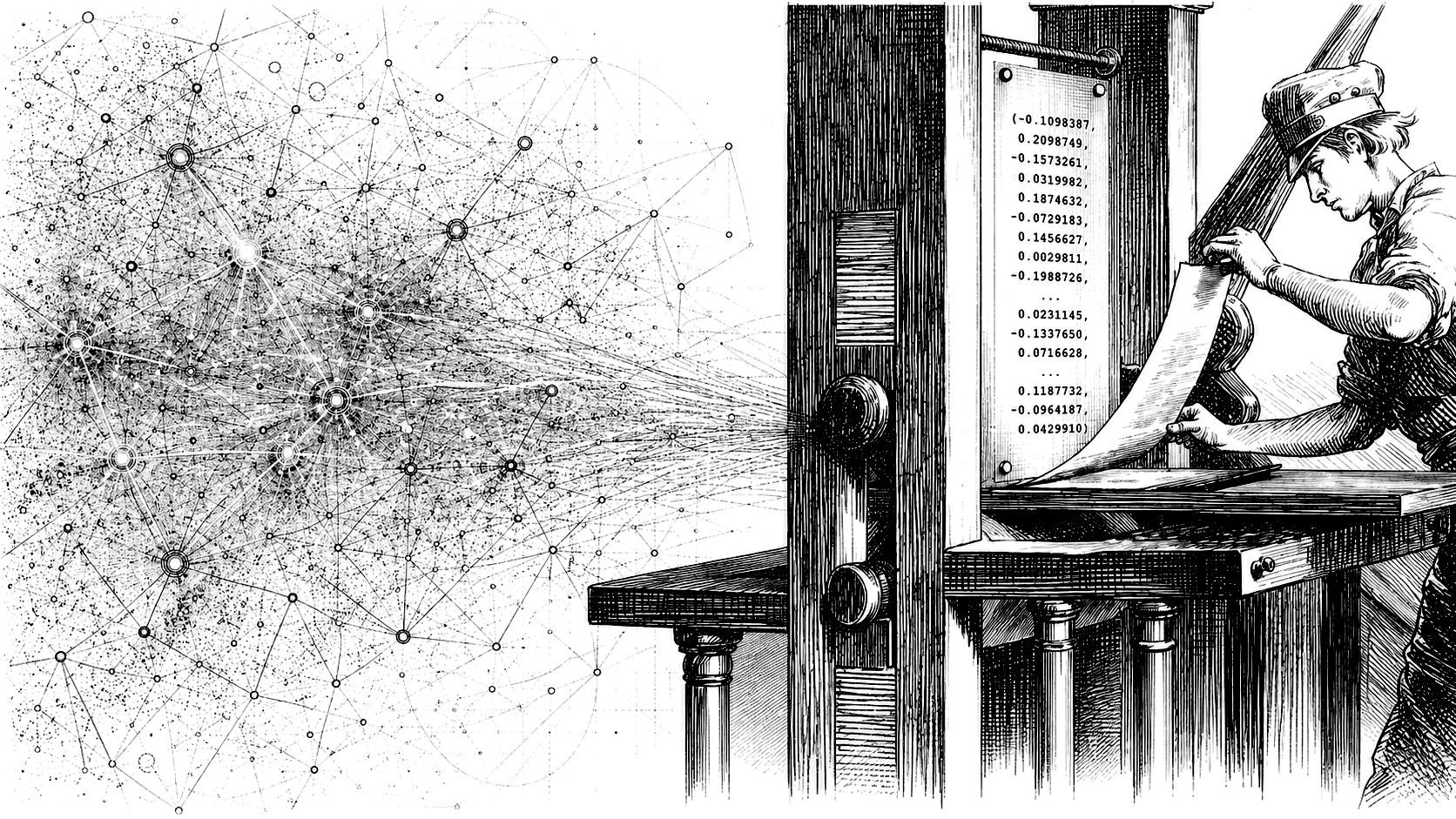
"Equality isolates and weakens men, but the press places at the side of each[...] a very powerful arm that [...they...] can make use of. [... It] permits him to call to his aid all[...] fellow citizens and all who are like him. Printing hastened the progress of equality, and it is one of its best…

read essay →

Infinite Monkeys

· 791 words

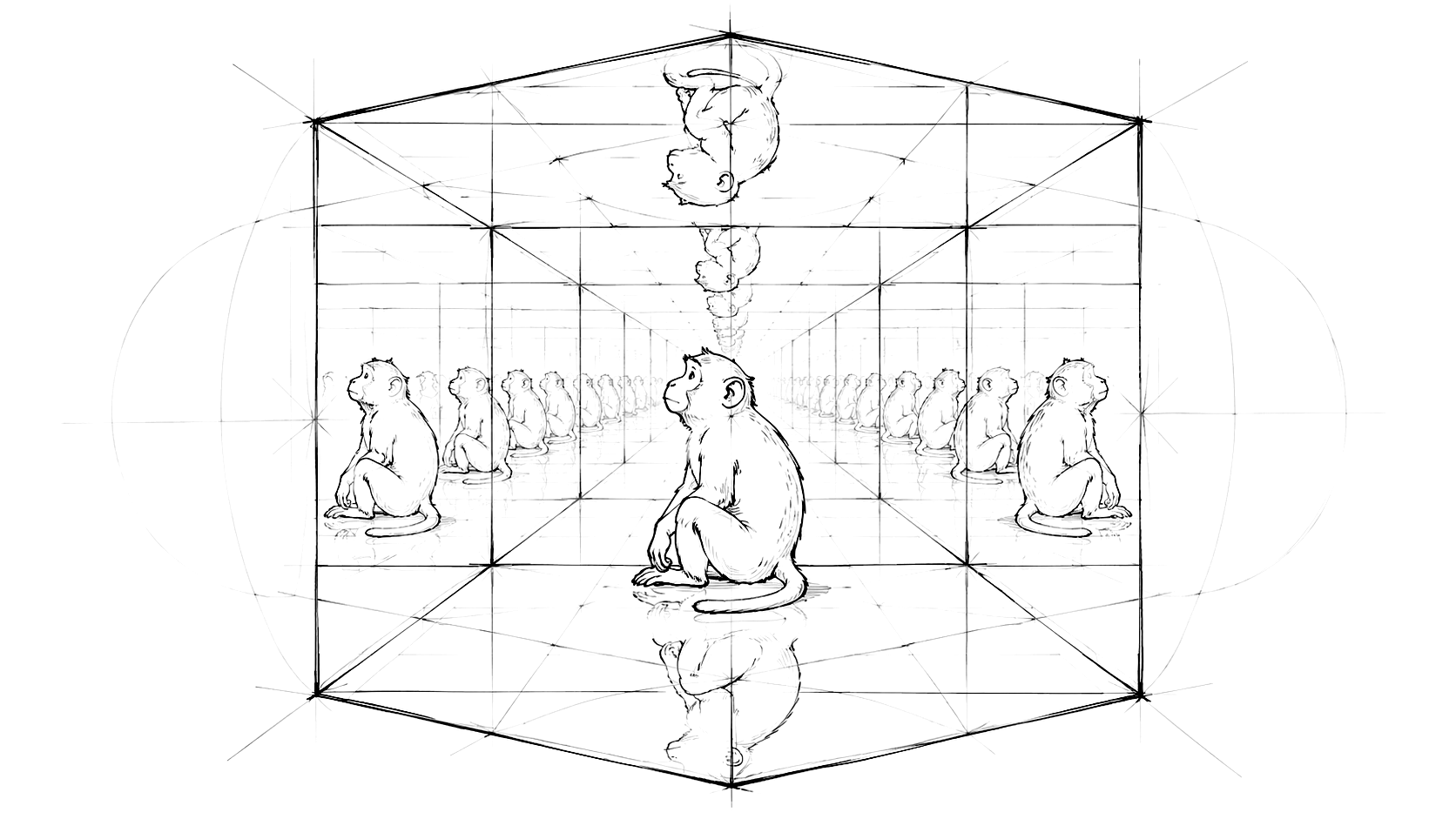
The infinite monkey theorem is often stated as, “if you give an infinite amount of monkeys an infinite number of time, one of them will eventually write Hamlet.” This is very off. I assume most people think it’s off because they know monkeys can’t write (which misses the point). I think it’s off in the other direction; it misunderstands what happens when you multiply infinite x infinite. You won’t just get one Hamlet; you’d get a whole lot more.

Let’s start with a single infinite: a monkey with infinite time. Imagine putting said monkey in a magic bubble that gives him immortality, endless focus to type random characters, and the ability to survive the death of all universes, quantum foam, or whatever. This monkey has a lot of time. Endless time. He won’t just write Hamlet once, he’ll write it many times. Actually, infinite times. Sometimes the monkey will go several million/billion/trillion years without writing Hamlet, but that’s okay because he’s on adderall, can’t die, and has only one job.

Now imagine there are infinite monkeys, too. In every frame of reality (assume this an Unreal Engine monkey simulator running at 120 FPS), the Creator can spawn monkey bubbles, 2 or 2 trillion bubbles, or however many bubbles are necessary for one of them to begin writing Hamlet in that moment. Then in the next frame (0.0083 seconds later), more monkeys are spawned until one of them starts Hamlet too. Over and over. (What we do with all the unsuccessful monkeys is a different problem.) Since all of these monkeys have internet, there are 432,000 Hamlet uploads every hour. And if these infinite monkeys started at the dawn of our universe, they would have written Hamlet 2.18×10^20 times.

The big idea is that when you multiply infinite x infinite, not only does the unlikely thing happen, but it becomes the new grammar of reality.

This thought experiment feels prescient now, because, of course, AI. While agents can replicate & work at radical speeds, it’s not literally infinite. Even if some monkey virus infected every computer on Earth, and did a years worth of work in a day, that’s still finite. But even if you multiply an astronomical x an astronomical, or even just a very big x very big, a similar effect happens: the unlikely thing becomes omnipresent.

I first started to notice this in the Sora app (which I haven’t heard about in months BTW). If you’re familiar with the “Wazzup” 1999 Budweiser commercial, you might remember that it involves two guys yelling “ZUUUUP” into a phone, with the video rapidly cutting back and forth between them. Now, you can prompt anyone into that meme. And so you can just swipe right and find the LOTR cast going “ZUUUUP,” and all the American presidents going “ZUUUUP,” and every member of the animal and pokemon kingdom going “ZUUUUP,” and everyone in your phonebook who uploaded their likeness to the app going “ZUUUUUUP,” as if every conceivable piece of media, IP, and matter just collapsed into this singular point, an arbitrarily selected commercial from 25 years ago.

Now this is a simple, harmless example. But it gets weirder when you imagine a single person’s intentions leveraged to such an extraordinary degree that they become the entirety of the Internet. It would be like, after I publish this note, all the comments came from fake accounts based on real people I know, but they each post a link to a version of Hamlet where all the characters are monkeys. And then I go to Reddit, or check my email, or listen to my voicemail, and it’s just monkey Hamlet everywhere. This is an exaggeration, but I’m trying to make a point that is something like an offshoot of the dead Internet theory. It won’t just be fake AI stuff that tries to blend in, but an assault of the bizzare, a thousand oddly specific info-viruses that we won’t be able to escape, orchestrated towards various ends that we won’t be able to wrap our heads around.

I generally don’t think the open Internet, as it’s designed today, will be able to stand it. I also don’t think that’s necessarily a bad thing, because the web today has ossified and enshittified and is probably due for a shakeup. I do think there will be some chaos/danger ahead, and we’ll have to each figure out how to navigate that safely, but I imagine we’ll reassemble into smaller communities, sheltered from the near-infinite, where you trust/know the 15-150 people involved, within the Dunbar limit. From this disaggregation, I think there’s a slow path of building back better and bot-resistant, and it’ll possibly be a much better place than the before-infinite-monkey times.

→ source

Software Incentives

· 449 words

One of the thrills of the AI revolution will be how it untangles software from bad incentives. Today, software is expensive to build and maintain, and so it needs returns to fund itself. The big social media companies have annual expenses of $50m-$50b; they are in no position to operate from virtues, or to deliver on their stated aspirations of “connecting the world,” because they need to optimize for attention and convert it to revenue to fund the ridiculous scale of the operation.

But now we’ve hit the point where autonomous coding is real: Claude’s Opus 4.5 can code for 30 hours straight. I am currently “rebuilding Circle,” the community platform, except not as a platform, but as a single customized instance for my community (Essay Club). I am maybe 4 hours in and half way done. Circle wanted $1k/year, so I built my own with a $20/mo Cursor subscription.

When you can just prompt software into existence, you don’t need fundraising, an expanding team, and all the sacrifices that come with capital. Software can start reflecting the will of visionaries, rather than the exploited psyches of the masses. Of course, AI coding will also enable huckster bot swarms to sell Candy Crush clones and other brain rot variants, but more importantly I think we’re entering a new era of techno-activism.

Millions will use their weekends to spin up apps, sites, tools, platforms, and networks, not for the sake of colonizing the planet’s attention, but for the sake of gift-giving or mischief-making or culture-shaping. It could mean that we shift our attention from hyper-commoditized feeds to mission-driven places.

Today, I think a single person could spin up a million-person writing-based network for under $100k/year (my guess is that’s <0.2% of Substack’s cost). If you clone something exactly (like Twitter>Bluesky), there’s little reason to switch because you lose the network effects. But the oozification of code & interface means that we can start experimenting with better social architectures. How might a network built for human flourishing actually function? A novel concept paired with a small critical mass (just a few hundred people) might be enough to trigger a cascade of platform switching.

The irony is that AI coding is only possible because big companies have been able to amass extreme amounts of capital, resources, and data, but in doing so they’ve released something that could erode their own monopolies on attention, the last scarce resource. Now I think it comes down to what people decide to build. If everyone can build anything, will we each try to build our own empire of extraction, or will we contribute to a culture we want to live in ourselves?

→ source