michael-dean-k/

Topic

paradox

5 pieces

Notes on the permanent underclass

· 2006 words
  1. A HYPE TERM: "Permanent underclass" is a dramatic mutation of an old term: class inequality. "Underclass" was coined in 1963 (Gunnar Mydral in Challenge to Affluence) and captured the anxiety of automation destroying common jobs. Now that AI is here in a real way, we can't help but imagine the irreversible evisceration of all jobs. When people say "you have 2-3 years to escape the permanent underclass," they mean that this is your last chance to build wealth, because in post AGI-economics, humans don't have economic relevance anymore. Employers employ agents (and eventually robots) instead. And so what will we do with all the meat bodies? The speculation has shades of darkness that start with mass employment, and spiral into feudalism, slavery, and even genocide. The uncertainty is real, but it gets delirious, and often ignores history, and also the many self-stabilizing mechanisms that get triggered on route to a collapse.
  2. MIDDLE CLASS ANOMALY: The real fear here is "the collapse of the middle class," which sounds like a news headline. But separate from AI, my generation is certainly already feeling it. My wife's grandfather was a painter (of houses) and got a million-dollar house (in today's terms) for $10,000. Now people are saying $100k/yr is the new poverty line. While this certainly feels like "the system has screwed us," middle classes are an anomaly, and a mass middle-class—what we had post WW2—is extremely rare. They existed in Athens, Rome, Byzantium, etc. but they were often in isolated cities (ie: Florence at 70,000 people), compared to the Han China Dynasty (100,000,000 people in a two-tier system). The total number of human-years in a middle class is probably around 5%. The relative size of our middle class is even more rare: pre-Industrialization, it was 10-30% of society, where ours is 50-70%. And finally, a middle class rarely persists: it either disintegrates back into an two-tier king/serf system, or, it's forced to transform it's method of work.
  3. FROM WORK TO PERSONAL WORKFORCE: AI will force a change in how next generation's middle class works: from employment to entrepreneurship. I think this is the unspoken tension between elites (who are not concerned with the future being filled with new opportunities), and the normal person (who have never earned a dollar outside of a W2 job). Entrepreneurship is maybe the greatest force for class mobility. This is where "new money" comes from. A poor person could become a billionaire if they know how to work the OS of the market. That is an anomaly and not going away! What's changing though is the economic mobility of non-entrepreneurs. The rising tide is reversing (92% of children born in 1940 earned more than their parents, and it's shifting the other way now), and the rapid automation of jobs via AI certainly won't help. I personally don't doubt that most jobs will get automated away, because I run a small business and I don't have the financial abundance to hire humans at the price they need. I've hired graphic designers, editors, and almost software designers, but found that today's AI models were able to do equal or better work, for a fraction of the cost, and are way more nimble to evolve with my evolving needs. Won't every rational business make this tradeoff? The consolation is that the "end of the work," brings a new era where every person has a personal workforce. It may be hard to find a job, but for $100/month you'll have 10-100 agents on hand, and so do you have a vision? So, no, no one will be in a permanent underclass, so long as they can succeed as an entrepreneur. It's as if the rise of AI has taken the startup/entrepreneur model of Silicon Valley, which once was and still is a minority, and scaled that up to become the new paradigm of work. That is better than nothing, but the odds aren't good. Only 0.05% of startups get funding, maybe 20% get a return; small businesses—the more likely path for the average person—also only have a 20% survival rate after 20 years. So again it's not the decimation of a middle class, but a contraction of the rare post-war middle class (and most middle-classes do emerge after wars) from 60% down to the historical norm of 20%.
  4. REVOLUTION UNLIKELY: The relative size of the lower class isn't necessarily associated with unemployment or risk of revolution. Consider how Mexico has ~70% lower class but only 3% unemployment. I guess the important question for stability in America is if, after AI automation, gig jobs can sustain people who lose their current jobs. 10-20% unemployment would lead to political instability, and 20-30% would create the situation where a revolution could form. If you read Tocqueville (or Brinton or Goldstone, who I haven't read), he says that beyond economics, a few things are required for revolution: an under-utilized but educated youth, elite extraction during widespread suffering, failed reform attempts, defection of intellectuals, coordination capacity... we seem to have all of these. He also notes that revolutions don't come from a collapse of the middle class, but from a perceived sense of being excluded from a new economic order (ie: massive gains from AI, hoarded by a few companies). But Tocqueville also says that the original American Revolution succeeded because we were able to retreat to open space, where the French Revolution failed because it was an open clash within the territory of the aristocracy. If there were a revolution here, it would almost definitely be thwarted, considering NSA surveillance, military power, geographic dispersion, and how most conflict is absorbed into left-right political feuds instead of up-down class feuds. So instead of class war, what's more likely in America is political warfare (underway), which in the worst case leads to authoritarian capture and state fragmentation. A civil war is a distraction from a revolution. The eeriness of all this is that it's right on schedule according to the Strauss-Howe theory; they mapped revolutions going back in 80 years cycles (American Revolution > Civil War > WW2), and predicted 2026 as a crisis that would spawn the next world order.
  5. PROPHETS OF REDISTRIBUTION: So if there is massive job loss and social strife, but no potential for revolution, how will the elites respond? The cynical view is that they will retreat into their already-constructed drone-protected bunkers and let the mess sort itself out. The optimistic view is that the entrepreneurs who are triggering the AI revolution are actually problem solvers at heart, and once or if the AI race is ever "over," they will be unimaginably wealthy and eager to play the role of utopian planners to restructure society in their image. Will elites side with the common man? It's happened. Voltaire was a French intellectual who died a decade before the French Revolution, but through his salons he injected ideas of equality, liberty, and reason into the aristocracy. It was like a Trojan Horse, because the elites became enamored with ideas that undermine aristocracy without realizing, and so they were quick to defect and enable the revolution. In terms of the Strauss-How cycle, Voltaire was a Second Turning "awakening prophet" that laid the spiritual grounding for the Fourth Turning of that time. The parallel to our time is the 1960s, where counter-cultural ideas about communal living, redistribution, and the end of work were forged; and also the very fabric of computing, the Internet, and AI all came out of the consciousness revolution—the sway of egalitarian-minded intellectuals could determine how the elite allocate their trillions. What we're facing is something like a crisis in capitalism. If the market is left to its own terms, with everyone on Polymarket "trading the madness," then it could turn Landian (re: Nick Land's vision for markets as inhuman alienating forces). Or, hyper-capitalism pushed to it's limits just turns into Marxism, and the counter-cultural ethos of the 60s gets fully mainstreamed (it's already in progress: hitchhiking turned to Uber, free love to Tinder, pad crashing to AirBnB, freak foods to Whole Foods).
  6. PAID TO SCROLL: But who will be doing the redistribution and why? I'm skeptical of a "universal basic income," which implies a world government (if you take "universal" seriously). Each country will have different policies on distribution (aka: welfare). We'll likely see a range of implementation, some being highly dysfunctional welfare states, and others being prototypes of a modern democratic socialism. Realistically though, governments will only have the means to redistribute any wealth if they seize and nationalize the AI companies (which Palantir's Karp is suggesting needs to happen). But if we go the way of The Sovereign Individual (where Thiel wrote the forward), it means that companies will replace governments, and lead us to a kind of lawless "anarcho-capitalism." And so in this model, what would elites do? Bunkers or philanthropy? Will Anthropic be anthropic? (We already know OpenAI didn't live up to their name). I think there's a more practical middle, where companies will be incentivized to provide "UBI" themselves. Assuming everything doesn't collapse into a singleton-powered mono-corp, there will still be 3-10 big companies competing, but now with massive budgets. What they used to spend on employees is now automated for a fraction of the cost, and so they might chose to re-allocate that budget to paying citizens, or really, their users. Attention is the last scarce resource, and so by paying users to lock in to their platforms (using their feeds, apps, cars, etc.), they hold that advantage over their competitors. I know that sounds extremely circular, but is not the current AI economy already circular? Is NVIDIA not paying OpenAI to buy their chips? And so why wouldn't OpenAI pay users to pay for their AGI?
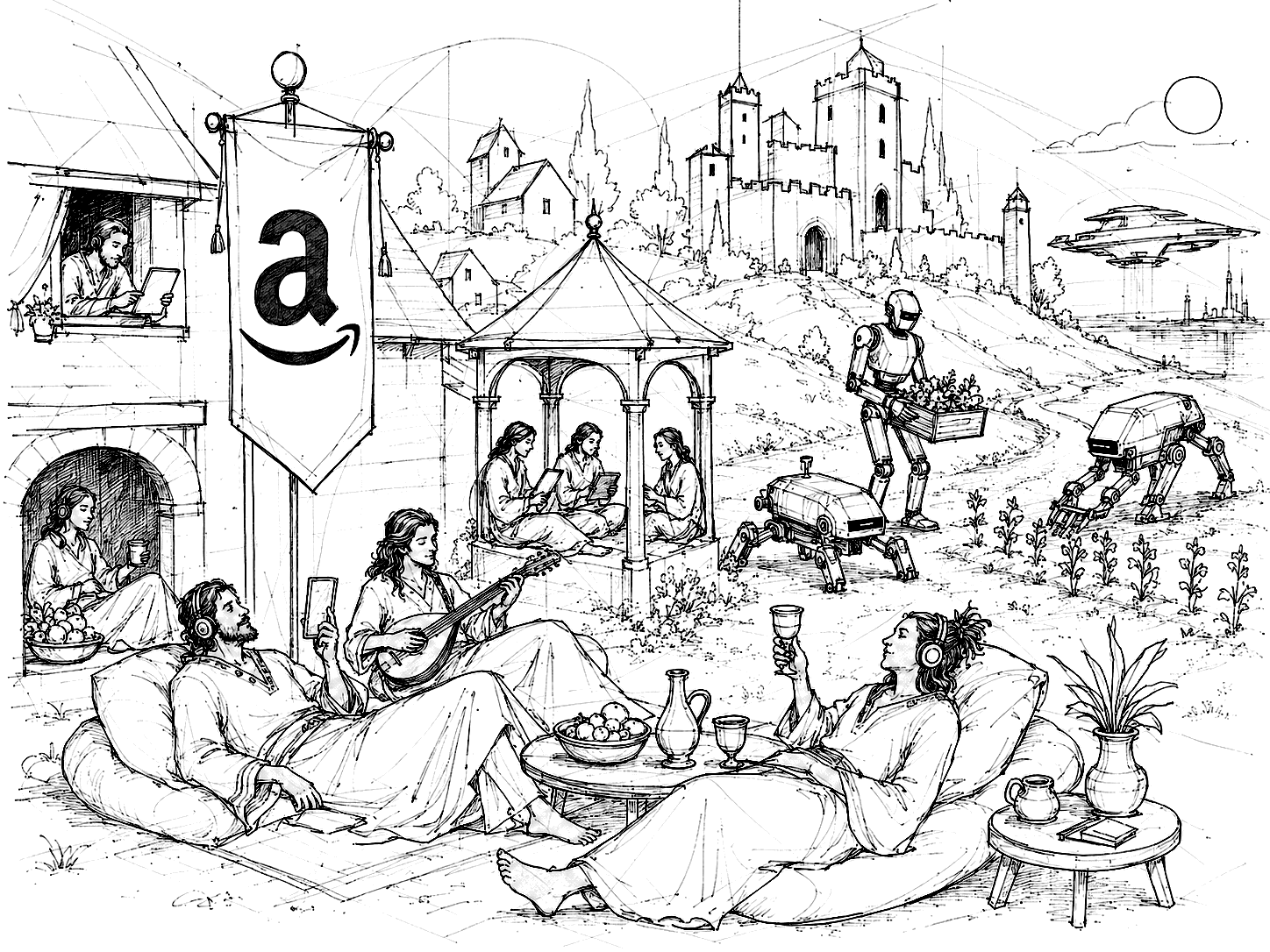
  7. NOT SERFS, BUT HIPPIES: If AGI/ASI does bring upon all the sci-fi advances we dream of, then we could see a dramatic cost collapse in everything: materials, medicine, food, energy. It could be trivial for a company to provide all the basic luxuries of living for little or no cost, but in exchange for loyalty. So to bring this back to the permanent underclass: the elite-backed companies, in order to prevent revolution and to beat competitors, could be rationally incentivized to offer a luxury quality of life to its users. What's strange though is that it's luxury without mobility. Meaning, the average person could be provided a sweet apartment and unlimited Grubhub, in exchange not for labor, but loyalty. They might not have the discretionary freedom to do things outside of what's in "the contract" (rings of indentured servitude, but with air conditioning!). ie: Your plan might include a free train and bus pass, but if you want to fly to Europe, you need to grind at gig work for 6 months to get actual money, since the plan offers only amenities. Different communes, I mean... companies... will offer different deals, and if one offers a yearly international vacation (possible by some fuel breakthrough), the others will follow. The citizen will have the freedom to pledge freely, which would make this not like socialism, but the first ever manifestation of communism. We confuse those terms: socialism is when all power is absorbed by the state, where communism is actually stateless and decentralized. North Korea, the USSR, and Maoist China were not communist, but socialist. Communism was Marx's ideal, and he would've never conceived that the path to the first instance of communism was through hyper-capitalism (though of course an alien bastardized version that he would probably hate). And to bring this back to the spirit of the 1960s, heavily anchored in communal ideas: the "permanent underclass," will be a lot less like being a serf and a lot more like being a hippy. Except more like a state-sponsored, highly-surveilled, find-your-meaning-through-our-menu-of-options hippies, with of course competing hippy factions, the permaculturists, the hedonists, the transhumanists, the bloboids, the transcendentalists, the academics, but shared among all of them is a new identity that is decorrelated with their economic value, and more anchored to new social systems of vainglory that are hard to imagine.

The Semantic Press

Reimagining Tocqueville's remedy to tutelary power in the age of AI

· 500 words

Submitted to an essay prize by the Cosmos Institute. The prompt: Tocqueville warned of a “tutelary power” that would keep citizens in perpetual childhood. How have Tocqueville’s concerns migrated from institutions to algorithms, and does AI fulfill or transform this fear?

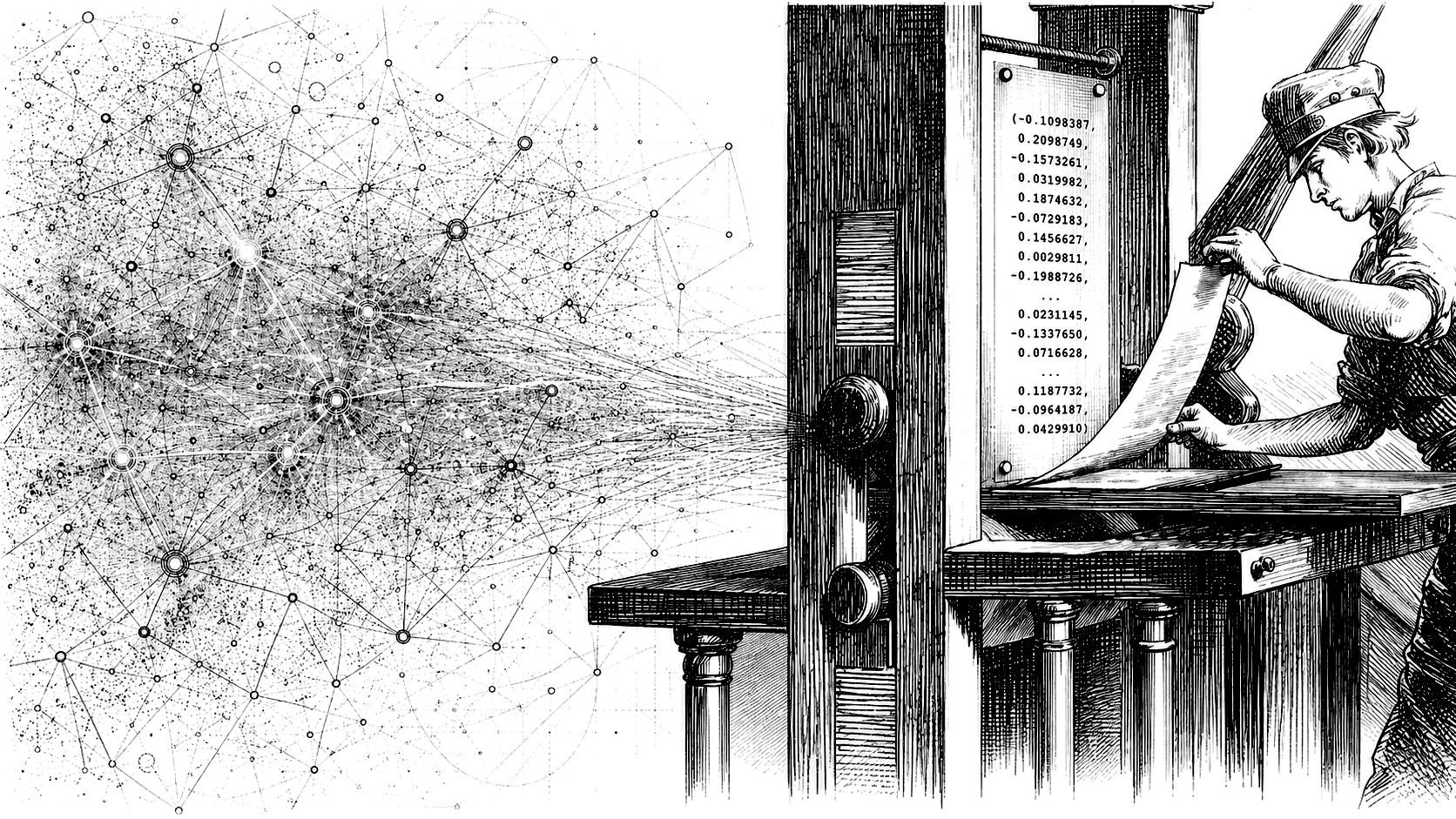
"Equality isolates and weakens men, but the press places at the side of each[...] a very powerful arm that [...they...] can make use of. [... It] permits him to call to his aid all[...] fellow citizens and all who are like him. Printing hastened the progress of equality, and it is one of its best…

read essay →

Experimental

· 190 words

I like the word experimental because it fuses two halves of a process we don't usually link. What we typically mean is divergence, deviance, tinkering, norm-breaking. Weird stuff. Think avant-garde John Cage soundscapes where he makes music with only kitchen appliances. But also, the word points directly to the scientific process: to run an experiment means to set boundaries, gather insights, and test a hypothesis. Either mode alone falls short. Endless mutations burn you out, and rigid systems can't take you anywhere interesting.

Many of the original experimental artists were scientific. Kandinsky didn't just make abstract shapes, he developed a systematic theory on how colors/geometry provoked specific feelings, and then at the Bauhaus he used questionnaires to test which of his theories were true. I don't know exactly when this happened, but as weird works became mainstream, the word shifted from a process to a genre; the way it was made mattered less than the fact that it was unusual.

Experimental drifted into a contronym, a single word that contains opposite meanings. The power in the word comes when you re-unite both halves, entering strange territory with an analytical eye.

→ source

Self-Deception

· 387 words

I've always thought 'writing shows you what you think and editing helps you change your mind'—and maybe that’s a decent heuristic—but it’s more complicated than that. I think it’s possible for writing to do the opposite of what we hope, to lead to self-deception. A few thoughts on how:

  1. Premature convergence: When you start drafting, you unlock a new stream of thoughts, but once you find a new center of gravity (a potential thesis), it’s common for all further thoughts to reinforce the thing you happened to stumble on, regardless of its substance. Beyond a point, writing can ossify & lock you into a frame.

  2. Aesthetic attachment: Once you’re trying to make a ‘good’ essay around your thesis, it’s easy to become enamored by phrases, sentences, images, and sources. Expression (vibes/voice) is an entirely different thing than thinking. You can dress up a static/wrong thought to be beautiful/persuasive.

  3. The sunk cost fallacy: after you spend hours on an essay and share it, it’s likely that you’ll continue to believe it. If you’re wrong, you’ll have ‘wasted’ that time. If you change your mind, your readers will have an outdated model of you (OFC, views evolve over time, but I wonder if publishing leads to short-term friction in your evolution).

One possible way around this is to, as soon as you think you found your thesis, to rigorously consider and explore the antithesis (not as a rhetorical strawman, but to really, earnestly, consider the opposite). It means a given draft will be scatter-brained and contradictory, but it’s how you find a synthesis, a more refined thesis. And once you find that, you start over, and repeat, until you end up somewhere that is far more nuanced, interesting, and weird than where you started.

The thing I’m grasping at is that thinking & expression are often at odds, and before you commit to an idea worth expressing, you need to go through rounds of unglamorous self-interrogation. There is probably a mode where thinking _is_expression, but the risk is not wanting to shed something that is elegantly said. One way through this it to get meta and explicitly express your doubt and your evolving POV; I think this is what separates essays from articles and propaganda, and it stops you from brainwashing yourself.

→ source

Wicked problems require paradoxical solutions

· 470 words

In "wicked domains," the only solutions are paradoxes.. It requires you to sleep with the enemy. If a problem is wicker, it means no single solution can unfuck a problem. It's an imbroglio. In every solution, everyone dies (in the extreme). Politically, the solution to wickedness is to somehow become all sides at once. We need to become far more authoritarian than is comfortable, AND simultaneously, far more libertarian than comfortable (these are opposites on the Nolan chart). It’s the paradox of being both far left and far right. We can longer exist at any one point on the Nolan chart, we need to straddle the entire diamond. We need unexpected fusions to solve the hardest problems; harnessing the best parts of each extreme, while, somehow, devising incredibly nuanced architectures to prevent the known and likely abuses.

Instead of a diamond, visualize it as a ring around the “radical center” that aims to synthesize all opposites.

Let’s assume authoritarianism and libertarianism are opposites. We have kings, and we have markets. How do you subsume a free market within a benevolent tyrant? I know the K-word (king) has a charge now, and so by even bringing this up, I assume you assume I’m a Trump apologist or something. But actually no. Rather, this comes from the fear of acceleration and Nick Land’s conclusions on capitalism. A free-market pushed to the extremes of automation creates an inhuman and pulverizing force. Alternatively, as we approach AGI/ASI, it’s possible for someone to create an open-source machine God to follow their whims. In this paradigm, decentralization might actually be more dangerous than tyranny, and so we’ll all need to unite under some centralized system that has an antibodies that can protect against the worst possible viruses (please bear the oversimplifications here...).

The general gist comes in this question: can we recreate a free-market economy within a one-world-government system, and design it in a way to prevent abuses from both ends of the spectrum? Obviously, not an ideal situation, but I think accepting paradox is the only way through.

Another problem: How do we fix the debt? Extreme taxation. But then how do we make it worthwhile to pay taxes? The rich gain formal power in government (via equity?) and the ability to control the budget (after base expenses are paid). But then how do you prevent abuses from the wealthy? You could have citizens operate as a check, to vote on and weight final allocations.

If it were ever possible to rebuild political system from scratch, I suppose it would look something like this. Paradoxical. Extreme on both poles. Obvious downsides, but then complex architecture to mitigate. This is the nature of how our species will have to respond to wicker problems and mitigate the abuses of power in the age of exponential tech.