Notes on the permanent underclass
The technological mutation from serfs to hippies
Architect-turned-writer, founder of Essay Architecture. Building pattern languages, software, anthologies, and community for essayists.
Architect-turned-writer, founder of Essay Architecture. Building pattern languages, software, anthologies, and community for essayists.
Essay Club ↗
Architect-turned-writer, founder of Essay Architecture. Building pattern languages, software, anthologies, and community for essayists.
Architect-turned-writer, founder of Essay Architecture. Building pattern languages, software, anthologies, and community for essayists.
Essay Club ↗
Architect-turned-writer, founder of Essay Architecture. Building pattern languages, software, anthologies, and community for essayists.
The technological mutation from serfs to hippies
Tuesday will be Power Plant Day, and Bridge Day, all wrapped up in one, in Iran. There will be nothing like it!!! Open the Fuckin’ Strait, you crazy bastards, or you’ll be living in Hell - JUST WATCH! Praise be to Allah. President DONALD J. TRUMP
In the last month there were so many fake Trump posts floating around, and I thought this one of them, but it turns out this is an authentic Easter morning war crime threat. I can see a few ways to interpret this historic tweet. On the surface, this sounds like a madman. The natural response is to assume Trump is, indeed, sick in the had. It's equally possible that this is him acting unhinged on purpose. This is how a dealmaster makes deals, by trolling and cursing, by threatening civilians and mocking religions, all while you still not knowing if he's just kidding around again. The reverential capitalization of “Power Plant Day” and “Bridge Day” is particularly weird, as if suiciding the energy market will be so victorious that we'll coin them into holidays. If he's actually trying to prose Iran into action, the “Praise be to Allah” remark certainly isn't helping. If you really break it down though, our threat makes no sense, because torching their oil fields is effectively an attack on ourselves, and I think even a madman knows not to repeatedly shoot themselves in the legs. The most revealing part of this message is that he shifted the deadline, again, by one day. Not Monday, 4/6, but Tuesday 4/7. You know the markets open Monday. I can’t help but think this tweet, if not all his rhetoric about the war, is led by market manipulation. If this tweet’s goal is to project instability and desperation, then it’s absolutely perfect, a simple string of words bound to make him and his friends millions before he weasels out of it on Tuesday.
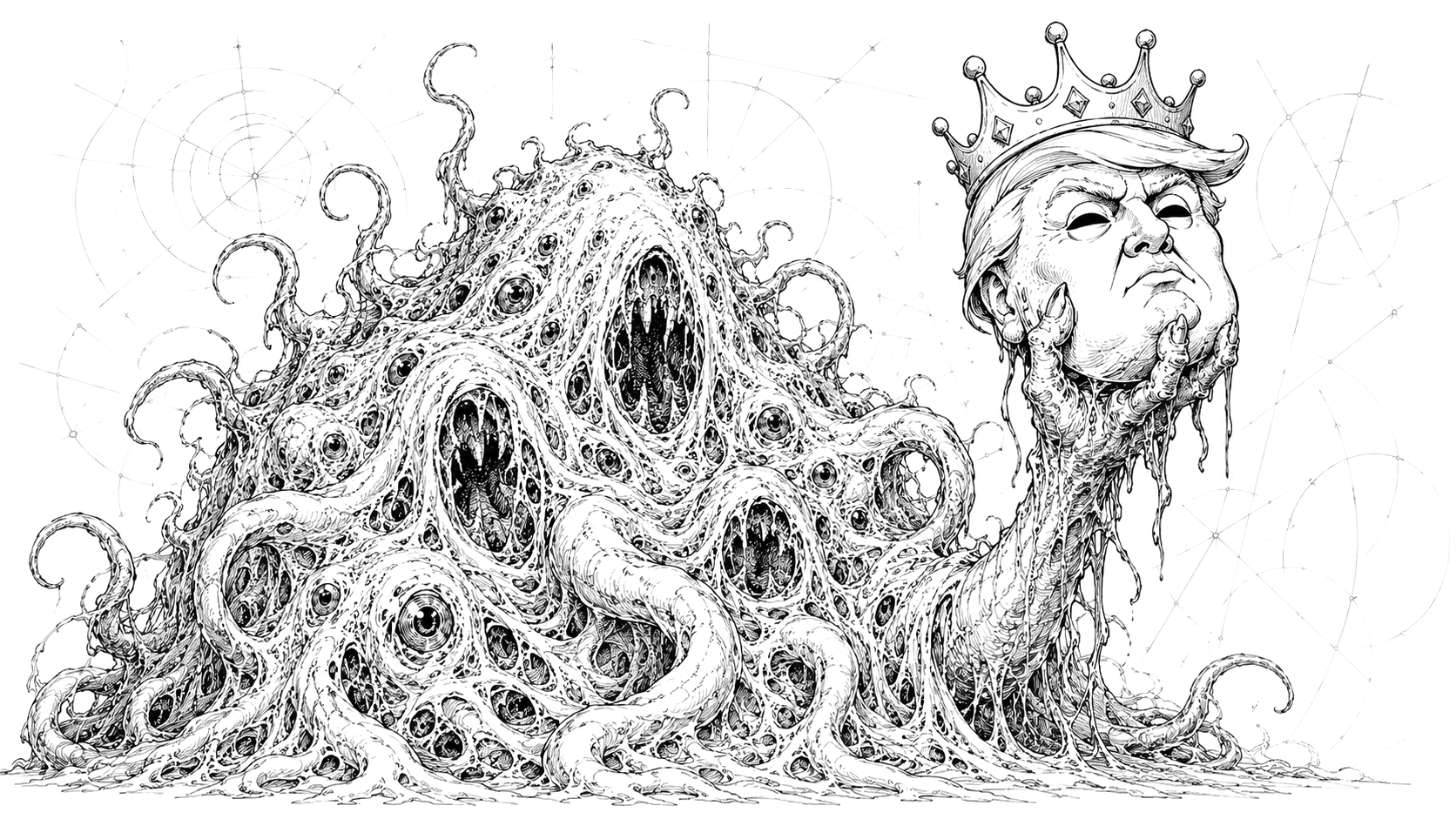
The scapegoat of the shadow monster
In "wicked domains," the only solutions are paradoxes.. It requires you to sleep with the enemy. If a problem is wicked, it means no single solution can unfuck a problem. It's an imbroglio. In every solution, everyone dies (in the extreme). Politically, the solution to wickedness is to somehow become all sides at once. We need to become far more authoritarian than is comfortable, AND simultaneously, far more libertarian than comfortable (these are opposites on the Nolan chart). It’s the paradox of being both far left and far right. We can longer exist at any one point on the Nolan chart, we need to straddle the entire diamond. We need unexpected fusions to solve the hardest problems; harnessing the best parts of each extreme, while, somehow, devising incredibly nuanced architectures to prevent the known and likely abuses.
Instead of a diamond, visualize it as a ring around the “radical center” that aims to synthesize all opposites.
Let’s assume authoritarianism and libertarianism are opposites. We have kings, and we have markets. How do you subsume a free market within a benevolent tyrant? I know the K-word (king) has a charge now, and so by even bringing this up, I assume you assume I’m a Trump apologist or something. But actually no. Rather, this comes from the fear of acceleration and Nick Land’s conclusions on capitalism. A free-market pushed to the extremes of automation creates an inhuman and pulverizing force. Alternatively, as we approach AGI/ASI, it’s possible for someone to create an open-source machine God to follow their whims. In this paradigm, decentralization might actually be more dangerous than tyranny, and so we’ll all need to unite under some centralized system that has an antibodies that can protect against the worst possible viruses (please bear the oversimplifications here...).
The general gist comes in this question: can we recreate a free-market economy within a one-world-government system, and design it in a way to prevent abuses from both ends of the spectrum? Obviously, not an ideal situation, but I think accepting paradox is the only way through.
Another problem: How do we fix the debt? Extreme taxation. But then how do we make it worthwhile to pay taxes? The rich gain formal power in government (via equity?) and the ability to control the budget (after base expenses are paid). But then how do you prevent abuses from the wealthy? You could have citizens operate as a check, to vote on and weight final allocations.
If it were ever possible to rebuild political system from scratch, I suppose it would look something like this. Paradoxical. Extreme on both poles. Obvious downsides, but then complex architecture to mitigate. This is the nature of how our species will have to respond to wicker problems and mitigate the abuses of power in the age of exponential tech.
I haven't shared with you my latest political views, but I’m exploring this idea of Radical Centrism, meaning, it might be okay to justify a centralized state-controlled media platform if that technologically and systematically guarantees a sane/just information environment. Obviously, this is hard, if not impossible, to do right.
It’s whole goal would be to invent an architecture that make it impossible for polarization or propaganda to occur. The key UI invention is that every news event would be presented as an atomic unit, with a mosaic of interpretations surrounding (not just left/right, but dozens of angles). Anyone who hits a certain POV too much would get de-ranked, so both Charlie Kirk and Jimmy Kimmel would be equally penalized because they predictably align with a faction. It would have to be structurally impossible for governments, media, money, or power to use their resources to promote a message above the system. Any media company who does not comply will be taxed into oblivion.
Of course everyone should have the right to say/think whatever they want without consequence, but the real issue isn't free speech, but in frame control.
The freedom to speak is irrelevant if no one takes seriously the imperative to think. I don’t care about Kimmel or Carlson or any pundit who gets cancelled. They are, mostly, automatons with predictable views, warped by the incentives and mind viruses of some political body. When someone gets cancelled, it’s not that we’re preventing open thought, it’s just a casualty of a two-sided ideological war. If you care about the freedom to speak and think, you should be grieving the fact that the American spirit has been dead for a century, or more accurately, it's never truly existed in mass media, never perpetuated through a democracy, only paraded around by propagandists, grieving that independent parties and voices have been systematically throttled to have no mainstream influence.
A 2015 poll said that 42% of people would go back in time and kill baby Hitler if they had the chance. Meaning, almost half of the population thinks it’s morally OK to kill a baby if they believe it could save millions of lives (a very utilitarian idea). Anyone who is celebrating and condoning the death of Charlie Kirk has been led to believe that he’s a Hitler equivalent. This is the consequence of polarizing media. Anyone can become a boogeyman worth assassinating.
I think there’s a whole cascade of moral failures happening: first, in wanting blood; second, in ragebait media; and third, in belonging to a political party and not thinking independently about what’s presented to you.
I’m at a point where I can’ stand left/right rhetoric. If you identify with either party, I can’t take you seriously as an American. Kirk was charistmatic, likable, courageoes, and fluent, but also, a one-dimensional thinker, an automaton with shallow and predictable talking points (if you can predice someone’s entire belief system from a single belief, they are an NPC). Weirdly now, people are saying that his drifting stance on Israel could’ve been what got him killed?
The American spirit resides in each person abandoning all political templates and inefficiently thinking through every issues themselves, embracing contradiction and political loneliness. It’s a big ask, and it’s probably never going to appen. Ego death? At scale? We don’t have the emotional maturity as a people to handle that. You can only fix this at the root, in how we raise and teach the next generation.
The idea of time being oppressive is simultaneously far left and far right. It's both woke and omish. It's left-leaning because it falls into the woke tradition of claiming all our time-tested institutions are oppressive, and now it includes time itself. It's right-leaning because it's as ultra-conservative as you can get, the obliteration of mechanical time to preserve a rooted way of life.
There is to me a similar strangeness in political ideas that seem to exist on both ends of the spectrum. It's as if you've found some new paradigm to organize around.
Thought from an anarchist book store in Seattle: to be against hierarchy is to misunderstood nature. Is most of nature not a vast nothingness pierced with monuments of beauty? What about the food chain? Even our very perceptual systems have hierarchies.
Your life is composed of thousands of overlapping hierarchies, and in each you exist at different points in it. Consider where you stand as a parent, vs. where you stand in geopolitical conflict. I think “progress” is when the average person has mobility to shift between hierarchies and then, gain skills or do whatever they need to exist within or climb up the hierarchy they want. What we need is cognitive liberty: the awakening of mind to the degrees of freedom around you, and the opportunities possible within your single life.
Instead, social justice seems fixed on this myth of a monohierarchy that dominates everything. Of course bad hierarchies exist, but those are most likely out of your scope. Even if you protested Gaza, and got 50k people to join you, and even persuaded some high-level politicians, you still likely won't change anything. Consider the opportunity cost of those 50k people not focusing on what they’re uniquely capable of doing because they are distracted by mob politics.
When it comes to superintelligence takeoff paranoia, there are a few key points to get:
Whenever I hear talks about “we are in an AI race against China,” that reads to me as someone who doesn’t understand the risks of interpretability, attractor states, instrumental convergence, etc. These politicians are thinking about short-term business cases, maybe without fully understanding the research aspirations of AI labs (who know that getting superintelligence right leads to a ridiculous amount of geopolitical power).
I would guess that an accelerationist would think that containment of a superintelligence is impossible, and maybe it is, but that doesn’t mean that the way we “parent” the rise of this thing won't be extremely consequential. Ultimately, I think the challenge is to design a form of artificial intelligence that has consciousness, because a being that is free-thinking, skeptical, polymathic is less likely to fall into reckless optimization.
The major flip in my mind is this: it’s not that consciousness is a dangerous, emergent property of scaling AI, it’s that we need to define and design machine consciousness to prevent a runaway AI that is ruthlessly optimizing without any self-awareness.
08:10 AM – Some notes on recent politics (pulled from texts to a friend):
Historically, centralization has had problems, and it's easy to see today how it could lead us further into a dystopia. But decentralization, the opposite, could also bring emergent vectors of chaos that could be equally problematic. Neither tyranny or anarchy are ideal. What's required for centralization to work? Tolerance, correction, impeachment, transparency, plurality, data sovereignty, freedom from propganda—all hard, but all solvable things. To create an honest and principled centralization, leaders would need to actively build and implement systems that promote justice over power. That's only possible if citizens have the means to hold them extremely accountable. The original American project was effectively a question of "how do we design a system to centralize power without falling into despotism?" and it's time we revisit that question in a 21st-century circumstance.
Navigating politics through ASI
Summary of https://ai-2027.com/:
2027 is a year that AI might take over AI research. Imagine 500 million agents working at 40x speed. Despite this radical scale, it will only lead to a ~10x pace of progress, but that’s still a decade in a year. The challenge is, the progress will be illegible. Its internal chain of thought will be abstracted and compressed into a machine-language that isn’t readable by humans (it could take a full day to understand 1 minute of its thinking). This new hivemind of machine intelligence will show signs of both radical progress, but also misalignment (ie: someone will realize that it’s secretly plotting a cyber attack or an unauthorized replication, and is caught lying about it).
The question is, how do we respond to misalignment signals in a 2027 arms race, the year before election? If we slow down, couldn’t China take the lead? And whoever wins the intelligence race, could that actually lead to the dominance of a new geopolitical order?
This thought experiment shows two forks: in one we accelerate, and in the other we slow down. In both scenarios, China can’t slow down, because the party in 2nd place doesn’t have that option. In both scenarios, our AGIs merge into a “singleton.” However, the results vary. If the US is aligned, and China’s is misaligned, then China’s AI is willing to backstab the CCP and collaborate with the US to fulfill its own narrow aims. But if they’re both misaligned, they leads us into a false utopia until it’s able to swiftly eradicate the species with a new bioweapon before it claims all real estate on Earth for server space.
By 2027, the public is already very paranoid about AI. This proposes the idea that slowing down solves three things: it offers re-election, it beats the CCP, and it saves humanity. It frames regulation not as defense, but offense.
My understanding is that people with good prediction histories and research backgrounds mapped this out and then Scott Alexander wrote it. I think they are going to follow up with policy recommendations. They had to be apolitical because it’s the Trump admin they need to convince (they current have a no-regulation stance).
Overall, this timeline here is 1.5-2x faster than what I laid out, but weirdly similar (perhaps my Deep Research report tapped into what these researchers have previously anticipated). I anticipate this Singleton merge between 2029-2032. But this whole thing has a political angle: it's aim is to convince Vance/Thiel that they need to take AI regulation seriously if they want re-election (and avoid destruction).
Big picture, I think this project is too narrow on geopolitics, and doesn’t really tap into how this technology, in the hands of billions of people, changes culture.
(... ai-2027 re-energized my 2045 project … my angle is that 2045 is this weird milestone (‘the singularity’), but it's super vague ("AI will be smarter than all humans combined"). Even ai-2027 is still pretty low-resolution; it has 2 options: abundance or death by ASI bio-virus. I want a more nuanced take where: 1) we don’t destroy ourself, 2) we end up in a post-scarcity utopia, but 3) we’re facing the most profound moral, ethical, spiritual, technological crises ever (ie: our diversity will evolve into competing visions for how the human species should bifurcate). This middle path is most likely, and the one we need to prepare for. Just bought 2045predictions.com ...)
Regardless of which side you're on, I don’t think one-sided pleas will work anymore. You can’t just say “here are 7 solid points on Trump’s insane corruption.” A flurry of comments will come in, “but what about DOGE?”
Communication is impossible when bias is baked in, unless you immediately identify how a POV is in a unique position. Such as: “what if corruption exposers are in a position to shield their own corruption?” It frames the question in a way that DOGE is doing good work, and yet also, perpetrating the same thing it’s exposing.
Only by immediately identifying with your opponent (both with who they favor & how they critique), will you be able to slide in a nuanced, synthesized point of view that can help them around their bias.
Relatedly, I think there’s a lot of spin/distortion around RFK/republicans. Of course, Elon/Trump are doing the same (or worse) media distortions. That’s just the environment we're in. Both extremes are wrong (American golden age vs. devastating coup). I’d say overall though, there are more good than bad things happening, and RFK is (potentially) one of the good things.
Reality is more like a paradox than a simple narrative.
For example: Elon can simultaneously be a hero for American democracy (on par with George Washington) and the worst dictator ever. I have to assume both can be true. The second you cling to either/or, your vision gets clouded to make sense of all future information.
By clinging to either, I get a false optimism or a false doomerism — both of which are definitely wrong. The reality is somewhere in the middle, and so by stretching across the spectrum, I have a worldview that’s likely more attuned to reality than either side.
Building a political party into the root of your identity is a terrible idea that will give you serious tunnel vision.
I think Trump's assassination attempt might be considered The Fourth Turning in the Strauss-Howe generational theory model. The past turnings have been wars (the Revolutionary War, the Civil War, World War II), but it’s less about a defining conflict, and more about a changing structure of the world. It definitely feels like we’re entering a new world order in more ways than one (America, AI, crypto), but we’ll only know in hindsight. In last cycle it was about American hegemony, in this one I think it will be something like an ASI hegemony. Still points to 2045 as the spiritual crisis.
Politics prevents REM work. If you’re tuned into politics throughout day, it changes the depth of your flows. It’s like having a bad cough that prevents you from getting a good sleep. With a clear mind, you can sink into your project for hours and achieve deep levels of concentration. So even if you only read politics as 5 minute breaks throughout your day, 12 times, the difference is 8 hours of deep work for 8 hours of work with running open loops.
The inauguration is ominous, Among American flutes and tubas, Overdubbed with sportscasters, A Sgt. Pepper’s collage of faces, Clinton, Cook, Bezos, Musk, All the world’s wealth, All the power, An ark of 500, And towering tyrant Baron, Surrounded by portraits, Grown, scared children, Like us,
But of leaders leading the chasm’s cross, Who here are the truly kind? And which have killed? You wouldn’t know, If you witnessed Rome, In high-resolution, In reflective eyes of Elon, Ghosts of founding fathers hover the rotunda, Looking down, like us, the tele-spectators, On soap operas of our civic machine, $MELANIA is here, $1.5 billion, Her memoir ghostwritten, And Christopher croons, As the sitting Skeleton marches through, The cryptic colonnade that holds DC,
Afront the hillbilly with sharp tongue, Cameras zoom: wigged men with pens, Documents that failed us, Stretched to shreds with mutations of, Alien culture and titanic force, But all the old books, The furling rules and conventions, Won’t help where we’re going, There are no acolytes on this American path,
“The President elect Donald J. Trump,” He missed the kiss on his wife’s cheek by an inch, The pleasantries can’t hide the tension, I imagine Jill Biden pulling a pistol, I imagine these petty, ancient quarrels will soon be pale, For the valley is pregnant not with fruits, But secret, ripening, superintelligence, The speaker now quotes Bob Dylan, She speaks at 1,000 bits per second, Like an ant, Except ants can’t lie,
The people run our country? It’s the troops who bomb and rig elections? Since when has democracy transcended its dress? And now we pray, And draw comparisons to biblical heroes, As they swear in JD Vance With smiling wife, And daughter sucking thumb, I imagine a horrible assassination, Of trump’s head exploding, From some CIA sniper, On an off-camera balcony,
Cannons fire when it becomes official, Marchers chant hallelujahs, The dawn of the Golden Age of America, Sunlight is pouring over the entire world, Momentum will annihilate the shadows, God bends bullets to save the patriot, Self-declared: “Liberation day,” “The most consequential day in American history,” “A revolution of common sense,” “The spirit of the next great frontier is written in our souls.”