michael-dean-k/

Archive

October 2025

18 pieces

Is mankind evolutionary chaff?

· 157 words

Emerson said a divine intelligence with a simple cause leads to endless variety. We are, rightly so, locked into humanism, but you also can’t assume that man is the ideal end form of this process. For all we known mankind could be relative devils—violent ants, with only a few angels among us—compared to other potential species from past or future in the unknown nooks of spacetime. We could be the necessary chaff, an evolutionary dead end, that’s iterated through in order to let a truly divine species emerge. I’m not implying this in a post-human sense; in fact, the very possibility of man evolving into a mechanical shell of itself could be the proof that we are not a stable species. Dark, but I do mean this all in a positive, hermetic sense, that we come from a cosmic engine that makes mountains, mice, humans, and psychologies unimaginable, which is our role to evolve into.

Reading in public is rude too

· 166 words

My head is tilted down 60 degrees, and I’m cut off from the people and world around me. My cousin’s cousin was actually in the shop, and I almost missed her. Reading Emerson while waiting online feels extremely rude. Isn’t reading a physical book in public just as bad as reading on your smartphone?

Of course, books aren’t evil. Neither are screens. It’s the action/context mismatch that’s wrong. I guess the problem is that screens make it easy to have all your books with you at all times, and so it’s convenient and normal to be rude.

What you reveal when you say screens are bad for society is that you don’t have the ability to wield tremendous power. It’s not the smartphones to blame, but the apps on them, and so often we realize how mindlessly we install them, and how long we’re willing to be mesmerized by a bad information architecture. When we reach the iOS vibe code singularity, there will be no excuses.

The rewards of rigor

· 199 words

I get the sense that creativity used to be seen as a form of artistic mastery, but in the 1990s, creativity turned into catharsis, therapy, self-help. It’s an “if I don’t do it, I’ll get sick,” attitude. I resonate with that—I often refer to writing as a release valve; without it, my head would get clogged and blow up—but not at the expense of technique!

Mastery is about breaking what you made, trying again, breaking it again, pushing the boundaries, and demanding an answer to “how do I make things?” Once you've made a bunch of things, you start to intuit your limitations, and the question is do you accept or interrogate why.

The process of interrogating is not only hard/heroic, but it’s rewarding in a gentle way. 1) The things you work hard on will be special to you for your whole life. 2) You slowly enhance and develop skills in and out your domain. 3) You build community through working together on hard things. 4) It reframes other elements of your life: pain is a puzzle.

I wonder if there is a Trojan Horse version of sneaking mastery into society through a self-help framework.

Your probability of AI psychosis

· 50 words

For every 1,000 ChatGPT users, one of them will go insane (ie: "AI psychosis"). It’s like Russian Roulette for your mental health but to the 4th power. [ (1 in 6 ) ^ 4 ]. Put another way, it’s like playing a Russian Roulette with four lives and losing four times in a row.

Be skeptical of every chatbot response

· 171 words

The issue with AI chatbot dependency might be that people are outsourcing their judgment.

"Feedback skepticism,” the ability to critically reflect on external judgments, is consequential for the future. If you go to design school, you learn not to trust anyone (students, teachers, online forums). Someone might give you a helpful suggestion, but never will you blindly follow someone else's praise or suggestion, for doing so erodes your own ability to evaluate. You have to hold ambiguity, test multiple paths, and then come to that decision yourself. It probably helped that in an architecture crit, you had multiple judges, and they all have different ideas for you and argued among themselves, so there often wasn't a single source of feedback.

But these chatbots are a single source, trained to default to positive feedback, and so over time you'll feel more validated and less sure of your own opinions. The most important frame here is so view every response with skepticism, but not so much skepticism that you won't even consider it.

Fuse the timely and the timeless

· 118 words

Robert Atwan (founding editor of Best American Essays) said that the timely is for articles and the timeless is for essays. That’s helpful, but I think it’s most powerful when you fuse the two, when you use something timely to capture a timeless theme. Also, when I go back and read old writers, I find it neat when I learn specific historical details of their time, and so it’s helpful to think that rendering 2025 in high detail would actually be appreciated by a theoretical reader in the 2100s. You have a unique opportunity to show your circumstance at a level of detail that no other generation will, and so I think it’s wrong to dismiss the timely.

New Geese album

· 106 words

On the new Geese album: I’m definitely a fan of the vocals, melodies, instrumentation, layering, song structures—basically everything except the lyrics. I wondered if after multiple listens, they would eventually click. Individual lines have, but none of them are coherent as a song. They’re generally vague, cryptic, and dramatic, kind of like some of Thom Yorke’s lyrics, which work if I’m in a particular mood and willing to interpret and make my own meaning from it. Subject-wise though, pretty hard to relate to (bombs, avoiding taxes, suicide, Maria’s bones?). FWIW, I do like the sailor/car lyric lol, but not the rest of the song.

Fear and loathing at Substack notes night

· 98 words

I don’t know the New York they write about in classic essays, because all of those are from the perspective of an out-of-state romantic, an Oklahomer, who moves into the fast lane of Manhattan and thinks it’s the only speed to live in the city. But actually the best way to exist in New York is at the edges. For one, you can see the skyline, but really, you get the perks of a normal life with the convenience of being a train ride away from the center of the world. I just got a last-minute invite to an event at Substack’s NYC office and so now I’m going. 

The guest list was full when I last checked it, but I must have been on the waitlist and some spots just opened up. It’s 4:30 PM and I have to make it to 25th Street by 6 PM (so again, nice to be able to get to the center of the world with almost no notice). I live in Queens, so I shifted a meeting, made plans for my mother-in-law to pick up my pregnant wife, took a shower, and headed out. En route, I reread the invite:

“Hear directly from our product and partnerships teams with a behind-the-scenes look at the Feed: what’s working, what’s next [emphasis mine], and how to grow and connect through Notes. There’ll be live demos, insider tips, and plenty of time for Q&A.”

My hope was to learn the future of Notes, the “feed product” that Substack is nudging everyone into, the place where many longform writers loathe. For the record, I have a history of being a Substack evangelist, and as recently as last week, I went hard on a friend: “Notes isn’t the problem; you’re the problem.” What I meant was that, a social media feed will always be imperfect, but it’s the best way to write in public, and since Note is the best option around, it’s each of our responsibilities to set a productive mental frame so we can show up as “citizens of the Internet.” It’s up to us to make Notes a place that’s worth spending time on. Personally, too, now that my career effectively depends on me talking about Essay Architecture in public, I feel the need to trick myself into loving Notes.

I was led to believe we would have a glimpse at the roadmap, some new vision, but mostly, this event confirmed a sinking suspicion: although Substack describes its own algorithm as a noble alternative, it’s just as optimized for revenue as the enshittified feeds it claims to be above, and could have a similar cultural conclusion.

The first thing I noticed when walking out onto the 12th (?) floor was that everyone was loud, beautiful, and extroverted. These people write? I would’ve guessed it to be an Instagram crowd. I recognized three people: I saw Hamish McKenzie, the CEO being mobbed by a crowd of schmoozers—who I would have loved to talk to—, I saw … Jamie? … a writer who recognized me last meetup, but I’ve forgotten her name, and I saw Daniel Pinchbeck of Liminal News (which I pay for) who writes about politics, psychedelics, and the occult, and who I imagined to be similarly uncomfortable with the vibe (I don’t know what he thought, but he did leave early).

At 6:10 PM, before Hamish gave his traditional pitch, he thanked us for baptising the new NYC office, and acknowledged it was his first time here too (this got me to believe, out of the gate, that the purpose of this get-together was to welcome the boss). I assume this office is possible because of the Series A round from a16z. We got the stats, good stats: 32 million free subscribers, half a million paid, and you’re 7x more likely to be shared within the app. He comforted us, told us they won’t follow the same fate as X or Facebook. “As you can tell, our culture is different.”

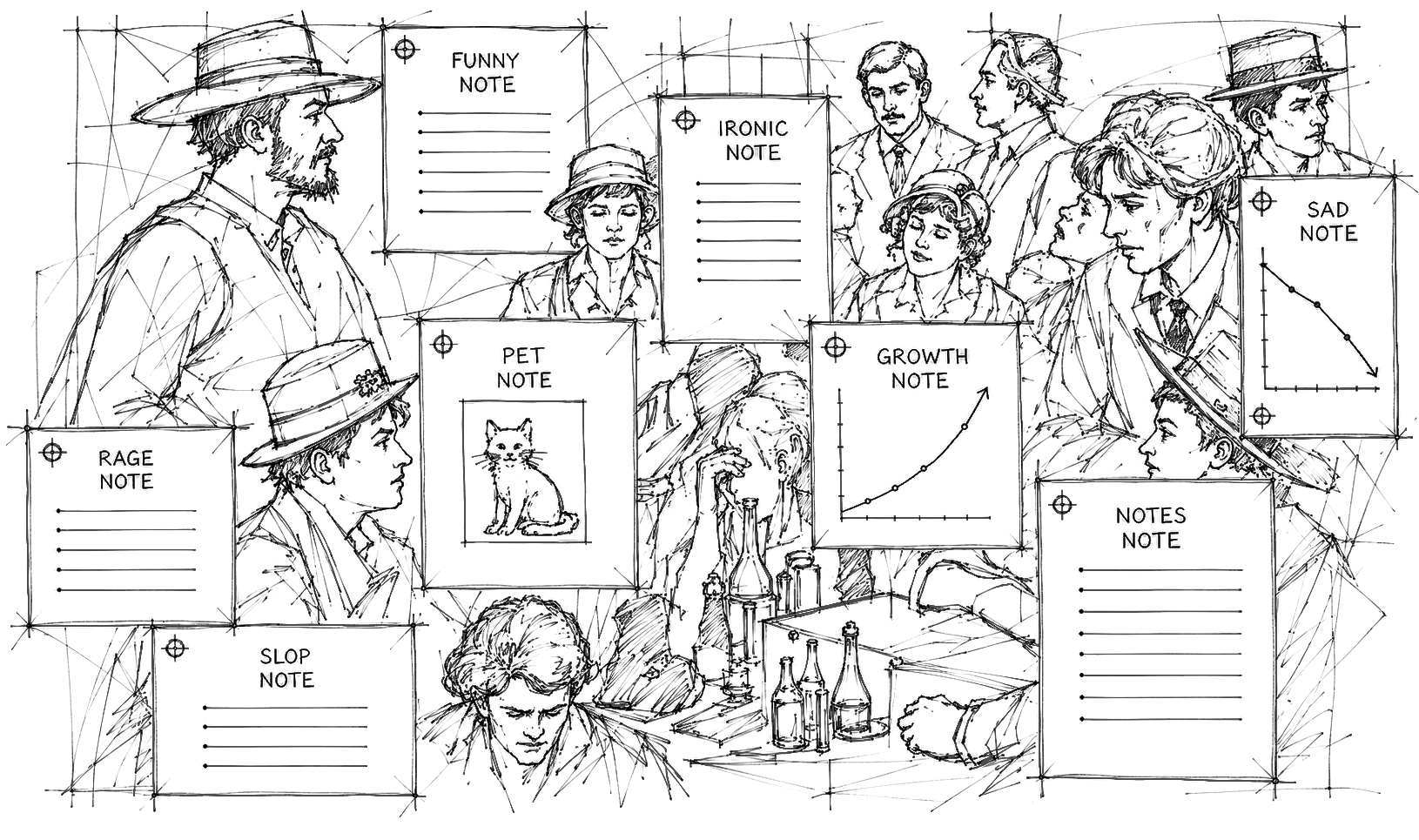
Soon, after the “head of social media” presented, but as if the room had never heard of Notes before. We got tips, but mostly, we were shown the different archetypes. We could be a “Tumblr Girl” or a “Reply Guy” or one of several other pre-packaged attitudes, and she showed memes and everyone laughed. She said she knows that writers hate to market their own work, and then showed an image of a writer’s Note showing their audience growth graph. We saw Viv Chen’s self-help note, proof that one note can get you 32,000 likes and $5,000 in paid subscribers. Paul Staples was in there too. I didn’t get the sense that Notes was about promoting our own work at all; I got the sense that Notes was about being snarky and ironic, campy and performative. There wasn’t one note with a paragraph. She closed with “so if you didn’t find those notes (her examples) funny, you’re boring and need to rethink your attitude.” The room roared.” (The room roared a lot, especially at tip #5, which was “visualize success and manifest it.”)

She almost forgot to show us new features. One: if you’re a publication with multiple writers, you can now add @ to write a note from a specific editorial staffer. Two: there’s a new embed format to crosspost to LinkedIn. Reminder: this is the roadmap update I rearranged my night for.

Finally we heard from Mike Cohen, “head of AI/ML,” the guy in charge of the feed. His goal is to turn people and content into numerical representations: it’s his job to figure out who you are, what you like, what’s out there that you’ll like, what will get you to subscribe, and ultimately what will get you to pay. This is the reward function. How do you get paid? Because that’s how they get paid too. This is noble, sort of. He made a point that the world “algorithm” has soured, but you can build good ones, it just depends what you optimize for. “Yeah, if you don’t like writers getting paid, then you’ll complain about this.” He said it sarcastically, as in, who would question the good intention of getting writers paid? Of course, I like writers getting paid. I’m a writer and I like getting paid! But when you slant the algorithm towards monetization, you pollute the culture, you elevate the growth-hackers, marketing businesses, and media companies, and you drown out the artists, the weirdos, and the free press.

His last question was what the roadmap is for the next 2 years, and we got, “we’re always trying new things … always tweaking the core retrieval engine … we keep iterating if what you see is relevant at all times … until what you see is perfect, which will never be.”

I feel like this would be a wasted trip if I didn’t personally talk to Mike Cohen and try to confirm my conspiracy theories on how the feed works. After my terrible warm open (“look my name is Mike too,” pointing at my name tag) I asked him to confirm it. I said that in November 2024 I hosted a workshop that brought in $10,000 founding tier subscriptions in a day or two, and unexpectedly, an old post of mine (from Nov 2023) started going mega-viral. It went viral for months. I asked him if the algorithm resurfaces posts from writers who are generating revenue. He said yes, but not revenue, subscribers. I clarified, paid subscribers? “All subscribers, but yes, even more so paid.” So it seems like paid subscribers are the strongest boost you can get.

Selfishlessly, this doesn’t bother me. I know what I need to do. By doubling down on paid subscriptions, I’ll be able to grow my audience faster on the platform. This validated my decision to host my book on Substack and not my own website. If I were mercenary and bold enough to hack the system, I’d set up some discount codes for 90% off, and set up 100 fake accounts through different VPNs, so for $100/month, I could be top of the Rising charts and hack the algorithm. I would bet this is exactly what lots of these AI-generated growth accounts are doing. I wonder if this is detected and manually banned though? Probably not worth the risk, especially because I already have a solid paid content strategy, but I imagine once people realize this, it will be rampant.

But, if I think outside of my selfish needs—and my confidence to crack Notes, eventually, somehow—, I think it’s a bad algorithm for culture. Yes, it’s framed as “for creators,” and it is, but there are side effects if money is the main attractor. It means that hucksters, partisan politics, slop, and smut will thrive. Effectively, it means that even though Substack says they care about culture, its algorithm doesn’t actually. Substack has an underbelly of amazing writers who simply can’t and won’t monetize their prose, and for that they will be lapped by salesmen. I shouldn’t have been surprised, but I was unable to articulate the source of a low-grade depression for the last few hours, possibly because the illusion popped; there really isn’t a place on the Internet that is unreasonable enough to defy economics and do something for culture’s sake. 

Before leaving, I asked Mike if they try to measure quality—I mentioned that I do this, and got a vague, “oh, cool”—and he said, “you know, I wonder if writers stopped writing and just used AI to generate their posts … if that got more readers to pay for their work, is that really so bad? Who are we to decide what’s good?”

Wicked problems require paradoxical solutions

· 470 words

In "wicked domains," the only solutions are paradoxes.. It requires you to sleep with the enemy. If a problem is wicker, it means no single solution can unfuck a problem. It's an imbroglio. In every solution, everyone dies (in the extreme). Politically, the solution to wickedness is to somehow become all sides at once. We need to become far more authoritarian than is comfortable, AND simultaneously, far more libertarian than comfortable (these are opposites on the Nolan chart). It’s the paradox of being both far left and far right. We can longer exist at any one point on the Nolan chart, we need to straddle the entire diamond. We need unexpected fusions to solve the hardest problems; harnessing the best parts of each extreme, while, somehow, devising incredibly nuanced architectures to prevent the known and likely abuses.

Instead of a diamond, visualize it as a ring around the “radical center” that aims to synthesize all opposites.

Let’s assume authoritarianism and libertarianism are opposites. We have kings, and we have markets. How do you subsume a free market within a benevolent tyrant? I know the K-word (king) has a charge now, and so by even bringing this up, I assume you assume I’m a Trump apologist or something. But actually no. Rather, this comes from the fear of acceleration and Nick Land’s conclusions on capitalism. A free-market pushed to the extremes of automation creates an inhuman and pulverizing force. Alternatively, as we approach AGI/ASI, it’s possible for someone to create an open-source machine God to follow their whims. In this paradigm, decentralization might actually be more dangerous than tyranny, and so we’ll all need to unite under some centralized system that has an antibodies that can protect against the worst possible viruses (please bear the oversimplifications here...).

The general gist comes in this question: can we recreate a free-market economy within a one-world-government system, and design it in a way to prevent abuses from both ends of the spectrum? Obviously, not an ideal situation, but I think accepting paradox is the only way through.

Another problem: How do we fix the debt? Extreme taxation. But then how do we make it worthwhile to pay taxes? The rich gain formal power in government (via equity?) and the ability to control the budget (after base expenses are paid). But then how do you prevent abuses from the wealthy? You could have citizens operate as a check, to vote on and weight final allocations.

If it were ever possible to rebuild political system from scratch, I suppose it would look something like this. Paradoxical. Extreme on both poles. Obvious downsides, but then complex architecture to mitigate. This is the nature of how our species will have to respond to wicker problems and mitigate the abuses of power in the age of exponential tech.

A stance on drug use

· 378 words

I need to think through a sensible stance on drugs for when my kids become teenagers. The simple solution is "just say no to drugs," but that isn't the safest one. They will not be in a bubble, they'll be surrounded by persuasive idiots who don't understand the drugs they're abusing. And so I think education, paired with both caution and openness, is probably the best approach. A draft:

  1. LD-50: To start simply, don’t take drugs that could possibly kill you. LD-50 is the dose that kills half the population. You want to consider the multiple between the lethal dose and the recreational dose. Maybe heroin is 3:1, cocaine 5:1, alcohol 15:1. Weed and psychedelics are less lethal than water.
  2. Set & setting: Even if psychoactive drugs aren't lethal, there are other risks. The first thing to know, aside from dosage, is that the experience is a reflection of your mind and surroundings. The drug is a mirror, and so don’t rip a bong around goons and watch brain rot; make a ritual where you only use it for creative projects (or some other mindful intention). There's a strong case for these drugs showing you new ways for your mind to work. Countless people, including Steve Jobs, said they couldn’t think the way they think if they weren't exposed to acid.
  3. Non-dependence: the crucial thing here is to not build a psychological dependency to the substance. Even if a substance isn't chemically addictive, it's easy to hold onto an assumption that you need it to do your best work. Instead, remember a drug is not something to continuously return to, but rather an occasional realm to find a lens that helps you through your sober, waking reality. Once it shows you something important, you can retain it without the drug, but it only sticks if you focus on that idea and take it seriously. This is why psychedelic therapy involves 10-20 sessions, before and after a single trip, because preparation and integration is where the results are. Worst case, if you endlessly bend your mind without internalizing any of the insights you find, it could lead to maladaptation or mental illness. As George Carlin said “get the message, and hang up the phone.”

Curating the infinite

· 474 words

If you give an infinite amount of monkeys a typewriter, with an infinite amount of time (obviously theoretical because neither a being or time can be infinite) not only will one of them produce Shakespeare, but the entire Western Canon would be re-derived from scratch in every moment of reality. This captures the difference between astronomic values and infinite values. In astronomic values, given an absurd amount of time, one monkey will eventually do the the impossible and write Shakespeare. But with infinite values, monkeys are inventing Shakespeare as the grammar of space-time. The astronomical shows that the impossible could happen once, but the infinite shows that the impossible could become the fabric of a reality.

And Sora is, like the 2005 Facebook feed, just the start of something new, but something that might actually be as nauseating as the infinite. If you have agents that can reproduce endlessly (potentially infinite “creators”), with the ability to remix/generate one piece of content against every other node in a growing cultural matrix (actually infinite), with limited time/cost (not infinitesimal, but fractional), that leads to every possible reality happening in every moment, at a cost that’s bearable to tech corporations.

I think I find this all interesting now, because something as abstract as the infinite might shape the future of creation/consumption. And to tie this to our talk last night about optimism/pessimism, I think the difference comes down to those who have the agency and discernment to plug in to the infinite on their own terms. It could be as simple as, if you plug in to OpenAI, Meta, or X, and let them use your data to create a generative algorithmic for you, you will be swept away in limitless personalized TV static. But if you know how to build your own tools (hardware, software, social communities), then you have a chance to harness it.

In Sora, I’m currently in a Bob Ross K-Hole, and it triggered an unexplainable interest in trying to explore the edges of Bob Ross lore, which is, now that I write this, so random and pointless and misaligned, but when I do it I’m cracking up and can’t really stop.

Contrast that with my own theoretical "infinite system," where every new log surfaces the 100 most related logs, and then each of those logs becomes the seed for an essay generator, each of which gets rewritten endlessly (for hours, days, or weeks) via an EA software feedback loop, until I decide I want to read it.

And so if you dive into the infinite, even if it’s something you love, it can easily destroy you, and instead we need to make our own systems/agents that can surf those edges for us, and bring back just the right amount of information that we can meaningfully work with.
Civic technology lags behind science

· 94 words

Kardashev ambitions reveal the self-destructive nature of science-forward intelligence. It’s like we’re skipping the prerequisite in social science. There's a fair chance that intelligent life destroys itself because civic technology lags behind hard technology—but I'm optimism in the sense that this is, in the end, just a very hard, society-scale design problem. No one person can fix the whole system, but any individual can contribute design protocols that can 1) solve little, local problems, 2) be reused in other contexts, and 3) integrate with other protocols.

Beauty without virtue is materialism

· 195 words

There has to be a better answer to the “why is nothing beautiful anymore?” discourse. This usually takes the form of plucking two objects, two hundred years apart, to make a point. If you take the best thing from the past and the worst thing from the present, you can make any conclusion you want, in any field. Are there not beautiful phone booths made in the 2000s? Might there actually be more of them than in the past?

Ultimately, though, I’m less interested in aesthetic studies if they don’t tie back to character. What good is beautiful architecture is everyone is ugly in spirit? I mean that. If we built beautiful, luxurious, maximalist cities, might that not reflect a kind of materialism in the soul of its people? Not saying that’s a given, but the real dilemma of architecture—the one that troubled me in my later years in school—is if the design of our world actually has any role in shaping its inhabitants. Maybe that’s an unfair thing to ask of bricks and steel. But maybe that’s why I shifted to other fields of design that are more influential in shaping virtue.

The abstractions above and below FIOS

· 370 words

As Brian the FIOS technician worked on the house outside, I sat on the porch to inspect and make myself available for questions, also while reading DFW’s “Everything and More: A History of Infinite.”

I just moved to a new apartment, just a town over, but with much more space, and so I've been in the process of corralling all my possessions into smaller and smaller boxes and then hiring men with trucks to lug everything. I've been unable to work for the last few days, both because of packing logistics, but also because this new unit is not already wired for Internet, unless I want to split the bull with my landlord, which is a no-go.

Brian was yelling back and forth with his assistant up in a cherry picker, connecting loose wires into the Verizon hive mind, and in that moment, as I read DFW write about layers of abstraction, I thought about the layers of abstraction in this very event. I've built a whole career on the Internet, and really, I could barely explain the fundamentals of it to a child. To some degree, not even Brian or his technician could do this, and fixing wires is their job. Could the guy up in the cherry picker explain the physics of data transfer or electricity? . You can exist within one layer without knowing anything about lower or higher layers. Here's how I'd map it: L1) the science of harnessing materials and natural forces to wield power, L2) building infrastructure to scale and deliver that power, L3) knowing how to edit/patch that infrastructure (Brian and his co-worker), L4) the general user of that infrastructure, and then L5) one who is able to navigate the social puzzles the emerge when millions of people use that infrastructure.

I can't operate outside of L4-L5. It is rare for someone to be competent at every layer of abstraction. Electricity has no understanding of “Verizon.” Brian might know very little about physics, but when you watch someone do their job at L3, you see the mystery of mastery at a non-adjacent layer. I can barely explain to you the infrastructure of the Internet, but I wish I could, and learn I should.

Act like Christ

· 50 words

Faith is overrated, what matters is that you act like Christ. You could have all the belief in the world and go to church every week, but if you haven’t rigorously and honestly observed your own soul under a microscope, you may be missing the point.

Reliving life through your child

· 92 words

Caught up in the logistics of preparing for a baby, as well as the biographic change in my own life (I am becoming a father), I am sometimes struck with simple but revelatory perspective shifts: I remember being in Kindergarden, and very soon I will have a kid (a version of me) in that very same position. These imaginal perspectives of the parent are very common. In some weird way, you live your whole life on repeat, except it’s not you, it’s through someone else who has their own sense of agency.

Sora

· 405 words

I'm ashamed to admit that a meme on Sora got me to laugh and cry so hard that my head was in pain and I had to close the app. It was Martin Luther King’s “I Have a Dream Speech,” but AI replaced the text with the script from the meme of that 4-year-old who can’t describe his dream (“Have you ever had a dream that you, um, you had, your, you— you could, you’ll do, you— you want, you, you could do…” etc.). There is something about seeing a great American orator mumble endlessly that I apparently can’t handle. Technically, I “made” this meme, which makes it worse, like I’m laughing at my own jokes.

What makes Sora an incredibly weird experiment is that, in 10 seconds, anyone can upload their “likeness.” Basically, you spin your head around, you say some words, and you get a photorealistic avatar that you can lend to your friends so they can prompt you into absurd situations. Of course, Sam Altman is one of the default avatars available. 50% of the app is Sam Altman fan fiction. You will find him stealing graphics cards from Target, smoking weed and saying “we’re cooked,” debating Cartman in court, using Pikachu to power a fusion reactor, etc. Also if you like Pikachu, there is now infinite Pikachu content. It is all very dumb, but it is endlessly novel.

This feels like a preview of a culture who only communicates through Superbowl commercial skits. I hope it doesn’t work, but I fear it might. I assume most people are questioning “why would anybody make their likeness public?” The answer is attention. I imagine that, within a week or two, Sam will have the montages and metrics to sway influencers and celebrities. It will be pitched as the new way to engage your audience: “let them create through you.” They know they can’t use the likeness of real people; I wonder if the point of this app (a wrapper over their underlying video model) is to get people to hand over their identity for free.

I am debating if I should delete this from my phone (I don’t allow any feeds on my phone … except Substack), or, if I should lean in, sell my likeness, and write about the consequences. This feels like an essay-worthy moment, but I can’t find the terms and conditions, and I get paranoid when I imagine the possibilities.

Radical Centrism and Controlled Media

· 158 words

I haven't shared with you my latest political views, but I’m exploring this idea of Radical Centrism, meaning, it might be okay to justify a centralized state-controlled media platform if that technologically and systematically guarantees a sane/just information environment. Obviously, this is hard, if not impossible, to do right.

It’s whole goal would be to invent an architecture that make it impossible for polarization or propaganda to occur. The key UI invention is that every news event would be presented as an atomic unit, with a mosaic of interpretations surrounding (not just left/right, but dozens of angles). Anyone who hits a certain POV too much would get de-ranked, so both Charlie Kirk and Jimmy Kimmel would be equally penalized because they predictably align with a faction. It would have to be structurally impossible for governments, media, money, or power to use their resources to promote a message above the system. Any media company who does not comply will be taxed into oblivion.

Of course everyone should have the right to say/think whatever they want without consequence, but the real issue isn't free speech, but in frame control.

Archive