michael-dean-k/

Topic

synthetic-video

7 pieces

When fake stunts go viral

· 88 words

There is a viral video of Milwaukee Brewer pitcher, Jacob Misiorowski, throwing a 104 mph fastball to knock an apple off a teammates head, who is sitting on a chair at home plate, arms crossed, back to pitcher. Yes, it's edited, but will everyone tell? What if 5% can't? How many hundreds of kids will try this stunt? Reminds of me of William S. Burroughs thinking he could drunkly shoot a beer bottle off his wife's head and missing. I guess the allure of virality can poison anyone.

Infinite Monkeys

· 791 words

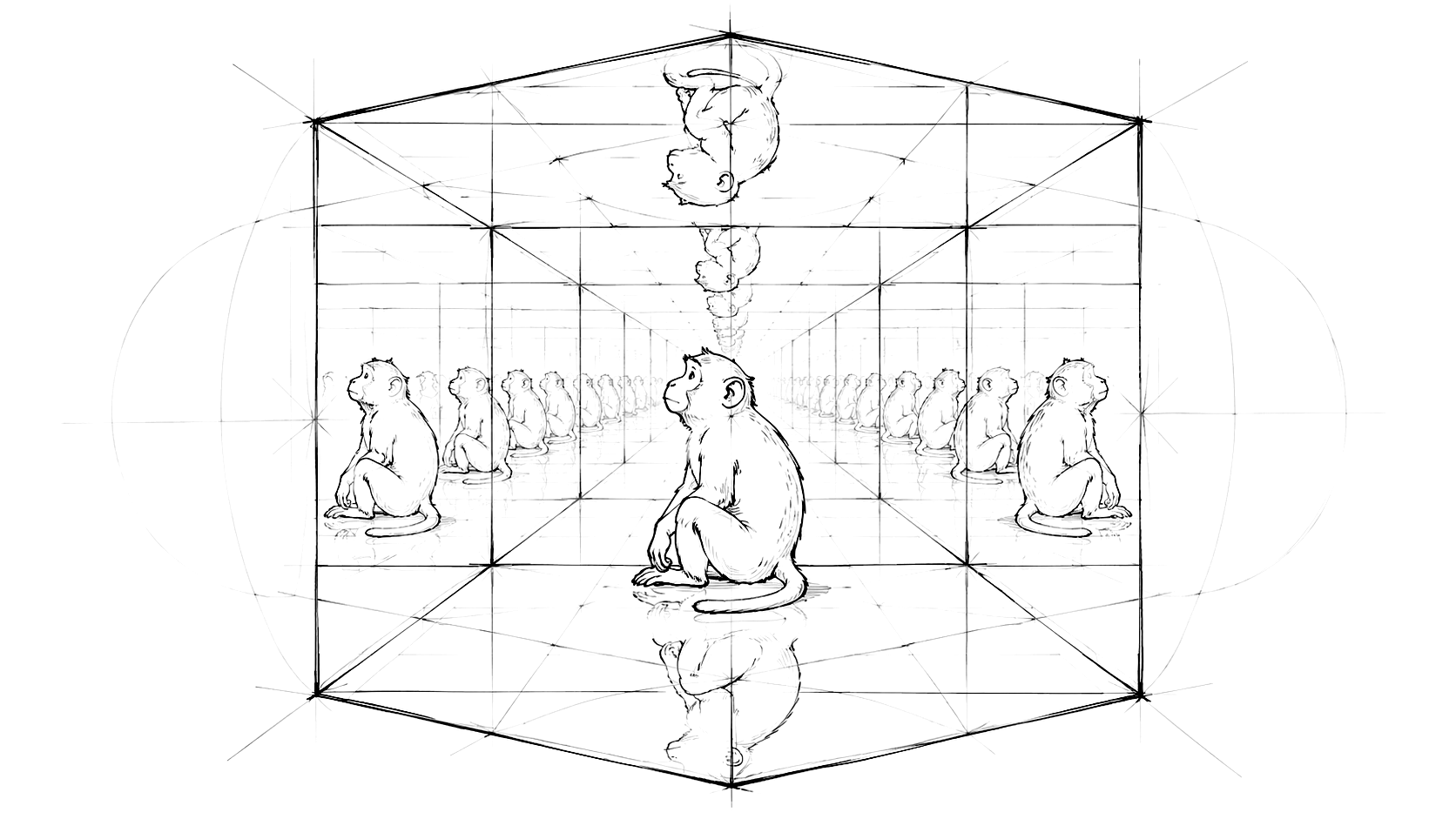
The infinite monkey theorem is often stated as, “if you give an infinite amount of monkeys an infinite number of time, one of them will eventually write Hamlet.” This is very off. I assume most people think it’s off because they know monkeys can’t write (which misses the point). I think it’s off in the other direction; it misunderstands what happens when you multiply infinite x infinite. You won’t just get one Hamlet; you’d get a whole lot more.

Let’s start with a single infinite: a monkey with infinite time. Imagine putting said monkey in a magic bubble that gives him immortality, endless focus to type random characters, and the ability to survive the death of all universes, quantum foam, or whatever. This monkey has a lot of time. Endless time. He won’t just write Hamlet once, he’ll write it many times. Actually, infinite times. Sometimes the monkey will go several million/billion/trillion years without writing Hamlet, but that’s okay because he’s on adderall, can’t die, and has only one job.

Now imagine there are infinite monkeys, too. In every frame of reality (assume this an Unreal Engine monkey simulator running at 120 FPS), the Creator can spawn monkey bubbles, 2 or 2 trillion bubbles, or however many bubbles are necessary for one of them to begin writing Hamlet in that moment. Then in the next frame (0.0083 seconds later), more monkeys are spawned until one of them starts Hamlet too. Over and over. (What we do with all the unsuccessful monkeys is a different problem.) Since all of these monkeys have internet, there are 432,000 Hamlet uploads every hour. And if these infinite monkeys started at the dawn of our universe, they would have written Hamlet 2.18×10^20 times.

The big idea is that when you multiply infinite x infinite, not only does the unlikely thing happen, but it becomes the new grammar of reality.

This thought experiment feels prescient now, because, of course, AI. While agents can replicate & work at radical speeds, it’s not literally infinite. Even if some monkey virus infected every computer on Earth, and did a years worth of work in a day, that’s still finite. But even if you multiply an astronomical x an astronomical, or even just a very big x very big, a similar effect happens: the unlikely thing becomes omnipresent.

I first started to notice this in the Sora app (which I haven’t heard about in months BTW). If you’re familiar with the “Wazzup” 1999 Budweiser commercial, you might remember that it involves two guys yelling “ZUUUUP” into a phone, with the video rapidly cutting back and forth between them. Now, you can prompt anyone into that meme. And so you can just swipe right and find the LOTR cast going “ZUUUUP,” and all the American presidents going “ZUUUUP,” and every member of the animal and pokemon kingdom going “ZUUUUP,” and everyone in your phonebook who uploaded their likeness to the app going “ZUUUUUUP,” as if every conceivable piece of media, IP, and matter just collapsed into this singular point, an arbitrarily selected commercial from 25 years ago.

Now this is a simple, harmless example. But it gets weirder when you imagine a single person’s intentions leveraged to such an extraordinary degree that they become the entirety of the Internet. It would be like, after I publish this note, all the comments came from fake accounts based on real people I know, but they each post a link to a version of Hamlet where all the characters are monkeys. And then I go to Reddit, or check my email, or listen to my voicemail, and it’s just monkey Hamlet everywhere. This is an exaggeration, but I’m trying to make a point that is something like an offshoot of the dead Internet theory. It won’t just be fake AI stuff that tries to blend in, but an assault of the bizzare, a thousand oddly specific info-viruses that we won’t be able to escape, orchestrated towards various ends that we won’t be able to wrap our heads around.

I generally don’t think the open Internet, as it’s designed today, will be able to stand it. I also don’t think that’s necessarily a bad thing, because the web today has ossified and enshittified and is probably due for a shakeup. I do think there will be some chaos/danger ahead, and we’ll have to each figure out how to navigate that safely, but I imagine we’ll reassemble into smaller communities, sheltered from the near-infinite, where you trust/know the 15-150 people involved, within the Dunbar limit. From this disaggregation, I think there’s a slow path of building back better and bot-resistant, and it’ll possibly be a much better place than the before-infinite-monkey times.

→ source

Fake but true

· 102 words

Here's an AI video of Jeffery Epstein moving through the different social circles of society and taking selfies with each. There's something about the video being fake, but true. It doesn't have to be real to articulate and expand an emotion. The video has 4 million likes; every knows its fake, but it doesn't matter, because it's a piece of media that articulates the creepiness, almost like a fast-forward vignette of his career. Consider the resources needed to make an Epstein documentary, vs. a video like this. And we're probably not far off from full-on documentaries.

Robots in feed

· 131 words

It’s uncanny to watch a Russian robot limp and wobble onto stage, wave, and then collapse face-first, before two guys rush to lift him, and another two follow to cover the fallen metalman with a black trap, as if it’s possible that we the audience have somehow not processed the last 10 seconds, and damage control is still possible. 

Not much later, I saw an Iranian robot with a photorealistic face; stiff cheeks, but convincing skin. This is what happens when ColdTurkey is off, I get exposed to “the horrors beyond my comprehension.” It will be interesting to see how culture responds to this coming wave of technology, which is not just existentially threatening (ie: labor automation), but biologically repulsive (ie: look at this not-face). [EDIT: I think this was AI]

Anything Can Be Remixed Without Effort

· 111 words

On X there is a photo there is about Molly, a reporter, talking to Alex Karp, CEO of Palantir. The comments are debating if either of their outfits are appropriate, before someone says, “Grok, interpret this,” and now there’s a video of them embracing and making out. More videos show up in the comments: them playing Twister, them dancing, them Kung Fu fighting, Molly turning into a rocket and busting through the ceiling. There’s one of Alex Karp wielding a rare Japanese sword; that one was real though. There aren’t watermarks, so you can’t tell. We are basically already in the age where anything can be remixed with AI without effort.

Curating the infinite

· 474 words

If you give an infinite amount of monkeys a typewriter, with an infinite amount of time (obviously theoretical because neither a being or time can be infinite) not only will one of them produce Shakespeare, but the entire Western Canon would be re-derived from scratch in every moment of reality. This captures the difference between astronomic values and infinite values. In astronomic values, given an absurd amount of time, one monkey will eventually do the the impossible and write Shakespeare. But with infinite values, monkeys are inventing Shakespeare as the grammar of space-time. The astronomical shows that the impossible could happen once, but the infinite shows that the impossible could become the fabric of a reality.

And Sora is, like the 2005 Facebook feed, just the start of something new, but something that might actually be as nauseating as the infinite. If you have agents that can reproduce endlessly (potentially infinite “creators”), with the ability to remix/generate one piece of content against every other node in a growing cultural matrix (actually infinite), with limited time/cost (not infinitesimal, but fractional), that leads to every possible reality happening in every moment, at a cost that’s bearable to tech corporations.

I think I find this all interesting now, because something as abstract as the infinite might shape the future of creation/consumption. And to tie this to our talk last night about optimism/pessimism, I think the difference comes down to those who have the agency and discernment to plug in to the infinite on their own terms. It could be as simple as, if you plug in to OpenAI, Meta, or X, and let them use your data to create a generative algorithmic for you, you will be swept away in limitless personalized TV static. But if you know how to build your own tools (hardware, software, social communities), then you have a chance to harness it.

In Sora, I’m currently in a Bob Ross K-Hole, and it triggered an unexplainable interest in trying to explore the edges of Bob Ross lore, which is, now that I write this, so random and pointless and misaligned, but when I do it I’m cracking up and can’t really stop.

Contrast that with my own theoretical "infinite system," where every new log surfaces the 100 most related logs, and then each of those logs becomes the seed for an essay generator, each of which gets rewritten endlessly (for hours, days, or weeks) via an EA software feedback loop, until I decide I want to read it.

And so if you dive into the infinite, even if it’s something you love, it can easily destroy you, and instead we need to make our own systems/agents that can surf those edges for us, and bring back just the right amount of information that we can meaningfully work with.

Sora

· 405 words

I'm ashamed to admit that a meme on Sora got me to laugh and cry so hard that my head was in pain and I had to close the app. It was Martin Luther King’s “I Have a Dream Speech,” but AI replaced the text with the script from the meme of that 4-year-old who can’t describe his dream (“Have you ever had a dream that you, um, you had, your, you— you could, you’ll do, you— you want, you, you could do…” etc.). There is something about seeing a great American orator mumble endlessly that I apparently can’t handle. Technically, I “made” this meme, which makes it worse, like I’m laughing at my own jokes.

What makes Sora an incredibly weird experiment is that, in 10 seconds, anyone can upload their “likeness.” Basically, you spin your head around, you say some words, and you get a photorealistic avatar that you can lend to your friends so they can prompt you into absurd situations. Of course, Sam Altman is one of the default avatars available. 50% of the app is Sam Altman fan fiction. You will find him stealing graphics cards from Target, smoking weed and saying “we’re cooked,” debating Cartman in court, using Pikachu to power a fusion reactor, etc. Also if you like Pikachu, there is now infinite Pikachu content. It is all very dumb, but it is endlessly novel.

This feels like a preview of a culture who only communicates through Superbowl commercial skits. I hope it doesn’t work, but I fear it might. I assume most people are questioning “why would anybody make their likeness public?” The answer is attention. I imagine that, within a week or two, Sam will have the montages and metrics to sway influencers and celebrities. It will be pitched as the new way to engage your audience: “let them create through you.” They know they can’t use the likeness of real people; I wonder if the point of this app (a wrapper over their underlying video model) is to get people to hand over their identity for free.

I am debating if I should delete this from my phone (I don’t allow any feeds on my phone … except Substack), or, if I should lean in, sell my likeness, and write about the consequences. This feels like an essay-worthy moment, but I can’t find the terms and conditions, and I get paranoid when I imagine the possibilities.