michael-dean-k/

Topic

social-media

8 pieces

You don't have a phone problem

· 101 words

You don’t have a phone problem, you are just poisoning yourself. I'm tired of people lamenting over phones, smartphones, screens—it's not the glass! I want to make a case why smartphones are essential for flourishing in our modern life. The real problem is with “inbound feeds,” and that’s not just social media, but email inboxes and task lists. By installing software with infinite refresh, the possibility of novelty consumes you. I say this all out loud to my wife, as the guy next to me is absorbed in a sloptunnel on TikTok, and it’s 50/50 if he heard me.

Robots in feed

· 131 words

It’s uncanny to watch a Russian robot limp and wobble onto stage, wave, and then collapse face-first, before two guys rush to lift him, and another two follow to cover the fallen metalman with a black trap, as if it’s possible that we the audience have somehow not processed the last 10 seconds, and damage control is still possible. 

Not much later, I saw an Iranian robot with a photorealistic face; stiff cheeks, but convincing skin. This is what happens when ColdTurkey is off, I get exposed to “the horrors beyond my comprehension.” It will be interesting to see how culture responds to this coming wave of technology, which is not just existentially threatening (ie: labor automation), but biologically repulsive (ie: look at this not-face). [EDIT: I think this was AI]

Anything Can Be Remixed Without Effort

· 111 words

On X there is a photo there is about Molly, a reporter, talking to Alex Karp, CEO of Palantir. The comments are debating if either of their outfits are appropriate, before someone says, “Grok, interpret this,” and now there’s a video of them embracing and making out. More videos show up in the comments: them playing Twister, them dancing, them Kung Fu fighting, Molly turning into a rocket and busting through the ceiling. There’s one of Alex Karp wielding a rare Japanese sword; that one was real though. There aren’t watermarks, so you can’t tell. We are basically already in the age where anything can be remixed with AI without effort.

On why feeds are soul poision

· 299 words

Even if a SM feed is filled with all of your favorite ideas, friends, and thinkers, it would still be poison from the sheer volume of randomness. Even the act of seeing two things in feed, forces you to shift from one context to another, forcing you to shift frames, destabilizing and disembodying you.

Alternatively, if you had a feed of a hundred things, but they all revolve around the same content, all spawned from a singular intention, I think it would be less dizzying; it’s more enables depth into your present, embodied frame. There is less of a “slot machine” effect. 

It’s not that feeds or algorithms are bad; they only became bad when they strip context. The logic of most feeds, however, do not care if you feel oriented. They have a simple reward function, show you as many different things as they can, to see which ones drive behavior. They are running a real-time self-adaptive experiment on your preferences, in the hope to discover which patterns might nudge you into their desired behavior (whether it’s towards an ad or towards an on-platform paid subscription by a beloved writer, they are effectively the same—it’s an algorithm that is not being real with you, and not respecting your attention).

I feel like a broken record in prescribing a solution, but it’s basically Plexus (RIP): show nothing until you post, and then from what you post, share a feed of semantically related posts. Substack, as a writing network, is a unique position to build this. It has a lot of long form content: not just notes, but essays, podcasts, and videos. It should be looking at the granular units, semantically embedding paragraphs, and then those become atomic objects that help populate the “semantic feed” generated after every Note.

Letter to Dobrenko

· 1392 words

So Alex Dobrenko started a new personal website (I will not link to it because it’s secret), but he sent it to me, so I spent some time on it and wrote him some notes, and then he wrote a reply post to me, and now I’m making a reply log to that (and upon re-reading, I realize it’s now a whole essay). It’s something like a semi-public letter exchange. 

Letters, emails, same thing. 

Similar to how the 20th century has books like “Virginia Woolf: The Letters,” I wonder if the 21st century will have “Alex Dobrenko: The Emails,” where his children posthumously assemble and publish all their dad’s best emails. ((Also, now that my cholesterol is borderline, and my daughter is on the way, I’m having new thoughts about preparing for my death, like “THIS IS DAD FROM THE PAST AND HERE ARE ALL THE PASSWORDS.”) Something about losing all my writing forever feels worse than dying. We eventually have to die, but you only lose your writing forever if you’re careless and lazy. Rant over.)

What I like about letters/emails over essays is that there isn’t a mass-market context, and so you’re writing for just one person. That’s good essay advice too (“write for one person”—we literally taught this in Write of Passage), but deep down, it’s hard to forget that you’re writing for all people of all times, especially if you are.

Recently I mentioned that I’ve spent 2 years nerding out on essay patterns (the objective stuff on the page), but I want to start thinking more about the process: how do I show up to write?

One idea is to start essays as letters to specific people. Eventually, that can evolve into something for the main list, but I don’t want to start with them in mind. I want to start with a specific problem in my life, and then, with a small group of people who relate to that problem. Any idea I have comes with a clear person in mind, someone who would probably be most excited to read it, and has all the context needed so I can avoid the bush beating.

If I want to write about Alternate Internet Communities and weird websites, I’ll write to Alex. If I want to write about the insanity of the Dark Enlightenment, I’ll write to Andrew. Theology to Taylor, Emerson to Will, Hope to Isabel, Fatherhood to Dan, Greeks to Chris, Dreams to Garrett, AGI to Davey, Architecture to Liz, etc. It’s also special to say, “I wrote this for you, and we should talk and get to the bottom of this,” and that could really change the nature of the essay because someone else is co-shaping it with you.

Alex brings up a good question: why doesn’t Substack feel like this? I have to think more on this, but I think the stage effect is still at play. If you have a 10k audience, it still feels like a megaphone, and when you’re on Notes, you participate in American Idol, again with new skin. It’s still the best town in town, and there are tricks (ie: set up an opt-in Section for experiments so you can have a “shadow audience” that’s 1% the size of your main one), but there’s friction in tricks like that. It’s not the main way the platform is intended to be used. It’s meant for loud, marketing-style updates, that confidently funnel readers into a paid subscription tier (I got 15 paid subs from my last one, and so I realize the value in learning to play that game, but it’s just that, a game, yet a game that determines my financial security, but it’s not the full “culture” in “culture engine” that Substack can possibly build; it’s a reward function that could make this place like LinkedIn in <3 years).

So, how do you build a “culture engine,” for real? What is it beyond a tagline or positioning? To start, I think it goes beyond revenue. Of course, Substack needs to pay bills (separate point, but once we reach the vibe code singularity, the bills might be so low that SM networks won’t have to ruthlessly optimize). I think Substack could 1) diversify their business model, so that they don’t have a single attractor that incentives every thought to be monetized, and 2) make decisions from a cultural perspective—even if there’s no explicit revenue tie-in, by creating a good culture, you retain the people and prevent a Writer’s Exodus.

But to get even more specific, a “culture engine,” sounds like the kind of place that would trigger long letters back and forth between writers, kind of like this. I used to see some of that happening, but it seemed like a performance too: “And now, here is email 6 of 7 about how to start a public email debate” or something. The core difference is that, when there’s two people writing back and forth, there’s permission to perform less and less until you’re eventually just very real with each other. This is what I love about Neal Cassady’s letters to Jack Kerouac (troubled guys, who are a topic for another time). 

Why aren’t Substack comments like this? For one, they’re truncated. But two, I don’t know, sometimes comments even feel performative too? I feel it, on both the giving and receiving end. After I post, it feels like a chore to respond, even though I often love what people write and want to respond. I think it’s because, since it’s in public, and everyone can read, it feels like an obligation to respond. I wish there was an option to have “private comments,” and even “private replies to comments.” Like, other readers could see, “Michael Dean replied to this, privately” so they know I’m not a dick.

Okay, last thing, maybe: I think the real problem is that the discovery mechanics are all wrong. Like, I don’t want to blast this letter to everyone I know. But yet also, I don’t mind if everyone I know happens to stumble across it. There is a huge difference. I’ll put this in my logs, but realistically, no one is going to find it. I guess I could put it on Notes? But that feels too vulnerable too. Ideally, the right people will find it as they write about similar issues. So if some Substacker is also writing about private comments, to themselves, or to a friend, they will suddenly find a thread between Alex and Michael talking about a similar thing, and then suddenly we all have visibility into each other’s notes, letters, essays about those things. Forks merged.

The social media network I want to park in (or plug my personal website into) is one where everything is semi-public, but you only discover things through your own writing. I don’t know the right metaphor: it’s like each notes or essay is a flashlight that you use to move around this massive information cavern and you make friends along the way. It has nothing to do with engagement or revenue, but semantic similarity. This feels closer to the original vision of the Internet, to connect people based on ideas.

Sublime has some features that are adjacent to this, and Plexus was very close to this too, but I do think there’s something to owning your place. Is there some protocol where you can fuse the autonomy of your website with the connectivity of a network? I feel like AI is going to simultaneously bring us to (a) slop town, and (b) a golden age in social media experimentation; as sloptown gets neck high, people will want to move.

PS1: To clarify: I love having an audience, I just don’t love the way my writing is distributed to them, and also don’t love the way conversation is facilitated. Comments are okay, but the Chat feature feels pretty off. I wish I could write 30 essays per month, like this, and each one would get the 3 that are most relevant.

PS2: It took Alex 9 days to reply to my original notes, which is still ~2x faster than the letter cadence back in the day. That’s fast! I wonder if AIM culture poisoned letter culture. I haven’t responded to my Substack comments from 5 days ago, and I feel bad.
Fear and loathing at Substack notes night

· 98 words

I don’t know the New York they write about in classic essays, because all of those are from the perspective of an out-of-state romantic, an Oklahomer, who moves into the fast lane of Manhattan and thinks it’s the only speed to live in the city. But actually the best way to exist in New York is at the edges. For one, you can see the skyline, but really, you get the perks of a normal life with the convenience of being a train ride away from the center of the world. I just got a last-minute invite to an event at Substack’s NYC office and so now I’m going. 

The guest list was full when I last checked it, but I must have been on the waitlist and some spots just opened up. It’s 4:30 PM and I have to make it to 25th Street by 6 PM (so again, nice to be able to get to the center of the world with almost no notice). I live in Queens, so I shifted a meeting, made plans for my mother-in-law to pick up my pregnant wife, took a shower, and headed out. En route, I reread the invite:

“Hear directly from our product and partnerships teams with a behind-the-scenes look at the Feed: what’s working, what’s next [emphasis mine], and how to grow and connect through Notes. There’ll be live demos, insider tips, and plenty of time for Q&A.”

My hope was to learn the future of Notes, the “feed product” that Substack is nudging everyone into, the place where many longform writers loathe. For the record, I have a history of being a Substack evangelist, and as recently as last week, I went hard on a friend: “Notes isn’t the problem; you’re the problem.” What I meant was that, a social media feed will always be imperfect, but it’s the best way to write in public, and since Note is the best option around, it’s each of our responsibilities to set a productive mental frame so we can show up as “citizens of the Internet.” It’s up to us to make Notes a place that’s worth spending time on. Personally, too, now that my career effectively depends on me talking about Essay Architecture in public, I feel the need to trick myself into loving Notes.

I was led to believe we would have a glimpse at the roadmap, some new vision, but mostly, this event confirmed a sinking suspicion: although Substack describes its own algorithm as a noble alternative, it’s just as optimized for revenue as the enshittified feeds it claims to be above, and could have a similar cultural conclusion.

The first thing I noticed when walking out onto the 12th (?) floor was that everyone was loud, beautiful, and extroverted. These people write? I would’ve guessed it to be an Instagram crowd. I recognized three people: I saw Hamish McKenzie, the CEO being mobbed by a crowd of schmoozers—who I would have loved to talk to—, I saw … Jamie? … a writer who recognized me last meetup, but I’ve forgotten her name, and I saw Daniel Pinchbeck of Liminal News (which I pay for) who writes about politics, psychedelics, and the occult, and who I imagined to be similarly uncomfortable with the vibe (I don’t know what he thought, but he did leave early).

At 6:10 PM, before Hamish gave his traditional pitch, he thanked us for baptising the new NYC office, and acknowledged it was his first time here too (this got me to believe, out of the gate, that the purpose of this get-together was to welcome the boss). I assume this office is possible because of the Series A round from a16z. We got the stats, good stats: 32 million free subscribers, half a million paid, and you’re 7x more likely to be shared within the app. He comforted us, told us they won’t follow the same fate as X or Facebook. “As you can tell, our culture is different.”

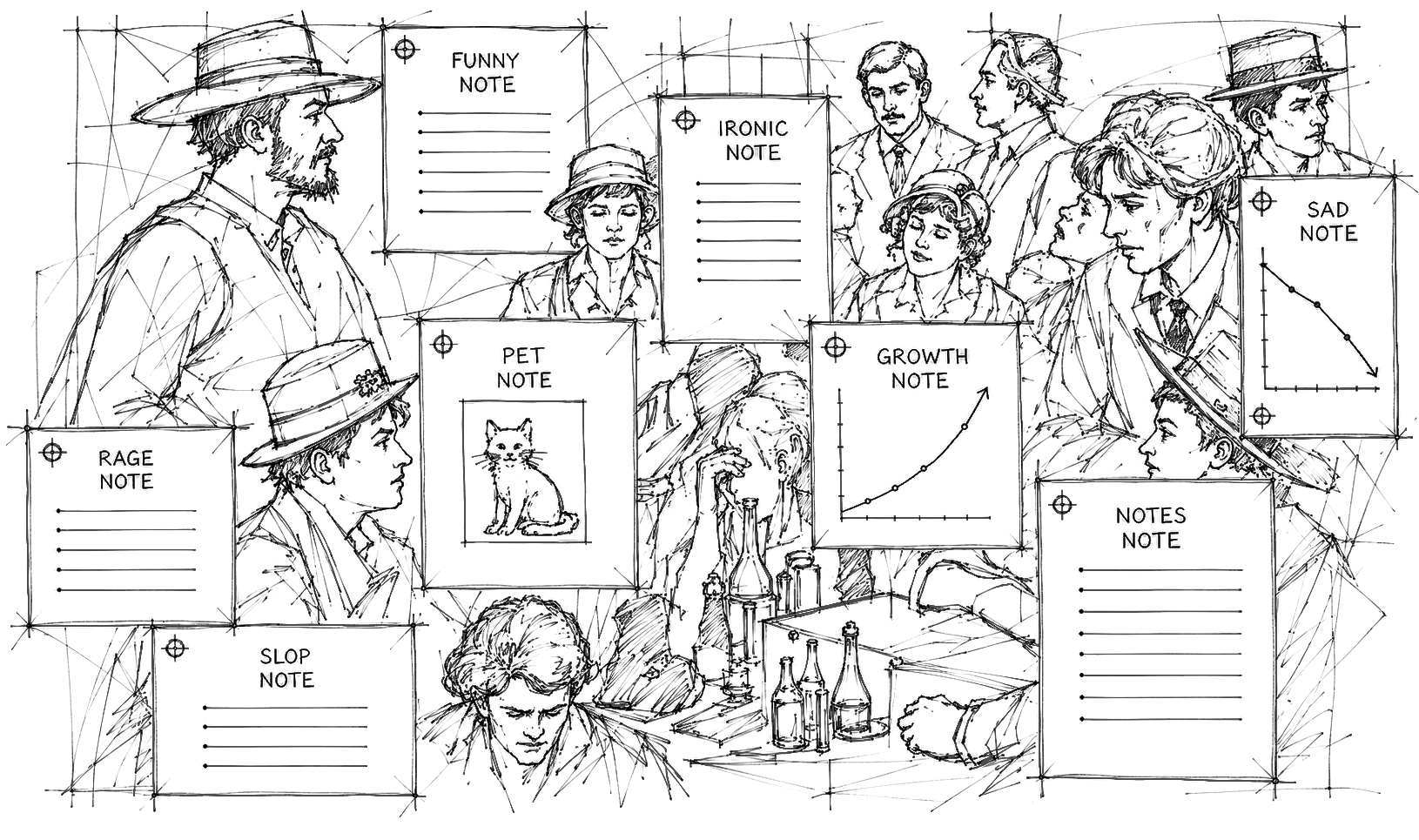
Soon, after the “head of social media” presented, but as if the room had never heard of Notes before. We got tips, but mostly, we were shown the different archetypes. We could be a “Tumblr Girl” or a “Reply Guy” or one of several other pre-packaged attitudes, and she showed memes and everyone laughed. She said she knows that writers hate to market their own work, and then showed an image of a writer’s Note showing their audience growth graph. We saw Viv Chen’s self-help note, proof that one note can get you 32,000 likes and $5,000 in paid subscribers. Paul Staples was in there too. I didn’t get the sense that Notes was about promoting our own work at all; I got the sense that Notes was about being snarky and ironic, campy and performative. There wasn’t one note with a paragraph. She closed with “so if you didn’t find those notes (her examples) funny, you’re boring and need to rethink your attitude.” The room roared.” (The room roared a lot, especially at tip #5, which was “visualize success and manifest it.”)

She almost forgot to show us new features. One: if you’re a publication with multiple writers, you can now add @ to write a note from a specific editorial staffer. Two: there’s a new embed format to crosspost to LinkedIn. Reminder: this is the roadmap update I rearranged my night for.

Finally we heard from Mike Cohen, “head of AI/ML,” the guy in charge of the feed. His goal is to turn people and content into numerical representations: it’s his job to figure out who you are, what you like, what’s out there that you’ll like, what will get you to subscribe, and ultimately what will get you to pay. This is the reward function. How do you get paid? Because that’s how they get paid too. This is noble, sort of. He made a point that the world “algorithm” has soured, but you can build good ones, it just depends what you optimize for. “Yeah, if you don’t like writers getting paid, then you’ll complain about this.” He said it sarcastically, as in, who would question the good intention of getting writers paid? Of course, I like writers getting paid. I’m a writer and I like getting paid! But when you slant the algorithm towards monetization, you pollute the culture, you elevate the growth-hackers, marketing businesses, and media companies, and you drown out the artists, the weirdos, and the free press.

His last question was what the roadmap is for the next 2 years, and we got, “we’re always trying new things … always tweaking the core retrieval engine … we keep iterating if what you see is relevant at all times … until what you see is perfect, which will never be.”

I feel like this would be a wasted trip if I didn’t personally talk to Mike Cohen and try to confirm my conspiracy theories on how the feed works. After my terrible warm open (“look my name is Mike too,” pointing at my name tag) I asked him to confirm it. I said that in November 2024 I hosted a workshop that brought in $10,000 founding tier subscriptions in a day or two, and unexpectedly, an old post of mine (from Nov 2023) started going mega-viral. It went viral for months. I asked him if the algorithm resurfaces posts from writers who are generating revenue. He said yes, but not revenue, subscribers. I clarified, paid subscribers? “All subscribers, but yes, even more so paid.” So it seems like paid subscribers are the strongest boost you can get.

Selfishlessly, this doesn’t bother me. I know what I need to do. By doubling down on paid subscriptions, I’ll be able to grow my audience faster on the platform. This validated my decision to host my book on Substack and not my own website. If I were mercenary and bold enough to hack the system, I’d set up some discount codes for 90% off, and set up 100 fake accounts through different VPNs, so for $100/month, I could be top of the Rising charts and hack the algorithm. I would bet this is exactly what lots of these AI-generated growth accounts are doing. I wonder if this is detected and manually banned though? Probably not worth the risk, especially because I already have a solid paid content strategy, but I imagine once people realize this, it will be rampant.

But, if I think outside of my selfish needs—and my confidence to crack Notes, eventually, somehow—, I think it’s a bad algorithm for culture. Yes, it’s framed as “for creators,” and it is, but there are side effects if money is the main attractor. It means that hucksters, partisan politics, slop, and smut will thrive. Effectively, it means that even though Substack says they care about culture, its algorithm doesn’t actually. Substack has an underbelly of amazing writers who simply can’t and won’t monetize their prose, and for that they will be lapped by salesmen. I shouldn’t have been surprised, but I was unable to articulate the source of a low-grade depression for the last few hours, possibly because the illusion popped; there really isn’t a place on the Internet that is unreasonable enough to defy economics and do something for culture’s sake. 

Before leaving, I asked Mike if they try to measure quality—I mentioned that I do this, and got a vague, “oh, cool”—and he said, “you know, I wonder if writers stopped writing and just used AI to generate their posts … if that got more readers to pay for their work, is that really so bad? Who are we to decide what’s good?”

Curating the infinite

· 474 words

If you give an infinite amount of monkeys a typewriter, with an infinite amount of time (obviously theoretical because neither a being or time can be infinite) not only will one of them produce Shakespeare, but the entire Western Canon would be re-derived from scratch in every moment of reality. This captures the difference between astronomic values and infinite values. In astronomic values, given an absurd amount of time, one monkey will eventually do the the impossible and write Shakespeare. But with infinite values, monkeys are inventing Shakespeare as the grammar of space-time. The astronomical shows that the impossible could happen once, but the infinite shows that the impossible could become the fabric of a reality.

And Sora is, like the 2005 Facebook feed, just the start of something new, but something that might actually be as nauseating as the infinite. If you have agents that can reproduce endlessly (potentially infinite “creators”), with the ability to remix/generate one piece of content against every other node in a growing cultural matrix (actually infinite), with limited time/cost (not infinitesimal, but fractional), that leads to every possible reality happening in every moment, at a cost that’s bearable to tech corporations.

I think I find this all interesting now, because something as abstract as the infinite might shape the future of creation/consumption. And to tie this to our talk last night about optimism/pessimism, I think the difference comes down to those who have the agency and discernment to plug in to the infinite on their own terms. It could be as simple as, if you plug in to OpenAI, Meta, or X, and let them use your data to create a generative algorithmic for you, you will be swept away in limitless personalized TV static. But if you know how to build your own tools (hardware, software, social communities), then you have a chance to harness it.

In Sora, I’m currently in a Bob Ross K-Hole, and it triggered an unexplainable interest in trying to explore the edges of Bob Ross lore, which is, now that I write this, so random and pointless and misaligned, but when I do it I’m cracking up and can’t really stop.

Contrast that with my own theoretical "infinite system," where every new log surfaces the 100 most related logs, and then each of those logs becomes the seed for an essay generator, each of which gets rewritten endlessly (for hours, days, or weeks) via an EA software feedback loop, until I decide I want to read it.

And so if you dive into the infinite, even if it’s something you love, it can easily destroy you, and instead we need to make our own systems/agents that can surf those edges for us, and bring back just the right amount of information that we can meaningfully work with.

Sora

· 405 words

I'm ashamed to admit that a meme on Sora got me to laugh and cry so hard that my head was in pain and I had to close the app. It was Martin Luther King’s “I Have a Dream Speech,” but AI replaced the text with the script from the meme of that 4-year-old who can’t describe his dream (“Have you ever had a dream that you, um, you had, your, you— you could, you’ll do, you— you want, you, you could do…” etc.). There is something about seeing a great American orator mumble endlessly that I apparently can’t handle. Technically, I “made” this meme, which makes it worse, like I’m laughing at my own jokes.

What makes Sora an incredibly weird experiment is that, in 10 seconds, anyone can upload their “likeness.” Basically, you spin your head around, you say some words, and you get a photorealistic avatar that you can lend to your friends so they can prompt you into absurd situations. Of course, Sam Altman is one of the default avatars available. 50% of the app is Sam Altman fan fiction. You will find him stealing graphics cards from Target, smoking weed and saying “we’re cooked,” debating Cartman in court, using Pikachu to power a fusion reactor, etc. Also if you like Pikachu, there is now infinite Pikachu content. It is all very dumb, but it is endlessly novel.

This feels like a preview of a culture who only communicates through Superbowl commercial skits. I hope it doesn’t work, but I fear it might. I assume most people are questioning “why would anybody make their likeness public?” The answer is attention. I imagine that, within a week or two, Sam will have the montages and metrics to sway influencers and celebrities. It will be pitched as the new way to engage your audience: “let them create through you.” They know they can’t use the likeness of real people; I wonder if the point of this app (a wrapper over their underlying video model) is to get people to hand over their identity for free.

I am debating if I should delete this from my phone (I don’t allow any feeds on my phone … except Substack), or, if I should lean in, sell my likeness, and write about the consequences. This feels like an essay-worthy moment, but I can’t find the terms and conditions, and I get paranoid when I imagine the possibilities.