Notes on the permanent underclass
The technological mutation from serfs to hippies
Architect-turned-writer, founder of Essay Architecture. Building pattern languages, software, anthologies, and community for essayists.
Architect-turned-writer, founder of Essay Architecture. Building pattern languages, software, anthologies, and community for essayists.
Essay Club ↗
Architect-turned-writer, founder of Essay Architecture. Building pattern languages, software, anthologies, and community for essayists.
Architect-turned-writer, founder of Essay Architecture. Building pattern languages, software, anthologies, and community for essayists.
Essay Club ↗
Architect-turned-writer, founder of Essay Architecture. Building pattern languages, software, anthologies, and community for essayists.
The technological mutation from serfs to hippies
Revolutionary tax proposal #1: anything above $100m/year is taxed at 90%, but in exchange for political equity in the country (ie: delegation and voting). It formalizes lobbying and makes it transparent. To prevent the rich from steering the country too hard in their favor, there can be provisions where legislators, citizens, and oligarchs have checks and balances. Ie: to put it kidishly simple, each can have a 33% stake in directing that taxation. Another way to think of it is forced investment in pre-approved pro-American funds, companies, etc.
TBF: I have little sense of what I'm talking about in these matters. But the general context behind this is that power dynamics organically took control of the country and defied the spirit of the founding architecture. I assume there are many examples on how the Constitution and it's amendments dit not protect the original vision. And so the principal is to understand how power actually moves and work with it; don't kill it or shun it, but formalize it into legal structures, make it transparent, and then force it to comply with specific standards that muzzle and channel it's wolf power.
I got charged $4,500 for a band-aid.
For that price I could’ve bought 90,000 band-aids on Amazon (two for each person in my NYC neighborhood), but emergency room band-aids must be of a different substance.
A month ago we cut my newborn daughter’s finger with a nail clipper and it wouldn't stop bleeding for an hour. The on-call pediatrician—who was naturally grumpy since it was after midnight—insisted we go to the ER, and after 5 hours in the waiting room, the bleeding stopped right before we were called in. After one minute with the doctor and five with the nurse (most of it small talk about islands in Greece), we left with a band-aid on a dry scab. I assumed it would be an expensive lesson, a few hundred dollars to breathe hospital air, but we were charged a whole family’s round-trip tickets to Athens.
What's weirder than American private healthcare is how used to it everyone is. A family member said, “well, it was March, so you didn’t hit your deductible yet.” I’m willing to pay the $577 for the emotional labor of fixing a boo boo, but the remaining mystery, the $3,923 on yesterday’s mail bill, feels beyond reason. I’ll be requesting an itemized breakdown to call their bluff, and if they don’t bring it down to a normal but still ridiculous level ($500 for a band-aid—10,000x above market price) I will evade the debt collectors until they tank my credit and jail me.
The scapegoat of the shadow monster
Why am I so engaged with the news these days? I think it’s part of a deeper desire to update my world model. There is no doubt, massive change. Geopolitical, economic, technological. And as abstract as those things usually are, it feels like some sort of shift that, in 2-3 years time, wil have an effect on my life. Of course, for many people in the world, it’s hitting them now. But similar to how COVID spared no one, it feels like your model of where things are going will directly effect your preparedness.
But this feels more existential; safety/security are actually on the line. And so that’s an anxious kind of thought, that the tectonic plates under your reality are shifting, and it’s not some recreational yearning to re-skill and recalibrate, but a mandatory thing.
And so to make sense, what do you do, go on X? That’s a total cesspool. New media is worse than the old gatekept media. And so, where I think I want to take this, is to build my own systems to sift through and aggregate information, and to build my own UI to do this. Even a simple Claude prompt, “what happened in Iran in the last 4 hours” is so much better than X. It’s stripped of sensationalism, and reading is just a less triggering medium. Bias aside, it’s at least free from people who are intentionally trying to deceive you for virality. There is a clout-chasing incentive, paired with actually turbulent times, which makes algorithmic news something like a schizophrenia filter.
And so what are these questions, these underlying uncertainties that are triggering a model change? How will anyone make income with the rise of AGI-3 and eventually ASI? How do I exist online and avoid hyper-surveillance and cyber-sabotage? Where in the world can I live to build a better future for my daughter, one where colleges doesn’t exist, jobs don’t exist, and where quality of life actually depends on nationalized social systems? A weird future. And weird to consider the fall of America, a kind of reverse migration, where, because of a confluence events, it might not be a place to raise a family in 1-2 generations down the line.
And so practically, this is resulting in things like: (a) applying for EU citizenship, (b) setting up AI agents for my business, and (c) considering cybersecurity, new ways to protect, share, and collaborate on writing (ie: how do you build an audience if the commons are polluted?). This is all very disorienting; it's hard to continue with business as usual when you become open to this scale of change.
The freedom to speak is irrelevant if no one takes seriously the imperative to think. I don’t care about Kimmel or Carlson or any pundit who gets cancelled. They are, mostly, automatons with predictable views, warped by the incentives and mind viruses of some political body. When someone gets cancelled, it’s not that we’re preventing open thought, it’s just a casualty of a two-sided ideological war. If you care about the freedom to speak and think, you should be grieving the fact that the American spirit has been dead for a century, or more accurately, it's never truly existed in mass media, never perpetuated through a democracy, only paraded around by propagandists, grieving that independent parties and voices have been systematically throttled to have no mainstream influence.
A 2015 poll said that 42% of people would go back in time and kill baby Hitler if they had the chance. Meaning, almost half of the population thinks it’s morally OK to kill a baby if they believe it could save millions of lives (a very utilitarian idea). Anyone who is celebrating and condoning the death of Charlie Kirk has been led to believe that he’s a Hitler equivalent. This is the consequence of polarizing media. Anyone can become a boogeyman worth assassinating.
I think there’s a whole cascade of moral failures happening: first, in wanting blood; second, in ragebait media; and third, in belonging to a political party and not thinking independently about what’s presented to you.
I’m at a point where I can’ stand left/right rhetoric. If you identify with either party, I can’t take you seriously as an American. Kirk was charistmatic, likable, courageoes, and fluent, but also, a one-dimensional thinker, an automaton with shallow and predictable talking points (if you can predice someone’s entire belief system from a single belief, they are an NPC). Weirdly now, people are saying that his drifting stance on Israel could’ve been what got him killed?
The American spirit resides in each person abandoning all political templates and inefficiently thinking through every issues themselves, embracing contradiction and political loneliness. It’s a big ask, and it’s probably never going to appen. Ego death? At scale? We don’t have the emotional maturity as a people to handle that. You can only fix this at the root, in how we raise and teach the next generation.
During the Star Spangled Banner, I noticed an older man at my 2:15, who rotated his body to face the flag at 10:00 (as you should). He held his salute through all the assholes who yelled “fuck the Red Sox” during the pauses, and I sensed America is a kind of religion for him. When it finish, he shot his hand off his hat with a bold gesture, an assertive thrust towards the outfield.
Futurists fear that robots and AIs will terraform and harvest the world, but it already feels eerie and unnatural to see midwestern fields carved out into perfect grids. It is as alien as crop circles, but more terrifying and less creative. Perfect 90 degree angles. It is brute order and dull patterns; a metallic fishnet over the midriff of America. I’d be surprised if there weren’t good reasons for this, but it is spooky in its orthagonality. FWIW, I am pro-grid; a grid-head FFS. But the grid to me is an invisible structure to guide the creation of complex, organic, natural forms, not the form itself, disappearing into the edges of sight.
08:10 AM – Some notes on recent politics (pulled from texts to a friend):
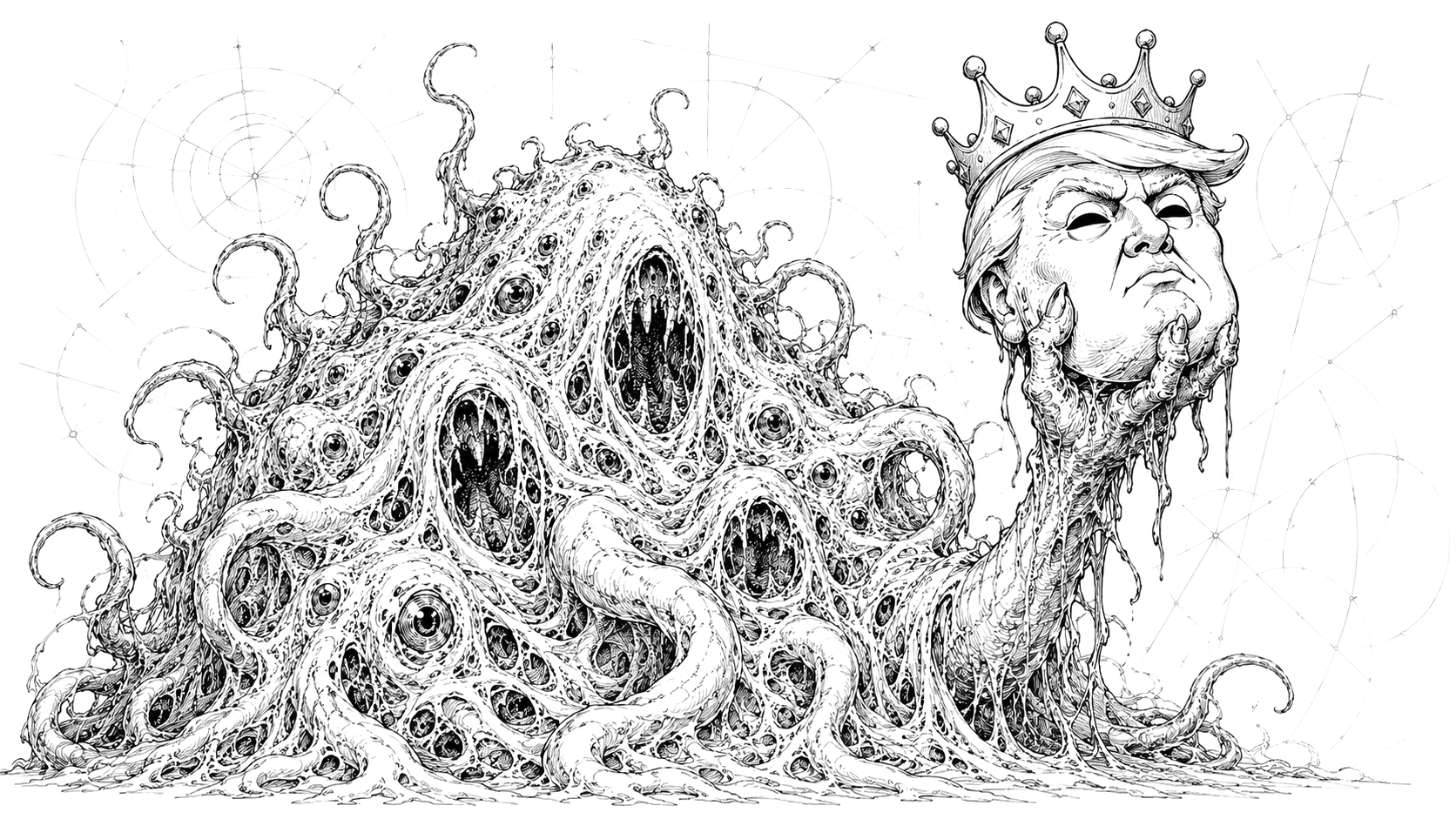
"Regime change" used to be a conspiracy theory, now it’s the outwardly-stated goal, presented as a shtick. MIGA? Regardless of who it is (Iran, Russia, China), to claim that we want to remove a leader and install someone who’s aligned with our own geopolitical interests feels like open-air election-hacking. At least it’s honest. It falls into the idea that Trump may actually be less singular than we think; he’s more like a visible manifestation of the shadow forces that have been at play for decades, but through sheer ego and hubris he makes the monster visible.
More Super Bowl commercial absurdity (from my parent's house): Eugene Levy’s flying eyebrows; UFOs want Doritos, William DeFoe is a pickleball hustler, Seal is a seal, a city of sloths, and a fleshy cowboy head.
I think Trump's assassination attempt might be considered The Fourth Turning in the Strauss-Howe generational theory model. The past turnings have been wars (the Revolutionary War, the Civil War, World War II), but it’s less about a defining conflict, and more about a changing structure of the world. It definitely feels like we’re entering a new world order in more ways than one (America, AI, crypto), but we’ll only know in hindsight. In last cycle it was about American hegemony, in this one I think it will be something like an ASI hegemony. Still points to 2045 as the spiritual crisis.
Here's what AI says about the moral decay of the Roaring Twenties:
“The main moral decays of the “Roaring Twenties” included the widespread disregard for Prohibition laws, leading to a rise in organized crime, a loosening of sexual mores with the “flapper” culture, a growing emphasis on consumerism and materialism, and a perceived decline in traditional values like hard work and family stability, often seen as a clash between urban and rural morals, with the cities being viewed as more decadent.”
I’d guess this era was highly formative of the culture that emerged in Post WWII. To bring this into Strauss-Howe theory, similar to how the spiritual revolution phase II comes to maturity in IV, the decay in IV becomes the foundation of the next phase I.
When people talk about techno-accelerationism, they’re often talking about GDP or Moore’s law, but there’s barely consideration in the specific social fabric that might emerge. I also don’t think we have a theory of collective virtue formation in an open market.
Elon did the Hail Hitler salute. There are so many interpretations, but here’s a middle-ground take: Maybe when a powerful leader is addressing a crowd, it’s almost an archetypal, symbolic gesture to touch your chest and then point it out, to the sky, imagining it like some projectile that extends to the back of the crowd. I don’t know anything about how this came to be associated with Hitler. Perhaps Elon didn’t do this consciously, and perhaps he’s not autistic, but he’s swimming in the same power dynamics that Hitler was. I think that might even be scarier. It’s not a conscious allusion to Hitler, but worse, he independently derived the same gesture.
The inauguration is ominous, Among American flutes and tubas, Overdubbed with sportscasters, A Sgt. Pepper’s collage of faces, Clinton, Cook, Bezos, Musk, All the world’s wealth, All the power, An ark of 500, And towering tyrant Baron, Surrounded by portraits, Grown, scared children, Like us,
But of leaders leading the chasm’s cross, Who here are the truly kind? And which have killed? You wouldn’t know, If you witnessed Rome, In high-resolution, In reflective eyes of Elon, Ghosts of founding fathers hover the rotunda, Looking down, like us, the tele-spectators, On soap operas of our civic machine, $MELANIA is here, $1.5 billion, Her memoir ghostwritten, And Christopher croons, As the sitting Skeleton marches through, The cryptic colonnade that holds DC,
Afront the hillbilly with sharp tongue, Cameras zoom: wigged men with pens, Documents that failed us, Stretched to shreds with mutations of, Alien culture and titanic force, But all the old books, The furling rules and conventions, Won’t help where we’re going, There are no acolytes on this American path,
“The President elect Donald J. Trump,” He missed the kiss on his wife’s cheek by an inch, The pleasantries can’t hide the tension, I imagine Jill Biden pulling a pistol, I imagine these petty, ancient quarrels will soon be pale, For the valley is pregnant not with fruits, But secret, ripening, superintelligence, The speaker now quotes Bob Dylan, She speaks at 1,000 bits per second, Like an ant, Except ants can’t lie,
The people run our country? It’s the troops who bomb and rig elections? Since when has democracy transcended its dress? And now we pray, And draw comparisons to biblical heroes, As they swear in JD Vance With smiling wife, And daughter sucking thumb, I imagine a horrible assassination, Of trump’s head exploding, From some CIA sniper, On an off-camera balcony,
Cannons fire when it becomes official, Marchers chant hallelujahs, The dawn of the Golden Age of America, Sunlight is pouring over the entire world, Momentum will annihilate the shadows, God bends bullets to save the patriot, Self-declared: “Liberation day,” “The most consequential day in American history,” “A revolution of common sense,” “The spirit of the next great frontier is written in our souls.”