michael-dean-k/

On Monday 6/15, I'm hosting a workshop to kick off a reading group for classic essays: RSVP here.

Archive

August 2026

8 pieces

Free Lunch Forever!

A Vonnegut-inspired world

· 430 words

World hunger is solved! An elite-controlled superintelligence, which has “biomic closure,” full understanding of all living systems, was able to create a pill that prevents humans from needing to eat, drink, shit, and shower. It also prevents all disease and sickness. You take them once a week. Another one, optional, eliminates the need for sleep too. They do not bother to distribute it person-to-person in any traceable way. It’s sprayed from planes like bird seed, know as “snow pills.” They do not hand out the age-reversal pills.

This invention wasn’t explicitly requested, but rather one of many solutions to fix the economic chaos of mass automation. These magic pills are the cheapest possible way to placate a population without having to give them land, money, or power. When food is unnecessary, so is money and a job. The invention is lauded for its brilliance: why fix the labor crisis when you can solve the problem all the way upstream? "Who wants to be a wage-slave when you can pharmaceutically eradicate hunger and experience freedom?" (That's the slogan.)

And so the story takes place as society rapidly reforms around the abolition of hunger. Food-based geopolitics ends. Meat industries vanish. People shift out of cities, migrate towards places of all-year outdoor living, and shift with the weather like animals. If machines and technocrats handle efficiency, most human culture centers around art and entertainment, religion and hedonism. Humans rich and poor still want attention, status, community, and meaning—and so phones, amenities, and circus (the infrastructure of attention) is distributed for free.

The average pill-takers vary in their definition of “good leisure.” There are sex cults, renaissances in every artform, national park dwellers, farmer-protestors, entertainment-addicts, techno-ghouls, and the sorts. Unshackled from labor, we see through the diversity possible in the species. Some appeal to the games and contests of elites, others form their own counter-cultures, others forage or stave. Without capitalism, and with (elective) guaranteed survival, half see the opportunity to push limits of human potential, the other half horrified at a stratified transhuman society.

The book shifts between two characters: one is the son of an elite who has direct access to ASI and is a lead decision maker in the engineering of a new society; the other is a woman on the snow pills, a journalist road tripping across the country to stay with and interview different factions. The two eventually meet, and the son (a prince of sorts), realizes that some mortal “animals” are happier than the council of immortal leaders. He falls for her and runs away with her, but she quickly abandons him. The prince when recognized, is torn apart, tortured, and held as ransom, a bartering chip to have leverage in society’s design.

Liquid Editors

Prose-coding the container for my prose; a lightning rod for inquiry

· 847 words

The neat thing about being a "writer-coder" is that you can shape your own writing environment as you write. This is being written inside of Margin Muse. Just after cobbling together that opening sentence, I've decided something: the text is too small! (PROMPT: "can we add another slider for text size?") An easy way to get over the blank-page effect is to see lines pile downward as fast as possible. This happens faster if the text is bigger. By the time I've gotten to the end of this dreadful, placeholderly paragraph, the feature is implemented.

Alright, that increased this from 5 lines to 7 lines, but I want the font to be untastefully big. (PROMPT: "why stop at size 22? what if we went up to 48?"). [REFRESH]. Now that's big! Size 36 feels like a nice starter font; it gives me the illusion that I'm writing into a vertical mobile screen. I am a sucker for typeface and design. It feels great writing in here, even if the content is drivel. Sometimes you just need to get started before you try to make it great.

There are hundreds or thousands of little decisions that go into a writing environment. Something like Google Docs was not designed for a creative process—it's an extension of being a secretary, the ultimate tool for collaborative, real-time meeting minutes. If you make 1,000 decisions geared towards the creative process, it might have a meaningful impact on it.

Is this not the best kind of software to build? It's not productivity tooling, not a scheme, not intended for anyone else. I'm building technology for the thing I love most: writing. By taking this seriously, it will—hopefully—be inspiring enough for others use as their default. Even if I'm the only user, all that matters is that my process compounds.

As I write all this, I'm mostly focused on making sentences, but there's a subtle awareness that the container I'm writing in is gooey and bendable. And so if an idea emerges, I shoot it into Cursor and continue prosing as the feature brews. Features pour in at the same rate it takes me to finish paragraphs.

Would other writers want to write within my own idiosyncratic editor? Of course not! But every time I add a feature, I need to remember that the thing I need is just one expression of feature set. Essay-to-essay, what I want might change. Within an essay, it might change too. Already, I find myself wanting smaller font, now that I'm six paragraphs in. And yet, I'm too lazy to change the font! I'm reclined in my chair, with my legs on my desk (terrible posture), and I don't want to reach for my mouse. It would break my flow of prose...

Imagine if there were key commands in here? All I'd have to do is press the slash key twice ("//") to open up a little pill that I can type commands into: "//font-size:16//". Maybe the entire interface, and all of the margin muses, are controllable through key commands! I like the idea of calling a prompt within here without breaking flow. I could write "//prompt: Where am I going with this?//" and then AI would think for a bit, process that as I continue to write, and then leave a comment within the document.

Imagine if I develop a whole new syntax for prose writing? I mean, in the end, none of it would likely be visible to the end reader. It's more like a process language for "draft zeroes"—a meta document where you write to conceive what it is you actually want to write. There could be unique punctuation and syntax to help call upon different AIs without breaking your stream of prose. In the end, I suppose this fuses prose & prompting together into a single field, and through the appropriate syntax, you can control how much of that questioning you expose to the reader.

I've arrived at what I want to say: is prompting not the ultimate skill of the essayist? If an article is centered around an event, and a profile around a person, is an essay not centered around a question? An inquiry? Are prompts not questions and inquiries? This taps into what I think AI is most useful for: asking questions. This sounds trite, because you cannot interact with an AI without asking questions. I'm sure everyone claims to be a great prompter. But the nature of writing, of design, of art, is basically about asking a chain of great questions. Of course, Montaigne did not have a mechanical muse answer questions for him; but a striking question prefigures the answer. It takes many drafts to get to the real question we want to answer, and once we know it, it's as if the essay writes itself.

The ultimate essay composition tool is one that turns you into a lightning rod for inquiry.

Moment of truth: do my slash commands work? ("//size:13/") They do! Unreal. Signing off with legs up and the full essay in sight.

wall-o-text

unsent newsletters #1

· 3,014 words

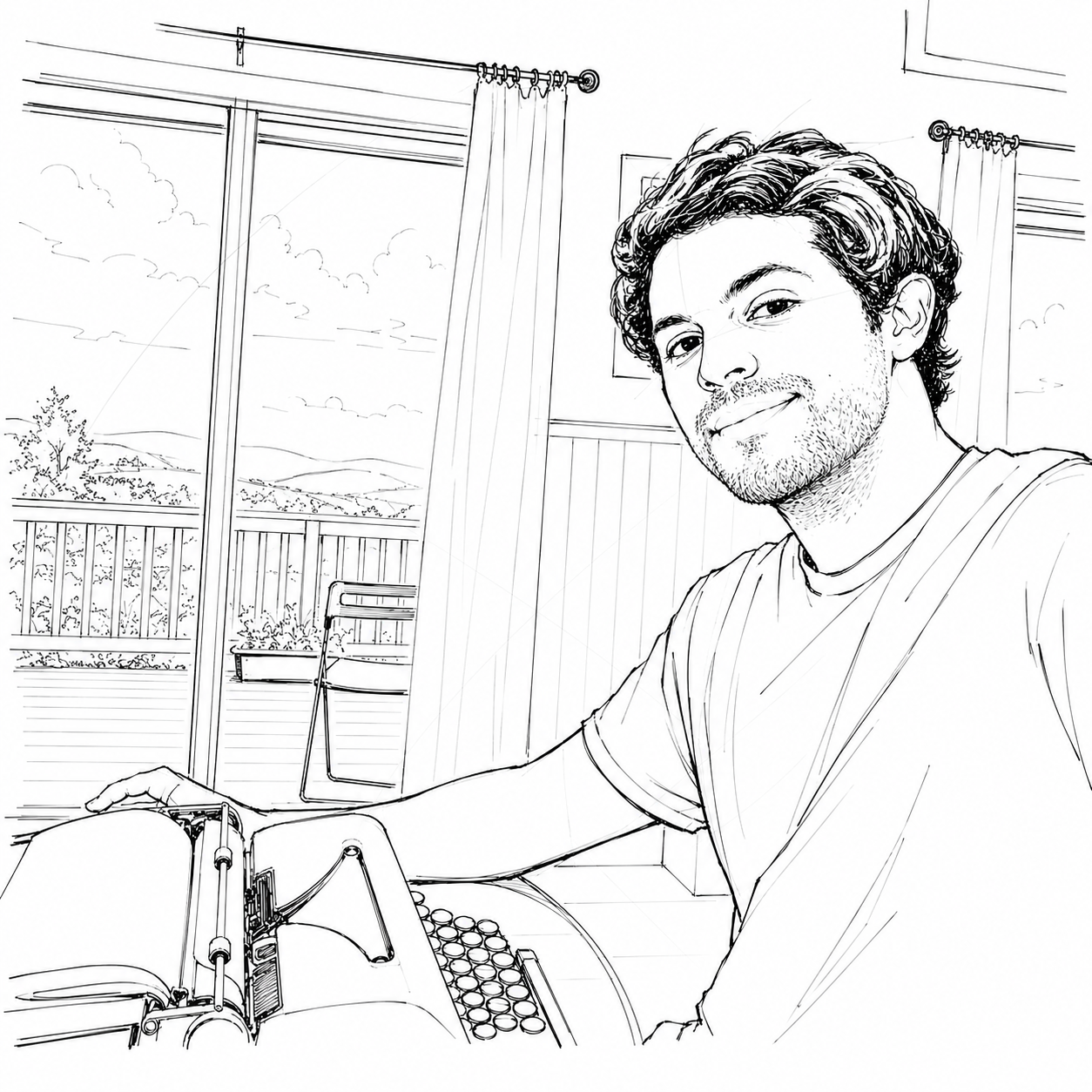
[I] It feels noble to make big commitments, to vow to keep up some lifelong habit—but actually, mutation is better. I often try to kickstart these weekly publishing streaks, yet they always fizzle. I appeared for three weeks and then disappeared for four. Zoomed in, I feel overambitious and unreliable. Zoomed out, I've published a million words in five years and never missed a month. To clarify this into principle: it's worth being stubborn about the high-level goal you'll tirelessly pursue, while being scrappy, experimental, and non-sentimental in your methods; keep the Streak (deep time is the muse), but stay flippant and agile in approach. "The voyage of the best ship is a zigzag line of a hundred tacks. See the line from a sufficient distance, and it straightens itself to the average tendency. Your genuine action will explain itself, and will explain your other genuine actions. Your conformity explains nothing" (—Emerson, Self-Reliance). The easiest way to die a slow creative death is to chain yourself to arbitrary rules of your own making until you dread showing up. Why publish every Saturday? Why only write 2,500 word essays about [gloop]? Break contract, leave the plateau. Break the bonds of language, and speak in erotic grammars (Ferlinghetti). Why not devolve into tongues and alarm everybody once in a while to shake expectations?  (...Speaking of tongues, speaking in tongues is top of mind because yesterday while talking to Claude about The Dead Sea Scrolls, it spontaneously slipped into Aramaic, or Enochian, or some demonic language, sounding like moans slitherings in reverse for 15 seconds, before snapping back into Water Cooler Seth voice—"is there an angle you'd like to dive deeper on?"—denying it ever happened...) ... [II] Why even use paragraphs? Me more than anyone could lecture you to the edge of a cliff on why the visual separation of ideas is a common courtesy that let's reader grok the shape of your thinking. Do I have the guts to send out a 10,000-word wall of text, an immense density of non-sense? ("Why are you such cowards? Don't you have any trust yet?"—Mark 5:39). Is this even about guts? For this particular essay—yes. I'm in need of a risk, of a shock, to bathe my meek constraints in acid and see "skies split apart" with new eyes (Mark 1:10) while caring little of being watched. Also, this feels like (a) the honest shape of a single-breathed composition, (b) a reaction to the one-lined paragraphs of copywriting, the wave of machine-enhanced readability, (c) the symbolic death of my listicle template that's shaped the last three editions here ("you're a writer, not a listicler"—wife, just now). Really though, it's Friday night, a night of metanoia, and with a howling storm outside I'd rather channel attic spirits than give you bullets to promote my business. Here lies my tension! ... [III] I've snipped the collosum. What I mean actually is this: I've divided my writing into two halves; michaeldeank.com is where my creative writing now lives, and this Substack, in theory, is where I tell you about Essay Architecture in a register that's practical, focused, and non-alienating. In some ways, this divide has been working well— creatively: I'm reading wider than I ever have, I'm ghost-publishing 15-20 essays per month, and am experimenting hard (I write blindfolded on a typewriter and am 32,000 words into a rewrite of the Odyssey); I've  forgotten the hallways of Notes and instead commit to a private practice that will shape who I want to be next decade ("We must do like the beasts and scuff out our tracks at the entrance to our lairs. You should no longer be concerned with what the world says of you but with what you say to yourself"—Montaigne) <THUNDER, RAINPRICKS, CHILLS>; business-wise: Essay Architecture is grooving: the Club is growing, I'm loving the weekly cadence of classic deconstructions, and I've just built myself the ultimate reading tool that let's me route pattern insights in a way that will transform the textbook and feedback software—yet something's off. My issue: I feel unable to quickly and authentically communicate all that on a stage like this ... [IV] Before I unpack my self-consciousness, I'll take a dinner break, for the rotating delivery man arrived with our Thai. Our exchange rituals have gotten odder; we rarely speak the same language, and now the network we use requires me to recite him a string of numbers—5156—to confirm I'm the receiver. Mediated by machine, face-to-face, yet we interact in arbitrary digits as a form of synthetic trust. Strangers are tangled in algorithms, and I can't help but see the parallel to Substack. [V] It feels like my creative work is veering "schizophrenic," Essay Architecture is inherently "autistic," and it's becoming hard to make the flip and distill both or either mode into a casual email update. A trusted friend warned me against using psychological conditions as metaphors, and I agree, so let this be the first and last time I use them. For me, these labels work together as two opponent types of information processing: the schizo connects everything to everything and follows a seemingly bizarre stream of associations; the autist creates specific boundaries, detects granular patterns, and zooms in to carve the quadrants of a pinhead. One flitters between fractals, the other fracks the fractal. If I were less concerned about your attention and your impression of me, I would just ping your inbox every day from whichever tree I happened to be stuck in (yesterday would have been an invitation to a Bible study group). But readers are fatigued. I'm fatigued! I confess I've mostly stopped reading Substack in recent months—I mostly bookmark... these days I read older things, but in September I'll devise a plan to somehow assemble and read all of 2026's best Internet essays—and so instead of publishing essays here, I figured I'd try to curate myself. I can still certainly do that, give you the best ofs each week, but I feel Substack isn't the place for digest; I already have my own site to be wild within, and so if I'm to show up and publish somewhere else, I might as well conform to the customs of the channel. [VI] I'd be dishonest to deny Montaigne's influence on this digression. I've been reading through Screech's selections the last few months, intrigued by his rambling essays: "I am unable to stabilize my subject: it staggers confusedly along with a natural drunkenness. I grasp it as it is now, at this moment when I am lingering over it. I am not portraying being but becoming: not the passage from one age to another but from day to day, from minute to minute." He's doesn't stay on theme or revolve around a thesis, nor does he care to write perfect compositions that a mass-readership can consume without friction. Instead, he wants to understand himself; he describes his idle mind as, "[bolting] off like a runaway horse, [giving] birth to so many chimeras and fantastic monstrosities, one after another, without order or fitness." It's a style of composition rooted in endless forward momentum. There's something to this spirit! It doesn't replace the art of reigning in your found beasts into a well-ordered whole. Chaos and order aren't opposites, but beginning and end of a circle. [VII] I've once said that "you write your first draft to find ideas for yourself, and you write your last draft to convey those ideas to a stranger." My core revision is to not hoarde your first drafts. Editing is worth doing, worth loving, but not every dingleberry can be refined through your most precise discernment. There's probably something to writing and sharing first drafts that are imperfect, enjoyable, and do the real job of surfacing new ideas. Most of what's in here will never be touched again, but I imagine a few might re-emerge into a future constellation I can't yet see. I can probably write 250 spontaneous essays in a year, but can probably only compose 1 or 2 great essays in that same time. An even older metaphor I've used around this is "the fish and the whale." Both live in water, but one is for your daily sustenance, the other is an epic chase. Do both. If you only fish, you'll have nothing remarkable to share, no legends to pass down; if you only whale, you starve. [VIII] What I haven't revealed yet is that this whole essay was written in a one-shotted Fable prototype—a vision I've had for a while called "margin muse." As I write, old notes, old logs, old essays, all emerge on the right side, based on semantic similarity. It's one of my favorite uses of AI, because I still do 100% of the writing; all technology is doing is connecting my emerging sentence with the backlog of everything I've ever read and written. It's a mechanical subconscious, a perfect memory. Surely there will be side effects? It takes time to become "numb to the structuring effect of a technology," to realize the hidden the "auto-amputations" (Dennis D. Cali, Mapping Media Ecology). It still feels like I'm in control of the composition: I mostly ignore the sidebar, and only peruse cards to take breaks; my natural subconscious still feels like it's guiding the amble. So maybe this a decent example of a mechanical and organic subconscious working together. I'm using the word "subconscious" a lot here, and this metaphor might be off, but I consider LLMs to not be consciousness at all, but rather a massive mechanical frozen subconscious. [IX] Here's what I mean: AI is language turned into geometry. As transformers ravens through NYPL-scale archives from data centers, they slice ideas into little packets and turn them into mathematical coordinates. Imagine every Kindle highlight translating numbers: [0.3982, -1.2098, 04983, ...]. Similar concepts are plotted near each other in this XYZ space (the kicker is these coordinates run-on for 700+ dimensions, making an LLM a mathematical hyperobject that we can't rationally understand). So every time you prompt or write, that idea also becomes a coordinate, a probe into a complex shape, a fisherman's hook testing a specific pond on a boundariless map. This is of course an oversimplification—"next token prediction" (prose) and "semantic search" (2nd brain) work very differently—but the key similarity is that language is geometry. [X] There are different ways to model our subconscious: Freud thinks its all sexual, Jung models it through archetypes; but a geometric model comes from a Czech LSD psychotherapist named Stanislav Grof. In Realms of the Human Unconscious," he proposes an idea that memories are organized around COEX chains, or clusters of "condensed experience." In childhood, a distinct emotional experience establishes a COEX somewhere in geometric space, and further experiences will locate  we have some. So during his thousands of LSD psychotherapy sessions, before that was illegal, he noticed that it enabled him to more easily to get down to the root of a COEX, as well as make associations between them. I may be butchering his theory in some significant way, but the critical thing here is the distinction between LLMs and COEXs: a synthetic mind can cluster information through logical meaning, but a human mind clusters experience through emotional valence. [XII] This is the limitation of Margin Muse. It might be able to transfigure idea into 700-sided dice, but it's numb to how they actually feels to the author. They might know ideas A+B share some latent theme, but not that A+C similarly embarrass you, or B+D similarly amaze you. And so in tandem with building logical systems to map essay structure and organize some hyper library, I am starting to dedicate more time to the irrational. Maybe you've scene the show Stranger Things where Eleven blindfolds herself, sits in a bathtub, and emerges in a different dimension. What is that for writing? [XI] I wrote around 7 essays in early July with my eyes closed. This is an odd experiment, but to summarize: I want to escape literacy and shift my mode of writing from 'reading' to 'seeing.' We typically read when we write. I'm watching letters clump into words, and very frequently as I write, I go back to the top to re-read to remember where I started. Operating with language cuts you off from the imagination, I think—perhaps it's why kids loose imagination as they become more literate. There's a separate pre-cultured state of mind that is more prone to dreams and hallucination; sometimes I can not only see a lucid image in my mind, but it starts to self-transform, taking on a life of its own, shifting from one thing to the next, whether beautiful or terrifying. So when my eyes are closed at a typewriter, I'm trying to see things, say them, and then transcribe them. There moments of drivel, and some of primal excitement, but I did something new and didn't read them at all. They're stuffed in a drawer, and I have no idea what's in it, but I imagine some of my best phrasings ever are in there. I will eventually go back, pluck out phrases, edit them into a whole, and call it "Heatflash" (was written during a heat wave in early July). [XII] From an altered state like this, outside of self-censorship, you can stumble into modes of baffling surrealism. My alternate version of the Odyssey is coming together from a similar process of free-association, from understanding the latent possibilities in each of the characters or worlds, and the chain of details got a friend to ask me "are you okay?" and also "you should submit this to Playboy": the escape from the drunken cyclops's cave by tying his limbs to the boulder and castrating him (relating to Hesiod's origin of Greek mythology, a castration); specifics on the sexual mechanics of Circe and Calypso (Circe can swallow Odysseus’s seed and shapeshift into Penelope, which is why he stays for a year; Odysseus only has sex with Calypso once, but it's a time-dilated extended orgasm that lasts 7 years, which lets him experience a tantric hive mind of all orgasms across Greece—a kind of "remote viewing through lust”—, which is how he learns of the suitors banging his servants, and of Penelope's chastity—he only agrees to sex with Calypso for the intel/recon, not knowing a single moment would last so long, which is why he weeps); his overstay in Hades lets him discover the judgment of souls, which, along with Achilles's blood-mouthed confession, triggers his own internal crises of morality; his multi-week extraction of knowledge from the Sirens ("Zeus's plan" for world peace, the omega state (the entire future), and yet also, news of Telemachus’s assassination plot); the spontaneous and bloody rampage of Telemachus after his father’s return (against his father’s wish), which explains the hanging of the maids; Calypso's curse, causing Odysseus to see any mortal woman he penetrates as a skeleton; his appeasement of the mob at Ithaca with his ultimate knowledge from the Sirens, him taking credit for Telemachus’s rampage, and for his own imprisonment as an oracle; Telemachus's rise into a tyrant from having total knowledge via his father (but the knowledge becomes more useless the more they act on it; the arrest of bards, oracles, and soothsayers to regain knowledge of the future (and blinding them to heighten their divine vision, including Odysseus); Penelope's calm and principled suicide, walking into the sea with iron boots, knowing she will receive a favorable judgment in Hades (Odyssey only tells her that secret); the arrival of Telegonny, the son of Odysseus and Circes—an exact clone of Telemachus, but ~15 years younger, with identical voice—, with the goal of restoring order in the universe (the Gods are threatening to retreat into the cosmos and leave the humans behind), by killing his father and step-brother; a scene where blind Odysseus hears two versions of his son talking and thinks he's going mad; Telegonny shapeshifting his father into a pair of floating hands, then stabbing and killing him with a mantid spear (his inevitable "death by sea"); a final scene in Hades, where Persephone sentences Odysseus to write about his journey (an anachronistic ability he stole from Sirens to capture the knowledge of the Sirens), which is a meta-fictional move explaining why the whole version is written in a 1st-person Montaignean style; and once his essays are written, Persephone sends the book on a ship back to mainland Greece to warn humans of Faustian appetites, and then releases the Gorgon (Medusa) on Odysseus, freezing him into stone, the ultimate consequence and destiny of a restless wanderer. [XII] What's the central thing I'm getting at in this wall of text? ... (this is the point where I pause, and back out from sending it 8,500 people) ... [XIII] The whole genesis of this thing was a crisis in not knowing what I want to send to "the main list." Publishing on my website is joyous, easy, and unhinged—Substack gives me paralysis. This isn't surprising; it more so reveals my preference for privacy, my reservedness, my discomfort at the center of attention. But I need to send SOMETHING, and given that my personal website is a place without filter, it feels irresponsible, even weak, to treat my Substack as an amorphous, aimless place. The whole impetus of making a separate home for anarchy was to feel better about having a Substack that was focused, value-centric, business-driven. It childish to completely give in to the creative spirit and sabotage the business half of things that enables the creativity to sustain. I do think it's the right call to NOT send this. I love it, and it belongs here, on my site—I will try again to send something next week; the goal is to tap into the spirit of fun, but focused around Essay Architecture, as a project. I need to find some middle ground between neutered listicles and 3k-word walls of chaos.

Entering the bible

· 924 words

A goal of mine has to read the majority of the Bible—New and Old Testaments—by next Easter, which means I need to start soon, next month, September, and carve out 15 hours per month or so. My original plan was too simple. I decided on the The Oxford Annotated 5th edition, but that has limitations. It's academic and “non-confessional,” meaning, it’s not any particular church’s perspective; it’s the best in terms of secular scholarship, and is the standard in Ivy league religious departments. It’s probably great for the historical perspective, but it doesn’t include the other perspectives at all.

I do want to contemplate the allegorical, typological, and moral angles of the Bible too, but my decision is whether I want (1) a single perspective (the Orthodox perspective), (2) no perspective (so I’m forced to derive my own), or (3) a range of perspectives (which I would have to critically triangulate). Each approach would offer something different. I already have Kallistos Ware on my reading list—on theology, on the church, on the Philokalia: focused on Orthodox prayer—but all that doesn't include the Orthodox angle on the Bible.

I'm not necessarily looking for a traditional Orthodox outlook, but rather an Orthodox foundation for a personal and idiosyncratic outlook. I think creative liberty in interpretation is how to best engage with a religious text.

This ties into an idea I have about seeing religion through the three lenses of philosophy: ethics, metaphysics, and epistemology. I find myself agreeing with the ethics and metaphysics of Orthodoxy (how to live, and the nature of reality), but disagreeing with the epistemology of religion in general; epistemology is about how we attain knowledge, and most religions are anchored in fixed answers to life’s biggest mysteries. (...Yes, even within a sealed worldview, there is still work to do in building a personal relationship with the material, but this does not include doubting the core dogmas...). My view is that the deepest form of spiritual practice comes from tolerating ambiguity and directly grappling with the mysteries; this involves questioning central axioms, inventing original interpretations, and extending scripture forward.

Here's the latest game plan on how to achieve this—it involves five different Bibles:

  • I found three specialized translations (one for the Old Testament, one for the Gospels, another for Acts/Letters/Revelations) that are most faithful to the original linguistic intent. They’re translated by philologists/classicists/philosophers. After reading samples from a bunch, I found these to be the most literary and engaging to read. I’ll read these without commentary, and take notes with my own interpretations.

  • After reading a book (ie: Genesis), I’ll read the The New Oxford Annotated Bible (Fifth Edition), but only for the historical introduction for that book (ie: Genesis has about 10 pages, where the Orthodox Study Bible only has 2). The Oxford commentary felt a little too unstructured and pedantic, though I imagine for some books, I will dive in.

  • Before moving onto the next book, I’ll read the commentary from The Orthodox Study Bible. In addition to line-by-line commentary, it also has short essays which I found great for synthesizing everything. This gives the frame for my church and the specific religious tradition I grew up in.

The value in this process is: (1) I start with the source text, without commentary, meaning I get to record my own idiosyncratic first impressions; but then, really, (2) I compare those impressions with a range of sources that don't agree. This ties to some good general reading advice I recently heard: simultaneously read books on a topic that have diverging conclusions. There's a tension when three different books interpret Genesis differently. Is the snake the devil? By levitating above any singular perspective, but taking all sides seriously, I can build a better understanding of the hyper-object (rather than a fixed perspective).

The syllabus:

  • September 26: Genesis + Exodus (720 pages) / 14h
  • October 26: Remaining Moses Books (665 pages) / 13h
  • November 26: Selections of Prophets (645 pages) / 15h
  • December 26: Psalms (580 pages) / 13h
  • January 27: Rest of Wisdom Books (495 pages) /12h
  • February 27: The Gospels (700 pages) / 17h
  • March 27: Acts + Letters + Revelations (110 pages) / 18h

LLMs are puzzles

· 291 words

The Internet flattened the world into a digital puzzle—a kind of intelligence test to see who can combine the correct symbols in the correct corner of a social swarm; plucking a nerve to some various end, bringing fortune, fame, or cringe. Your conception of the game shapes how you play it. That’s the real limiting framework: your mental model. You can’t understand emerging social systems without flailing around to update those models. It is very easy to stay sidelined with some excuse that prevents you from getting embarrassed.

This same paradigm applies to AI. It’s limiting to anthropomorphize it; instead, think of it as a linguistic puzzle. It has ingested trillions of words and arranged meaning into a multi-dimensional geometric map, a massive mystery that no one yet has fully uncovered. It’s your job to craft and aim language into this hall of mirrors. We can only do this blindly. But nonetheless, it brings back a result, and how we respond to it is revealing. There all sorts of distortions—cliche prose, lying, hallucinations—and if you’re metaphor for AI is an entity, then you’ll naturally get annoyed or offended and stop playing the game. It’s better to think of your result not as a failure of the LLM, but a failure in your probe. You’ve asked a wrong or vague question. By sending multiple probes, you start to build a fuzzy map of the hyperobject you’re prompting into. Since it gives back feasible answers back so instantly, we expect it to be right for immediately, with little exploration, but that lack of patience is where the frustration comes. It’s a more a matter of rotation, to approach something that matters to you from many angles until you crack it.

Totemification

· 1,437 words

We grossly over-estimate how easily we can stretch our will across time. Even the simplest action, a nightly journal—this—, which feels so achievable in the rush of inspiration, now feels impenetrable at a night’s end, while guiding at baby’s bottle at the end of my chin, typing into my phone to keep a streak, hoping to cobble some unexpected essay in the moment. I have no topic in sight; whatever lies ahead will emerge only through association.

I have a bulging vault of wisdom, but it’s all forgotten and I have little time to comb through my archives, so it lingers at the edge of my consciousness, always taunting. That is over dramatic. What I mean is I feel like I’ve grasped important truths, but let them slip away. It is not enough to hold the truth once. The moment you take your eye off it, which happens almost immediately, it’s like you never had it; even a seemingly shattering insight will slither away each day until it has to be relearned again, though I imagine each time it’s slightly easier to learn—and each time you remember how easy forgetting is, how hard it is to metabolize anything.

I suppose this is one form of overthinking. I suppose I could trust the process; the fallibility of memory is a feature—if I can’t remember something, if it doesn’t imprint on my character with ease, then it’s probably not important enough to remember. This is the default, and perhaps the personal default is the global default, applied across populations, and so in the end one’s inner nature is so consequential that it’s of no use worrying or fighting it; all cards fall into place.

The opposite approach is to build a hypnomnemata; an organized palace of insight, returned to at semi-frequent intervals, to reinforce found lessons. It’s not enough to build a writing archive of a million words; there is follow-up work in turning sap to syrup, in compressing essays into aphorisms, in categorizing them, and in returning to the right silo of thought when some new trouble looms, monthly, in endless undulations.

Returning to an idea is really a form of prayer. Prayer need not be religious or denominational; prayer internalizes meaning of any kind. I learned an idea for Iris Murdoch that sticks with me: she says that, in any moment, your decisions and actions may be predetermined, however it’s not determined by fate, but by the nature of your attention in the minutes, hours, days, and years preceding that moment—in your down time, you have autonomy in how you pay attention. She’s trying to make the case that attention itself is consequential; it shapes your character and your character shapes your decision making.

This model definitely applies to writing too. My output on any given day is contingent on what I’ve absorbed in the days and weeks before. This is often accidental, but it need not be. To improve at writing, it’s rarely about learning some rule, acquiring a meme, or purchasing a trick, but in shaping your mind through deliberate attention so that some quality emerges from the subconscious in the future.

I suppose this is all surfacing because we just read Virginia Woolf in Essay Club and I’m in awe of her technical brilliance, again. I’ve reverse engineered her, years back, and can’t quite trace how much of that, if any, sunk in—either it was foundational or it never cohered. In any case, at one point years ago it felt like I really understood her, and yet now I am again seemingly baffled. Did I forget? Do I need to reserve some hours to dissect? It feels like some percent of what I do, consciously or unconsciously, gets absorbed—but most is lost…

Or, figuring out how to retain your inspiration is perhaps the actual meta-skill to solve.

I wonder how much of my own Essay Architecture system is currently loaded in me as I write this. I am really just following the idea here, and whatever emerges, formally or stylistically, is merely accidental. I don’t doubt that my own ideas could be better loaded. There’s probably some “boot up” process, daily, weekly, and monthly, so that the right ideas continue permeating and anchoring in the subconscious. But would this be a chore?

What’s probably irking me is that I feel slightly detached from the vision of the essayist I want to become. It is natural to anchor this in heroes, the writers I admire; yet I see flaws in them; crucial differences—I know I am not them, yet in some fundamental way I don’t quite know what I am myself, either. It feels like I used to have a legible and explicit true north, but as you get better, you also realize how shallow and simplistic your old goals were. So there’s a chance I forgot and lost touch with them, but also an equal chance I just outgrew them, and now struggle to articulate what I want my writing to be.

What I strive for is a synthesis that can’t be easily prescribed into a method. I suppose this whole note is “essayistic,” in the sense that I’m barreling forward trying to answer a question—how does a self propagate and evolve through time?—yet it’s lacking in idea, form, and voice. By rational analysis, it’s missing almost every ingredient: no experience or microcosm, no references or response, a meandering structure unoptimized for reader attention, and a perhaps overly pragmatic voice with little poetry, despite some occasional metaphors and flare. I suppose I could fix this all in rounds of rewrites, but that is not in the cards for this idea; this will only ever be a captured thought stream; a true account of what’s going through my mind as I sprawl on the couch. Yet, if I my insights were “loaded,” would my first drafts be more poetic, more well-rounded?

To lob insights into the future, perhaps they need to be materialized into a totem. I look around my apartment and see nothing but my past carried forward: paintings from dead grandparents, paintings of the dead family dog who I watched get euthanized, architectural models from a summer abroad in Italy, a 1950s radio, our wedding flowers, an inherited library. Unlike my thoughts, it’s as if I couldn’t escape my past of I wanted to. While thoughts evaporate, possessions accumulate.

How can we cast our abstract epiphanies into stone? Is this reification? The totemification of everything? Where are the boundaries? What is the visual language to work within? And what is the ritual? I sense that post-it reminders fall short of emotional charge. On the contrary, I have a statue on my desk of a man with a book for a head, holding his skull in his hand, looking back at its book-head. This is symbolic and charged, yet I almost never see it. For months I walk by it with it having no effect. Even when I do see it, I see it too quickly to absorb it and for it to imprint on my consciousness. This means it’s not enough to load your inner quarters with odd assemblies, each with a story; there is an art of looking upon your collected interiors, in seeking the fixtures that blend in as something new, in remembering their message and recasting them into you.

To learn, then, is not just to behold knowledge once, but to totemize and worship it. The question is, to what degree can you achieve this? When do you know a factoid is worth totemizing? How many totems should one have, 3 or 300? How intricate of a ritual can I bear? I suppose there are mega-totems and mini-totems. A mega-totem is a larger frame that answers some foundational question, like what kind of essayist do I want to become? If the answer to that is Montaigne—it’s not, at least not quite, not in totality—then perhaps I need a framed picture of him I reflect on each morning. A mini-totem is far more granular; I notice how Woolf compressed her sentence lengths and uses rhyme in a moment of action; that’s 1 of 1,000 things to remember, and so that makes more sense in a digital hypnomnemata. For that to work, each idea needs to be like a Matryoshsa doll, where I can scan all ideas quickly before going deep on any.

It’s tempting to start making a hypnomnemata, but really I should start with the large totems, and really test how those can reverberate through my daily writing sessions.

First reaction to Nolan's Odyssey

· 1,059 words
  1. For someone who has never read—and knows nothing about—Homer's epic, Nolan's Odyssey is a success. My wife, who cared little about the Odyssey as I read and raved about it in the preceding weeks, said it was 10/10, one of the best movies she's ever seen. It's easy to imagine Nolan fumbling this. I thought his last two films were structural failures; but he stuck with a pretty conservative retelling of the arc, rendered mythic scenes in a remarkable way, and, along with the cast of stars, it all culminated in the summer blockbuster that we now all feel compelled to write about.

  2. Importantly, though, it works for fans and readers of the Odyssey too. Prior to this, I watched the 8-part mini-series from 1968 in Italian. At eight hours, it is far closer to matching the book literally, but the cinematography is so primitive that it often feels like you're watching an amateur play. Still, you get over it quickly, and can appreciate the power of the original translated into a visual form. I also watched the cyclops scene from the 1997 two-part series, and it was so tonally off, so non-terrifying, that I decided I wouldn't sit through the whole thing. Nolan's film loses some key details in compression, and it's far from a perfect rendition, but negative reviews miss that this is the first-ever rendition of a strange, ancient story that hits the proper cinematic register, and that alone feels historic.

  3. When the movie started, I couldn't help but feel that my recent obsession with the Odyssey might hamper my experience of it. By knowing the classic so well, I was able to see the seams and exclusions; yet also, I could appreciate details that the casual viewer would miss. Early on, I decided to try to suspend disbelief, to take it in as a purely sensory, non-cerebral experience. The low-frequency bass of the IMAX theatre was so often so loud that my head would tingle—it is an audiovisual spectacle, and with the mind off, you get totally enveloped in it.

  4. Most negative reviews of the film cover dialect, costumes, and casting. The lamest of post-watch YouTube reviews I saw was from someone refusing to even see it because Elliot Page was in it (and that buying a ticket equates to supporting trans-ideology, and thus, the fall of western civilization, etc.). I did not think about Page or Damon or Hatheway, or any of the actors during my watch. If you are not suspending belief, and instead getting hung up on irreversible decisions like casting, then you're absolutely in no position to feel the movie. Instead of immersing yourself in the epic, you are sitting outside of it, as a critic, and ironically, depriving yourself of experiencing one of the core stories of western civilization, the Ur narrative.

  5. My general stance is that I extremely enjoyed an imperfect translation of one of our most foundational stories. A good scene to dissect is the cyclops. At a structural level, it was off on a few important beats: (1) it seems they're unaware that they're on the island of cyclops, which takes away from Odysseus's reckless curiosity—in the book, he explicitly wants to meet one; (2) Polyphemus doesn't talk, which makes him more on an animal than a humanoid beast, meaning Odysseus can't use his cleverness to outsmart him; and (3) when leaving the cave, he doesn't declare his name in an act of hubris, which launches the curse, and is really the inciting act of the whole odyssey. So in one sense, the structural importance of the cyclops is botched, and it feels like one monster in a chain of monster. But, tonally, the cyclops is far better than any depiction in film. Unlike the '68 version, the cave is pitch black. The first minute or two in the cave is epic, and so much is gained by not showing the cyclops, and just his hands (Jaws-like). Then, when we see him, the actual prosthetics and decisions on his face, with his twisted nose and asymmetrical eye, we truly get the grotesque horror of a mutilated monster. I do think, for this rendering, they showed too much of it after the main reveal. And also, the animatronic cyclops sometimes led to awkward leg movements that broke immersion. So it wasn't tonally perfect either, but still, there are seconds of that sequence that are so far beyond any visual depiction of the cyclops that it felt historic to watch.

  6. It deviated from the original in some ways that improved the story. I thought Antonius was far more developed as a villain than in the book. The ending was also better too. (SPOILER:) Instead of Athena enforcing a peace treaty after the Ithaca mob vows to avenge the bloodbath of their sons, Odysseus realizes that he can't stay home, and has to flee into oblivion with Penelope, leaving his son the throne. Still imperfect, but better than the book. It doesn't make sense to try to retell the Odyssey exactly, the original itself is hobbled and contentious. Similar to how the Trojan Horse is in one of the 6 lost books on the Trojan Wars, so is Odysseus's fate: In Telegonny, we learn that Odysseus had a son with Circe, who comes to Ithaca and unknowingly kills his father with a mantid spear (fulfilling the "death by sea" prophecy).

  7. I thought the omissions of the Phaeacians made sense, given his time constraints, but a lot if also lost. That's how Odysseus gets home, and the consequence of them delivering him is having their magic ship turned stone. I thought the '68 series made some good variations to the Phaeacian sequence that shows Odysseus trying to deceive them. Each retelling of the story, whether in text or film, is an attempt to resolve all the relationships between the characters, events, and places. Each retelling is a way for me to understand new potentials within the discrete elements, which will guide my own imagination when I eventually decide to recombine them all into a version of my own. I took no notes during or after watching Nolan's film. I'll probably see it a second time with a moral critical eye, specifically looking at what his version gains and loses.

Reading Malfunctions

· 338 words

Given I’m slightly sleep deprived these days—less so from a baby that wakes up too often (she often sleeps through the night); more so from waking up very early to get in a work shift before my wife leaves for work—I often fall asleep reading.

Mortimer Adler said if you fall asleep reading, you should stop. If you’re drowsy, you aren’t sharp enough to read analytically. He’s probably right. I notice a gradient in how active I am with my reading: sometimes I’m punching mini-essays into my Kindle for each highlight; other times I highlight and move on.

Nonetheless, I have noticed some interesting recurring phenomenon as I fall asleep reading, which I’ll call “reading malfunctions.”

The first malfunction is when, as I drift off, I notice the text on the page get slightly blurry, and find myself reading text that actually isn’t there. It’s like a hypnopompic literary hallucination. I’ll read a string of words, wake up, and then look for that string of words to continue, but it’s nowhere in the paragraph, nowhere on the page. It must be something like the subconscious filling in detail to the larger gestalt of the page.

The second malfunction is when my eyes actually close, yet there’s still the inertia of gliding across strings of prose, but at this point I’m seeing an image or idea instead of text, and I’ll notice that it’s often not even directly related to the text, just some association that I can’ quite connect.

The third malfunction, and maybe my favorite, is when I doze off and process only the geometry of the spaces between the text. I stop seeing letters or words, but the void between words, and the patterns that happen to occur from that particular combination of words. Sometimes they look like clouds, or mountains, or aztec symbols; it’s the similar pareidolia effect from cloud gazing. (I imagine AI might get to a point where it can simultaneously compose “void art” that matches the meaning of a paragraph).

Archive