michael-dean-k/

On Monday 6/15, I'm hosting a workshop to kick off a reading group for classic essays: RSVP here.

Archive

June 2026

15 pieces

How should an essay writer read differently?

On building a syllabus, reading analytically, and the 12 essays we're reading in Essay Club

I've been circling this question for a few months now. As a new parent I find little predictable focus time but a surge in unpredictable reading time. I have always been semi-intentional with what I read (essay books), but this seemed like a new opportunity. What started as a simple question spiraled into an unruly project: simple book searches grew into a multi-year 121-book personal reading syllabus along with two custom apps, one to plan my reading each month, and another to organize my Kindle highlights, letting me write response essays that get auto-published to my website. Underpinning all of this is the belief that the essays I write emerge from my life and library. You become your syllabus.

Naturally, a good portion of my syllabus contains classic essay books, from Montaigne backwards and forwards, back to some proto-essayists of antiquity, and forward to living writers. While I read non-fiction and history for ideas, fiction and poetry for feeling, I read essays for form, to understand the composition patterns I can use in my own writing and editing. The best way to do this is to teach. I suppose Essay Architecture as a whole is an act of teaching, but part of this new reading project is live teaching, through sessions on Zoom.

This post is a recap of a workshop I gave on Monday, June 15th (2026). It covers both the high-level questions of mine in terms of "how should an essay writer read?" but then zooms into the practical: how you can join us this summer to analytically read a classic essay every week.
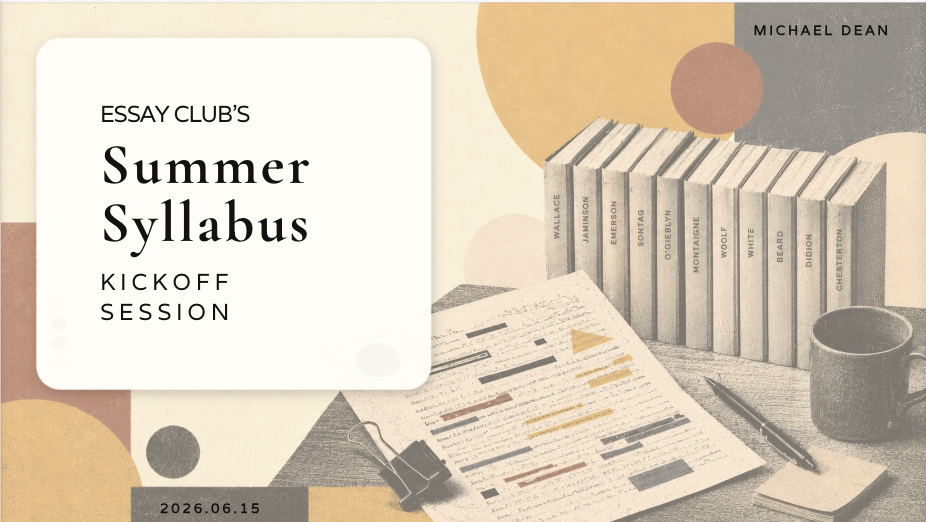
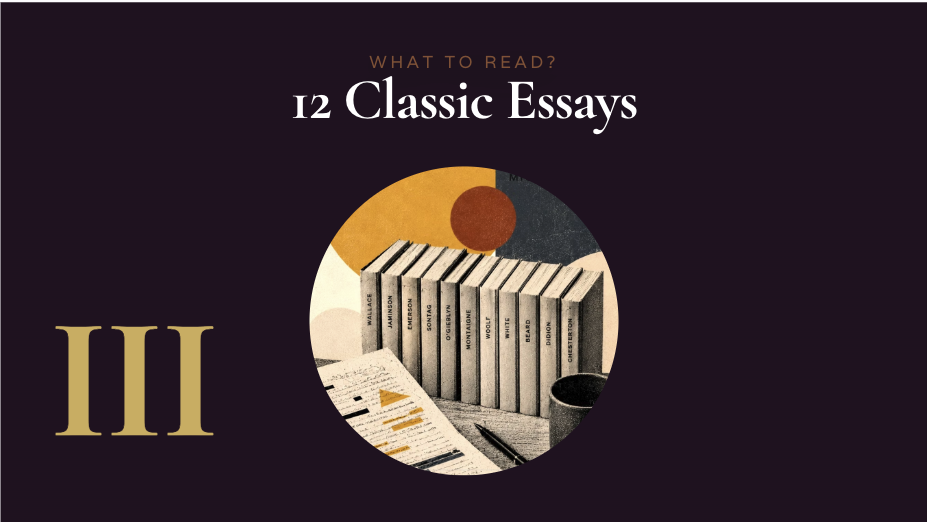
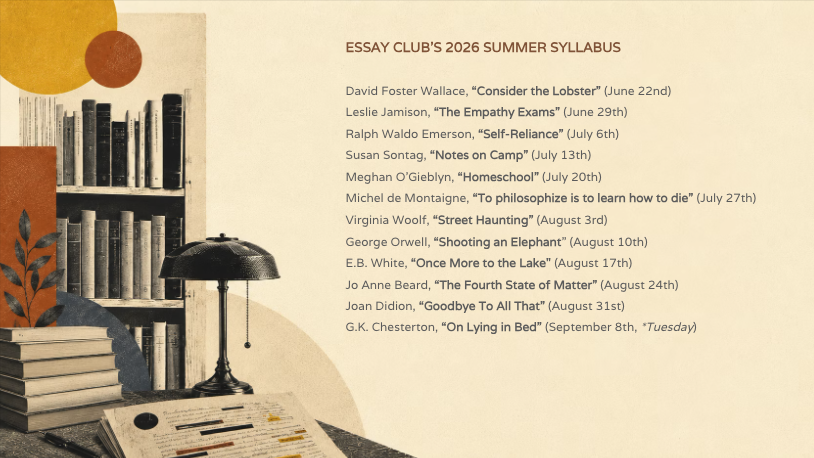
I'll start by getting to the point: here's the syllabus. I imagine you've heard of many or most of these writers, but maybe you've never read their core essays, or maybe you have but never read them analytically to understand how they work. That's our goal.

  1. David Foster Wallace, "Consider the Lobster" (June 22nd)
  2. Leslie Jamison, "The Empathy Exams" (June 29th)
  3. Ralph Waldo Emerson, "Self-Reliance" (July 6th)
  4. Susan Sontag, "Notes on Camp" (July 13th)
  5. Meghan O'Gieblyn, "Homeschool" (July 20th)
  6. Michel de Montaigne, "To philosophize is to learn how to die" (July 27th)
  7. Virginia Woolf, "Street Haunting" (August 3rd)
  8. George Orwell, "Shooting an Elephant" (August 10th)
  9. E.B. White, "Once More to the Lake" (August 17th)
  10. Jo Anne Beard, "The Fourth State of Matter" (August 24th)
  11. Joan Didion, "Goodbye To All That" (August 31st)
  12. G.K. Chesterton, "On Lying in Bed" (September 8th, *Tuesday)

Before I get too theoretical on the philosophy or mechanics of reading, I'll share what we actually plan to do each week (on Mondays at 7pm ET). I run a community called Essay Club—which has 60 of us and has been running for 2.5 years now—and we kicked off 2026 with "monthly readings." Our members voted for this—among other features—but I originally set it up like a traditional book club with assigned readings (and nobody wants homework). We quickly realized that since essays are short, we could read them together on the call. We've run this session four times now, and I guess I would call it a "co-reading" experience, which feels sort of novel.

Here's how it works:

  • I start with a 5-10 minute presentation where I give you context on the writer, and show you diagrams to illustrate some of patterns that the essay is representative of.
  • We all read for 20-30 minutes in the same shared document and comment as we read. This let's you see how different people are all reacting to the same material. In case you can't make the session live, you'll still be able to read along through our shared doc.
  • After that we jump into breakout rooms to talk it through, and then reconvene as a group.
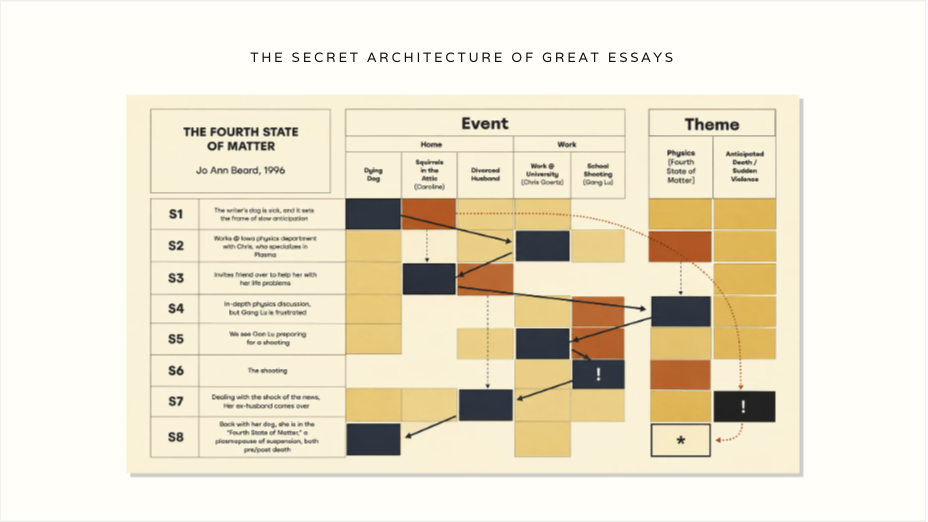
Here's a diagram of Jo Anne Beard's "Fourth State of Matter," which we're reading in August.

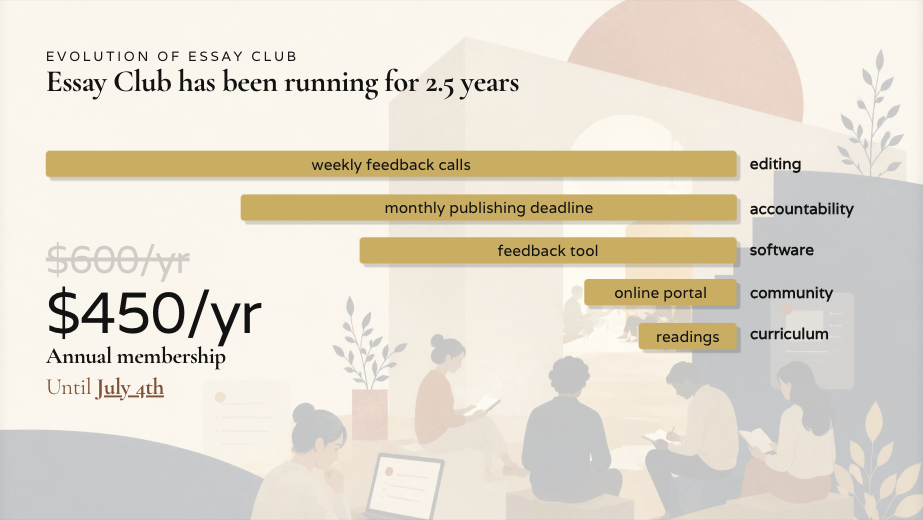
I included the links above in case you want to read through these on your own, but Essay Club give you the accountability to actually stick with it. Reading ambitions are one of the easiest things to deprioritize when you get busy. Honestly, I'm partly doing this for myself; it forces me to show up every week with a firm understanding of how each essay is working (and it also helps me expand v2 of the textbook with a rich example bank). Most importantly, we aren't reading for reading's sake—which BTW is totally valid—but our main goal is to publish essays; we also have weekly feedback calls Friday at 3pm ET, and all aim to publish one piece at the edge of our ability by the 1st of each month.

If you're considering joining, check out the Essay Club website, and when you're ready you can sign up for an annual membership here, which is discounted at $450/yr through July 4th. The rest of this post is about how I'm personally thinking through my reading practice, covering everything from how to build a syllabus to how to read analytically and syntopically. I think it will give you helpful context whether you want to join Essay Club or want to build a syllabus of your own. (I actually recommend both: join a community to study essay form, but then build your own path that's more specific to what you're writing about).

An essay is made made of Material that orbits a Thesis. That material comes from your life and your library, so in some fundamental sense, you're only limited by how you live and what you read. I guess the real question is though, are you reading in a way so that it oozes into your writing?

There are all sorts of annoying reading maxims—on what you should read ("only read primary sources, never commentary or summaries"), how you should read ("never listen at 2x speed"), the volume of reading (X books per year)—that get disconnected from a reader's specific goal. All advice is contingent on your goal. A friend of mine reads for the purpose of doing something analog and relaxing before bed that isn't scrolling, and it would be dense of me to insist that he highlight excerpts and diagram the structure.
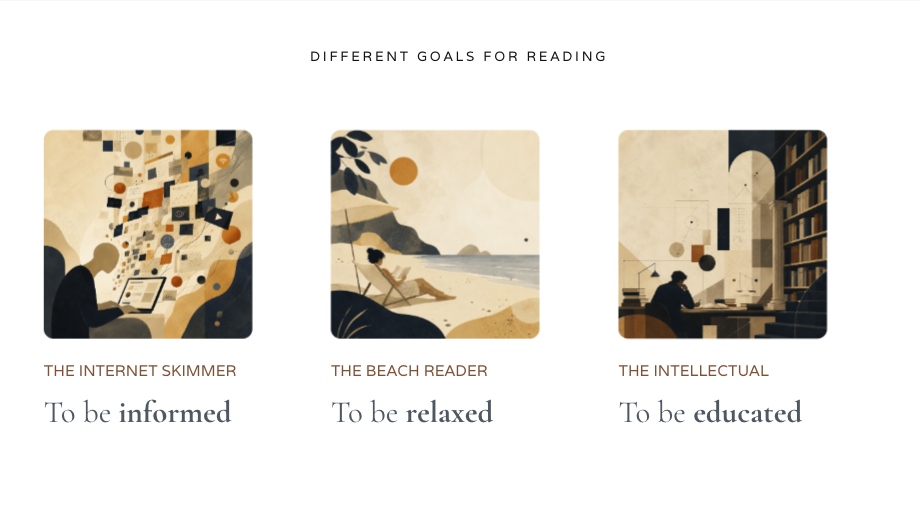
There are secondary reasons why I read of course—sometimes I'll binge Internet articles to makes sense of an event, or scour Wikipedia to become articulate in a sphere I feel like disoriented in—but the core reason I read is to evolve my writing. It's impossible to know exactly how reading changes you, but over time, in very noticeable ways, it all gets imperfectly synthesized through your writing. The inputs shape the outputs.
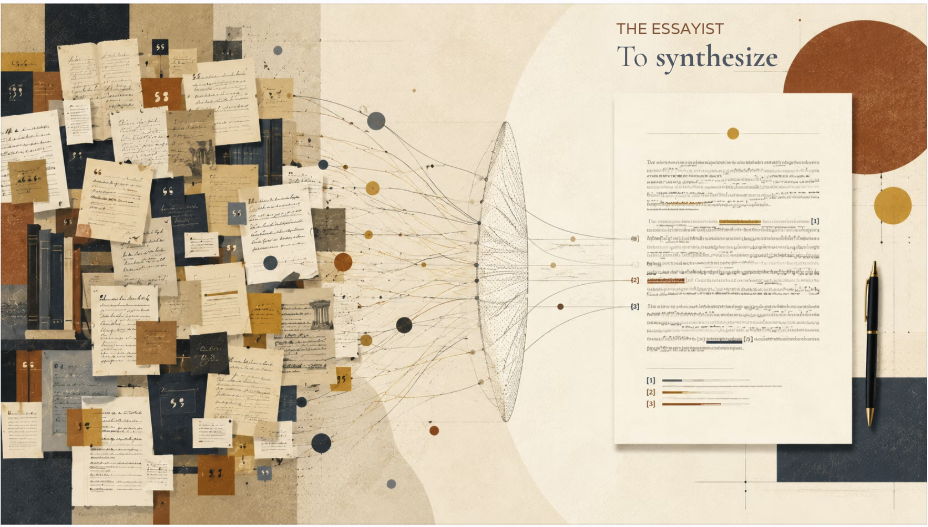
It's not about vanity book counts or the recital of facts at meetups, but slowly shaping the future corpus. I subconsciously absorb a writer's voice, consciously break down essays to see how they work, and save excerpts that becomes prompts for original essays. Here's an app I built to browse highlights; anything I write in the text field on the right gets auto-synced to my website.
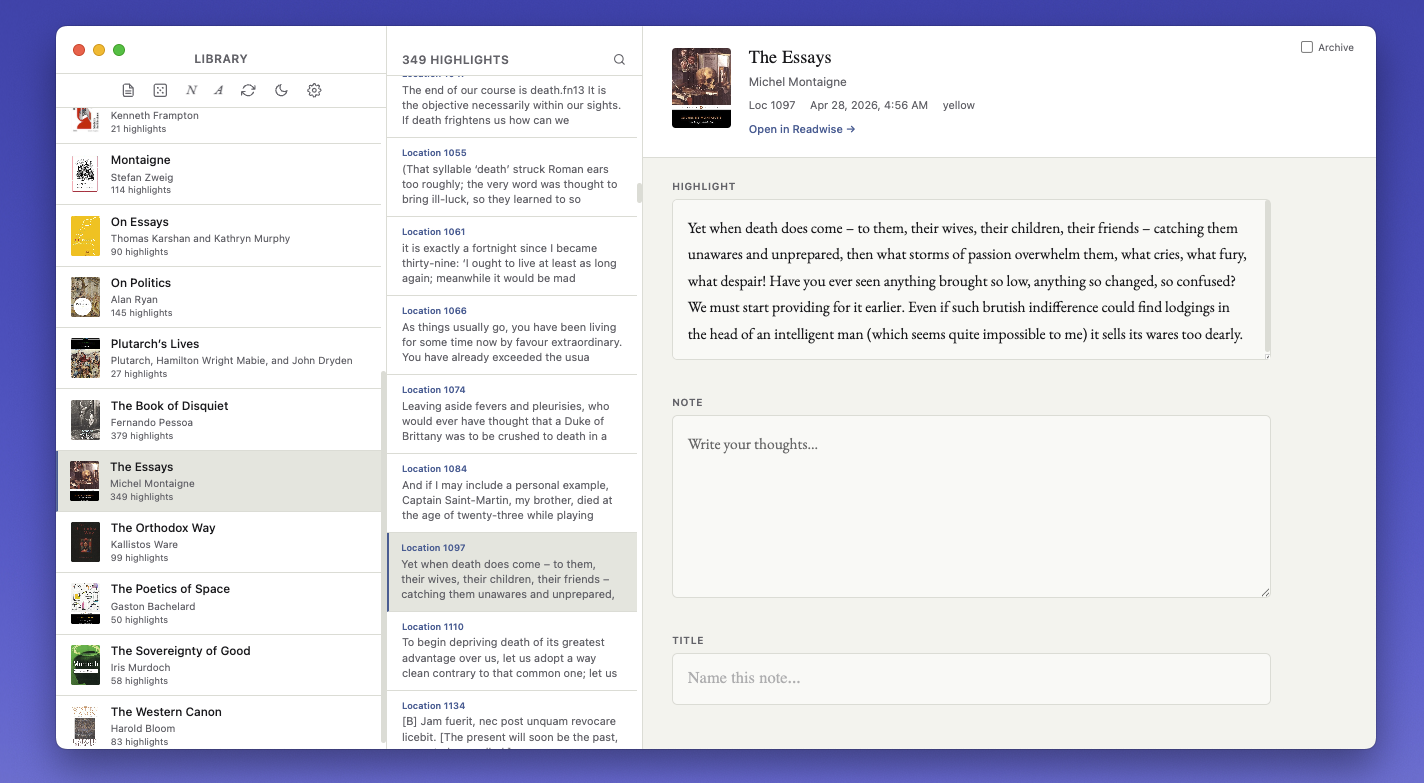
This idea of "responding" to the authors I read was inspired by going deeper into Montaigne. If Montaigne were to be described for a single thing, it's that "he is the subject of his book," which was radical for the time; this gives the impression that all his ideas derive from his own life and mind. On the contrary, a typical essay of his might be peppered with 30 or so quotes from antiquity, featuring Plutarch, Seneca, Epicurus, Augustine, etc. He was a man of his library, and the genre of essay was forged by Montaigne's commonplace book, setting a very literal example for how your inputs shape your outputs.

A modern inspiration is Virginia Woolf, whose first two essay volumes were titled, "The Common Reader." These were responses and extensions of her reading diet, which was extremely polymathic in range. She was reading the Ancient Greeks (in Greek), the Romantic poets, Victorian biographies, Montaigne, and more, simultaneously, each shaping the topics of her writing, and the voice that would come to be her own.
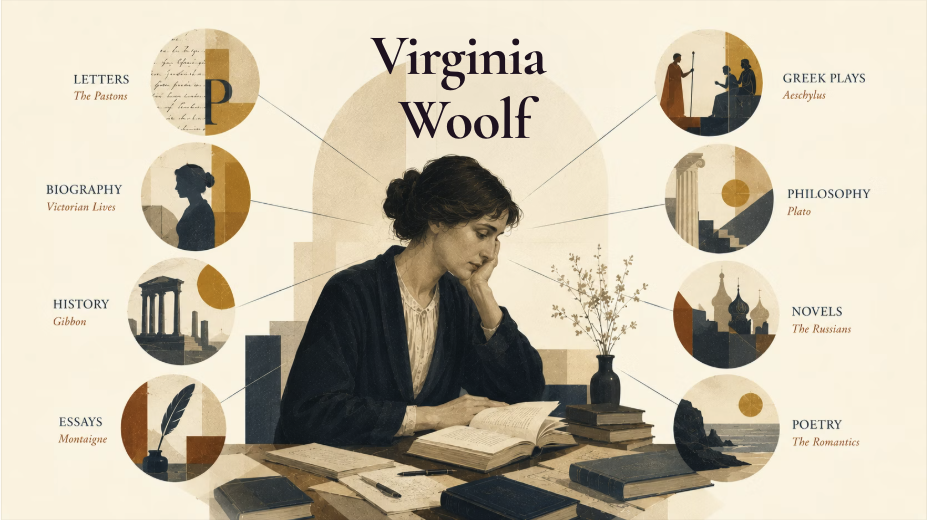
It's been two years since I've committed to reading essay books, but I see this new syllabus project as a chance to widen the aperture. I've re-examined my physical library, found out lists, gathered recommendations, and found the inspirations of my inspirations. As the list grew, I split it into four genres, each of which I think will offer me something unique as an essay writer.
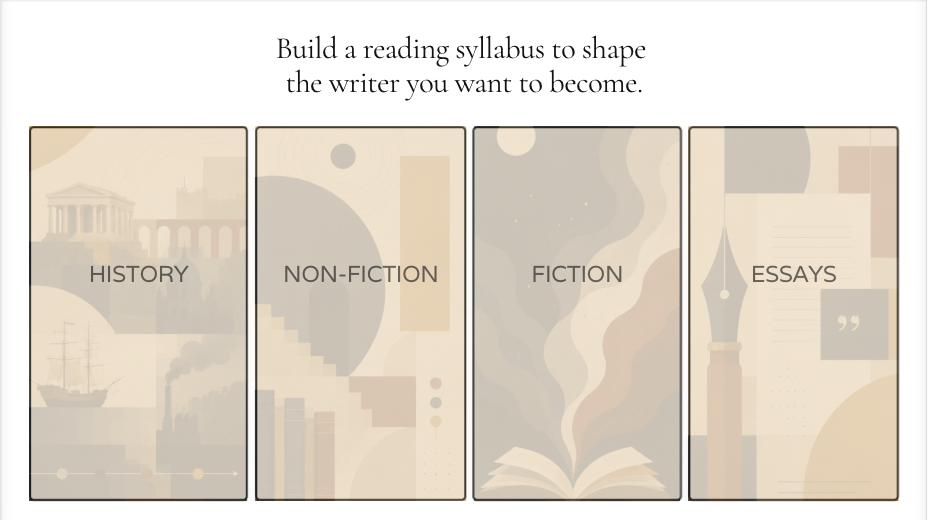
I'm reading History to build fuzzy maps across disciplines. It's about breadth. I'm looking for historians, curators, and biographers who can write literary textbooks (informative, but fun to read). This goes against the maxim of "read primary sources." If I were to read the western canon in full, it might take me 10 years and bottleneck my own publishing. Instead, I can read a chapter per month of Harold Bloom's The Western Canon, and slowly build a model of the history of literature. Who are the Bloom's in each domain? The goal is to slowly read many textbooks in parallel, each at a chapter per month. As an essay writer, I want to be able to quickly connect original ideas to historical ones. Sure, I could use AI to surface these connections, but I'd rather have concepts and figures available in the substrate of thought itself.
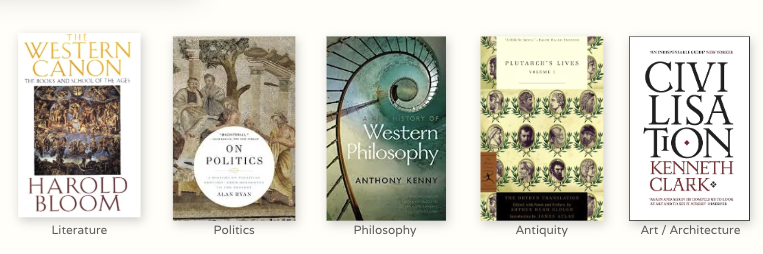
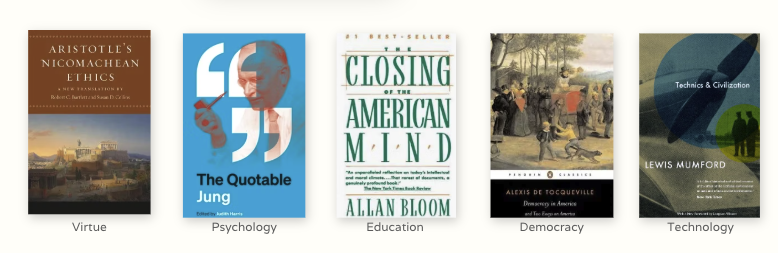
I'm reading Non-fiction to go deep on specific topics that I want to write essays on. That means this list should look different for each writer. I've gathered books across 5 categories: moral philosophy, perception, education, technology, and democracy. By having a list of many books around a single idea, I can read "syntopically" (more on that later). Realistically, among all my other reading, I can only read one of these per month.
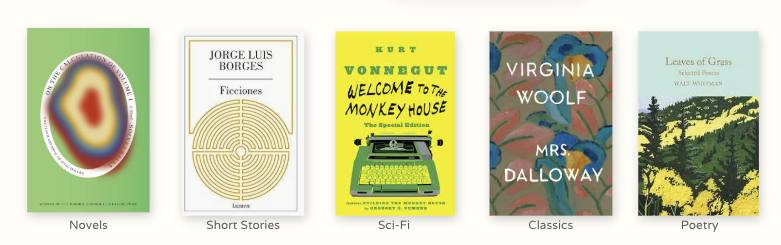
I'm reading Fiction to understand narrative and feeling. Unlike the last two genres, this one is less about idea collection and more about experience the range of ways literature can move you, and understanding the art of the microcosm. I'm convinced that David Foster Wallace is such a good essayist because he was focused on fiction; this makes his essays very allegorical, where abstract concepts are baked into tangible characters, places, and situations. I intentionally don't have long books on my syllabus (ie: no Middlemarch, Moby Dick, or Infinite Jest), because again I can't read more than one of these per month. I limited my search to novels under 250 words, and to short story collections—the picks are evenly split between modern, classic, and science fiction.
I'm reading Essays to understand the form. It surprises me when I learn that aspiring essay writers on Substack don't read the history of the genre they write in. It's a 1:1 translation, and you not only get a complete literary experience in a single sitting, but you get to absorb pattens to bring into your own work, whether deliberately or through osmosis. Personally, I'm trying to read across time periods (thought not in any particular oder), along with specialized anthologies—including all 40 introductions to The Best American Essays series—and some works in popular literary theory, the main two being Essayists on the Essay and On Essays.

If you're interested in building out a syllabus, you need to factor in both what you're actually interested in, and what you have the bandwidth for. But at the very minimum, if you have a publishing cadence for essays, you should consider a reading cadence for classic essays too. I've done a daily classic per day, and it's very doable, but to fully digest and teach these, I'm slowing it down to one per week.
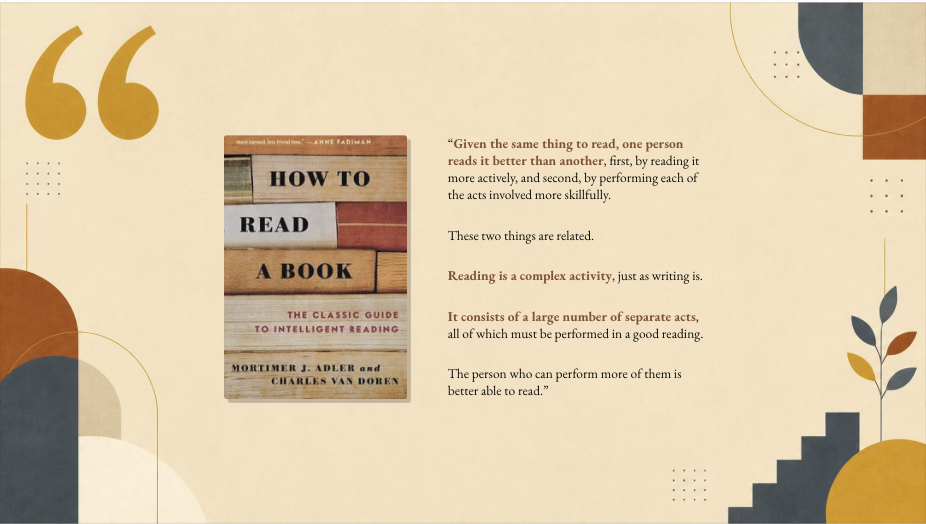
I'm going to read Reading Like a Writer, once I finish How to Read a Book, which is a funny title that gets laughs whenever I bring it up. The paradox is straightforward: if you can read, why read the book?; and if you can't read, how will you be able to read the book?"
This assumes reading is a binary thing—are you literate or not?—when really it's more like skiing or carpentry or writing, a skill with multiple levels of difficulty.

From Mortimer J. Adler and Charles Can Doren's "How to Read a Book":

"Given the same thing to read, one person reads it better than another, first, by reading it more actively, and second, by performing each of the acts more skillfully. These two things are related. Reading is a complex activity, just as writing is. It consists of a large number of separate acts, all of which must be performed in a good reading. The person who can perform more of them is better able to read."
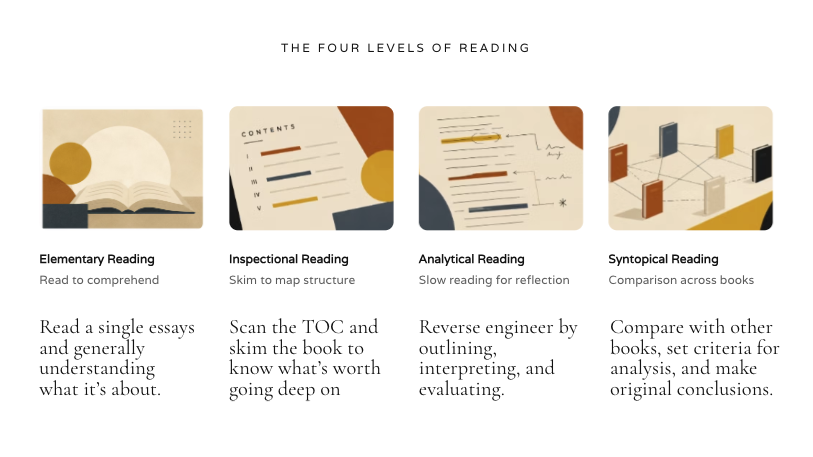
The book breaks down four levels of reading, each one stacked atop the other.

  • Elementary Reading is about basic comprehension: do you get it? It's very possible to read Heidegger or Dostoyevsky or any of the convoluted jargon-filled architecture theory textbook and walk away without a firm idea of what's been actually been said. Without an elementary understanding, it's hard to do anything at the higher levels.
  • Inspectional Reading is not something I've done much of before recently building out my personal syllabus. It's not quite "speed reading," (at 2-3x speed) but flipping through an entire book in 30 minutes, scanning the table of contents and selectively reading parts—ie: the first paragraph of each chapter—to get a feel for the prose and ideas. This helps you decide if it's worth reading in full. Maybe you only need to read a specific chapter based on your writing goals. Those 30 minutes might save you 30 hours of toil. If you're building a long term reading plan, it becomes crucial.
  • Analytical Reading is when you very slowly make sense of something you want to understand. You break the work down into chunks so you understand exactly how the pieces cohere into a larger argument.
  • Syntopical Reading is when you read analytical across many books to triangulate ideas, find disagreements, and extend into your own original research and essay writing.
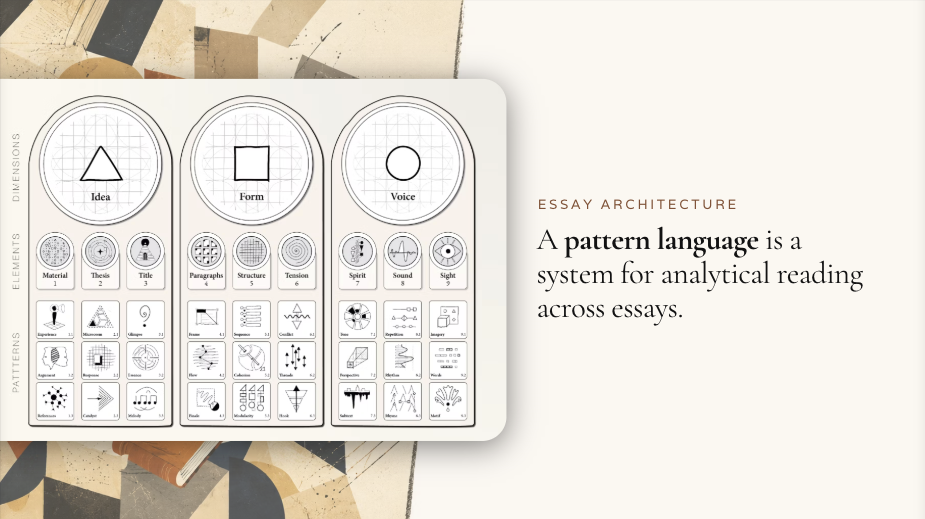
Analytical and syntopical reading is usually focused on the idea itself, but we can use these same concepts to deconstruct the composition of an essay. My pattern language is effectively a framework for syntopical reading. You use it across essays. Instead of inventing how to read analytical reading yourself, Essay Architecture gives you a tool of lenses to read through.
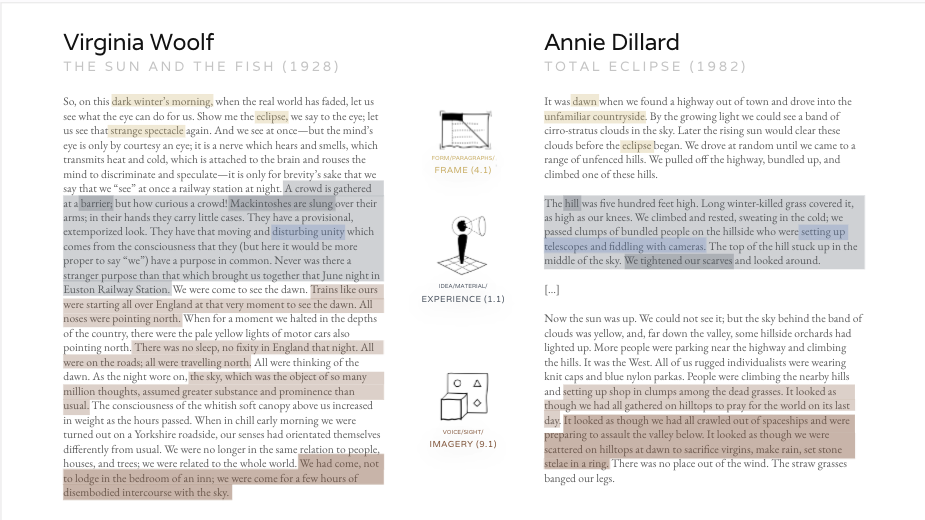
In our workshop we did an exercise where we all read two excerpts, by Woolf and Dillard, each about the total eclipse but fifty years apart. The excerpts were similar in many ways; they had a near identical frame—setting the when, the what, and the tone of the scene—the middle had an experience where they described the people around them, and each closed with imagery. But, they varied in how they used the Imagery (9.1) pattern. Woolf tapped into scale to induce awe, while Dillard tapped into alien and tribal metaphors to capture the fear and anticipation of the moment.
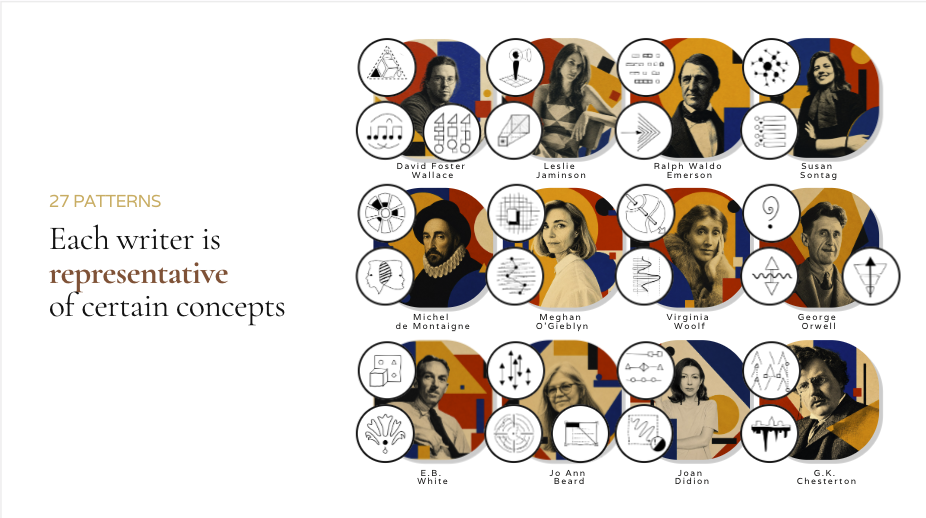
We won't just be reading 12 great essays analytically, we'll do so using a shared language so we can get very specific on the patterns that great writers use. Whether you use my pattern language, or create your own lenses for cross-essay reading, the point is that you can only really understand a concept when you see it across multiple works, taking on unique expressions based on different contexts. I write about this more in my essay How do you deconstruct prose?, on how we shouldn't just imitate syntax, rather we need to know the specific way to use a specific pattern to achieve a specific effect.
So far we talked about the importance of building a syllabus (inspectional reading) and then how to read (analytical/inspectional). Now I want to talk about why I picked these specific 12 essays. In the future, I would love Essay Architecture to help generate a 1-of-1 custom syllabus for you. After uploading your own work, and analyzing the patterns across it, my software could make you a personal reading list, including essays that both share your strengths, yet show your weaknesses elevated to their peak, giving you a vision into the writer you could become. That will take some time! But for now, the goal is to make a general introduction, a good starting point for someone who hasn't start reading the classic essays yet. What are the heuristics to make this list?
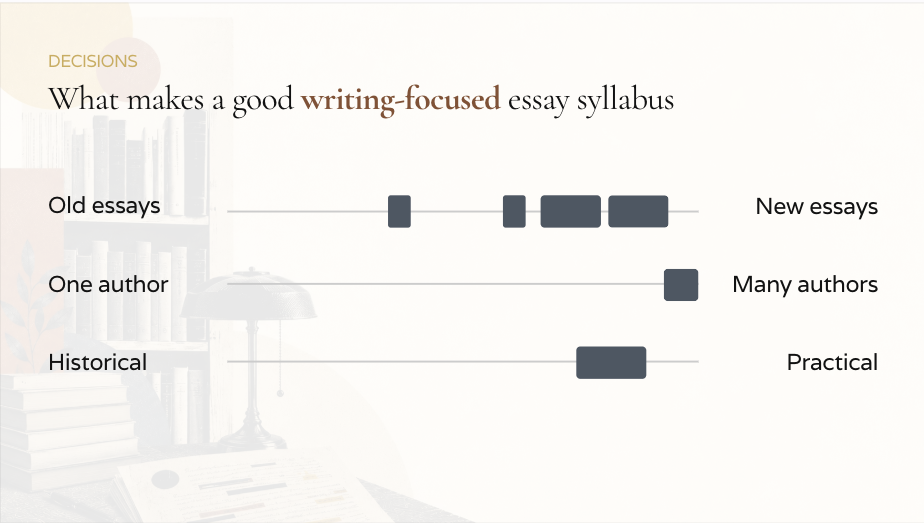
I decided that we should focus on many authors (one per week) with the practical goal of learning patterns we can bring into our own work. There might be a future where we do single author deep dives, or historical assays into more obscure writers, but for now, I want to introduce you to a range of writers. I also decided it would be most accessible to focus on new essays, since they're more parallel to what we're all publishing today. That said, I did want to include some older writers that have more challenging, relatively archaic prose, because they show the power of a medium before text was neutered and optimized for mass readability—I'll do my best to provide a frame and the right translations so you have all the context you need.

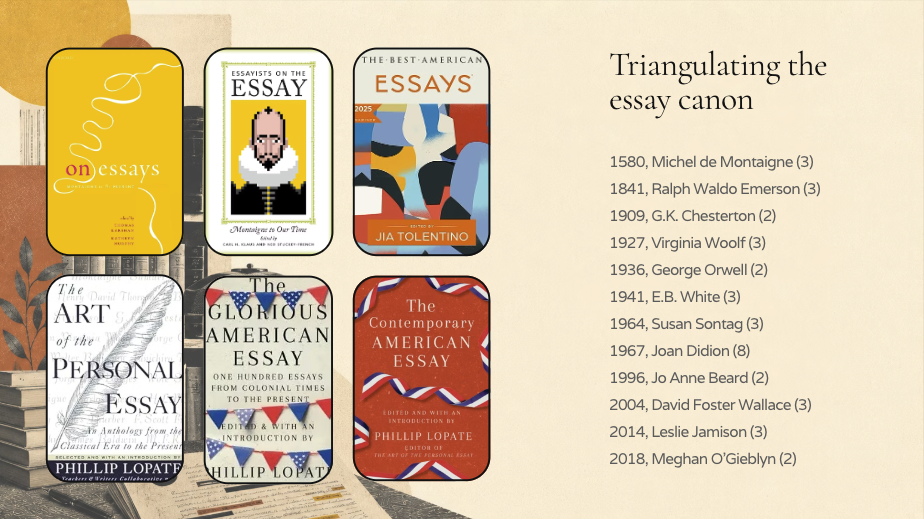
I started with 12 writers that I've been reading and am starting to know decently well. Across six of the more prominent anthologies and theory books, each of these essayists are featured at least twice, meaning there's an objective anchor to validate the importance of these figures.
I also made sure there was a good amount of "opponent processing" in my selections, so that you would see the largest range of possibilities:

  • Each writer has an "opposite." For example Emerson and Montaigne represent the dichotomy of the skeptic vs. the sermon. Didion and Sontag represent the journalist vs. the academic. Orwell and White represent the aggressive vs. the sensitive.
  • Within these twelve, each could also be a representative of a distinct "mode" of writing; where patterns are about the objective patterns the reader experiences, think of mode as the internal sensibility that drives creation. I'm defining these modes as inquiry (getting to the bottom of a question) vs. interiority (rendering their consciousness), and expression (articulating through poetic words) vs. critique (engaging with their culture).
  • And finally, each selected essay will be a lens to properly understand a particular pattern—DFW for microcosm, Jamison for perspective, Emerson for word choice, Sontag for references, etc. I think it will be easier to remember these patterns when they're personified through people and specific essays.
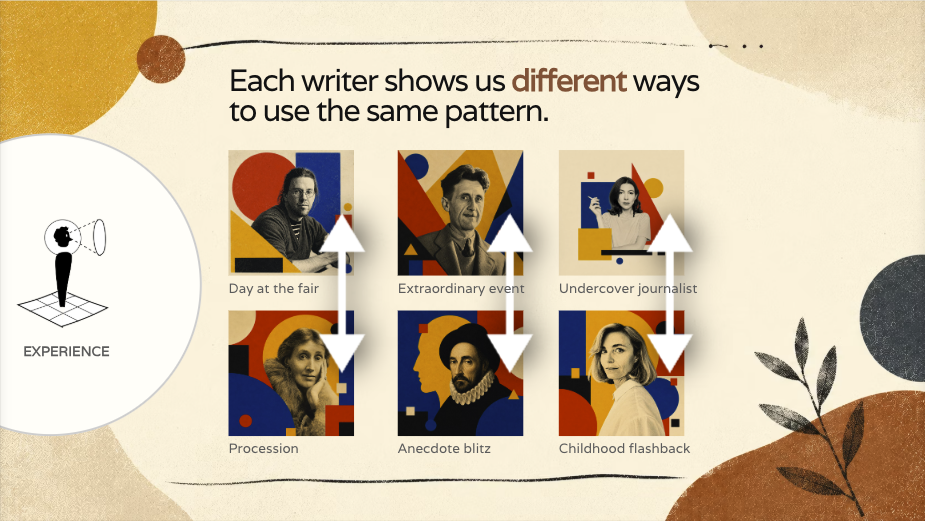
Over time, we'll get to see very different articulations of the same pattern. A personal experience can be contained within a single place ("a day at the fair" essay), or it can be an A>B journey. It can be an extraordinary event, the kind of thing that happens once in your life, or maybe your essay just has a spattering of humble anecdotes. It can be an experience you purposely throw yourself into like a journlist, or it can be a recollection of your childhood, the things that inevitably happened to you.
If you want to work through these essays intentionally and with a group, that's what Essay Club is for.
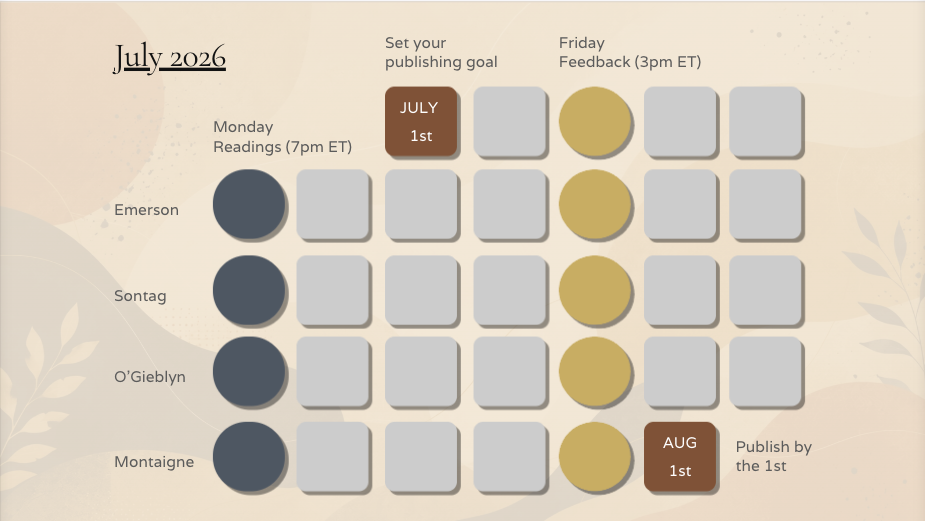
We don't just read together, we write and publish. Our readings are meant to augment our own original writings. The group runs on a simple monthly template. At the beginning of each month we set our goals, and we're all unified with a shared publishing deadline: the 1st of each month (marked by a "publish party" where we read and comment on each other's work).

Every Friday at 3pm ET we have a working session, where you can exchange feedback (1:1 in a breakout room), talk through your ideas, or simple block out the time to write.

Then on Mondays at 7pm ET we have our reading sessions. In July for example, you'll read Emerson, Sontag, O'Gieblyn, and Montaigne, each of who might teach you a pattern to integrate into your own work.
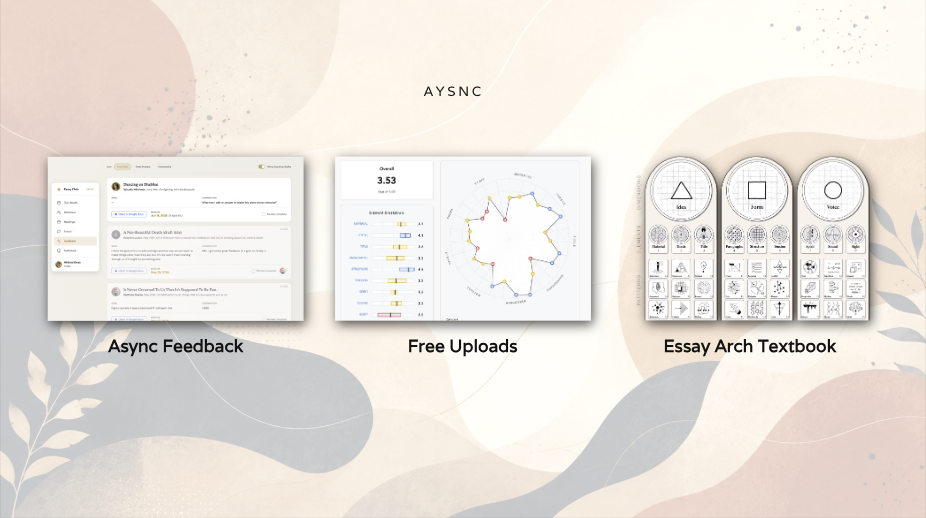
If you can't make the live calls, there's a lot happening async too. For one, all our live readings happen in a shared document, which you'll have access to, meaning you can read it on your own time while still seeing how everyone reacted in the moment. Additionally, we have a forum where you can upload drafts for async feedback exchanges. And since the club is so anchored in Essay Architecture, every gets the textbook for free, along with free uploads to the Essay Architecture software, which analyzes your essay along the 27 patterns to help you identify areas to work on.
I've been running Essay Club for 30 months now. The goal is to sustain this for the long haul, to create a place where I can be independent writer, teacher, and scholar of the essay; I say this to say that I'm in there writing with you, and I'm invested in evolving the club because it's integral to my own practice. Around every 6 months we add a new feature, and this new weekly reading curriculum is just the latest. More to come. It's structured as an annual membership at $600/year, but I'm offering it at $450/year through July 4th to promote the launch of our summer syllabus.
However you move forward, I hope this got you thinking about how you read. I recommend you take the time to think through the writer you want to become, and shape your own syllabus accordingly (in addition to joining our essay reading list). Try reading less, but reading slower and more deliberately, looking for patterns across works. And finally, Essay Club gives you the structure to do this every week, so even if this whole idea of building your own syllabus sounds intimidating, all you have to do is show up and read.
Essay Club website | Sign up for an annual membership here

A Whitman noun-collage from the LIRR

[Whitman's Songs of Myself #15:] The pure contralto sings in the organ loft, The carpenter dresses his plank, the tongue of his foreplane whistles its wild ascending lisp, The married and unmarried children ride home to their Thanksgiving dinner, [...] The mate stands braced in the whale-boat, lance and harpoon are ready, The duck-shooter walks by silent and cautious stretches, The deacons are ordain’d with cross’d hands at the altar, The spinning-girl retreats and advances to the hum of the big wheel, The farmer stops by the bars as he walks on a First-day loafe and looks at the oats and rye, The lunatic is carried at last to the asylum a confirm’d case, (He will never sleep any more as he did in the cot in his mother’s bed-room;) [...]; The malform’d limbs are tied to the surgeon’s table, What is removed drops horribly in a pail; The quadroon girl is sold at the auction-stand, the drunkard nods by the bar-room stove, The machinist rolls up his sleeves, the policeman travels his beat, the gate-keeper marks who pass, The young fellow drives the express-wagon, (I love him, though I do not know him;) [...] The western turkey-shooting draws old and young, some lean on their rifles, some sit on logs, Out from the crowd steps the marksman, takes his position, levels his piece; The groups of newly-come immigrants cover the wharf or levee, [...] The bugle calls in the ball-room, the gentlemen run for their partners, the dancers bow to each other, The youth lies awake in the cedar-roof’d garret and harks to the musical rain, The Wolverine sets traps on the creek that helps fill the Huron, The squaw wrapt in her yellow-hemm’d cloth is offering moccasins and bead-bags for sale, The connoisseur peers along the exhibition-gallery with half shut eyes bent sideways, As the deck-hands make fast the steamboat the plank is thrown for the shore-going passengers, The young sister holds out the skein while the elder sister winds it off in a ball, and stops now and then for the knots, The one-year wife is recovering and happy having a week ago borne her first child, The clean-hair’d Yankee girl works with her sewing-machine or in the factory or mill, The paving-man leans on his two-handed rammer, the reporter’s lead flies swiftly over the note-book, the sign painter is lettering with blue and gold, The canal boy trots on the tow-path, the book-keeper counts at his desk, the shoemaker waxes his thread, The conductor beats time for the band and all the performers follow him, The child is baptized, the convert is making his first professions, [...]

Eastward travelers scurry back to their homes, drunk sleepy and full; The conductor checks in strangers to his traveling home, amazed at faces forever anew; The passengers giggle and holler and look down to find anything they may need; Trains haul through fields of sleepers all sleeping through machine-cooled June; The trees asleep see no difference between you and the spiders; Two-legged travelers all scrawny from wheels on their luggage, wheels in their sneakers, wheels take them everywhere; A fan bursting with zeal yells “Mexico!” for soccer, while the city’s baseball team slogs through a meltdown; While anchormen proclaim the war’s finally over, the oil will be plenty; No man, woman, or child trusts their ears, eyes or tongue; The executive chief has demons check his mail; Through grandmother’s window the street’s always and never changing; With half-dressed kids howling for nothing; With pizza shop owners deaf from their speakers; With basketball teams dribbling balls to the bars; With gangs flashing boulevards with one-handed wheelies, because death like everything is a joke; As the funeral home locks up for the night; And pizza men fill backseats with cheese for the night; And the corner-house couple tries to conceive again for the night; A Lutheran priest tonight keeps the red lights on; Ten thousand souls all weep joy at the commotion; Landlord asleep as I sneak up into my home.

Summoning Levers

Patience and diversification amid collapse

· 910 words

Appreciate you bringing this up in the Q&A [X], and thanks for starting this thread [Y]. This taps into some themes I’ve been thinking and writing on, so I’ll use this as an opportunity to further unpack it.

There’s a lot to say on making “art”—or any individual pursuit—through a collective crisis where individual effort feels meaningless. Fortunately we aren't alone and have a whole history of crises, so there’s probably a lot to learn in how people responded (this is one impetus for me trying to read more, especially in political philosophy).

I imagine there is a spectrum here, ranging from “focus on yourself” to “society-scale action.” I think if you focus too much on either side, you risk deflation. Purely selfish pursuits, however noble, can easily have the narrative behind them ripped out if the bigger picture hits a certain intensity. And purely collective actions, like protesting, also lose momentum when you realize a million people together have no leverage, and you’ve contributed much of your time to a cause instead on what you’re uniquely qualified to do, which is equally demoralizing. So the answer I think is to run both in parallel.

I’ve come across a Ghandian POV from some writers I admire, which is essentially, “be the change you want to see in the world.” While I resonate with this from multiple levels—for example, on taking responsibility for everything, and being very diligent in your own values instead of worrying about or judging others for their lack—I also think it can be a bit myopic. Cultural progress is possible, and it exists at a scale far bigger than any individual. Meaning, a lot of values and culture stem not form charismatic and well-principled individuals, but from the larger architectures we’re all entangled in. Those systems are designed, and history seems to oscillate between periods where systems are designed to withhold/protect virtues or designed to expand/preserve power.

The bigger question for me: how can any regular person be part of systemic change? It comes down to a leverage thing. I don’t currently operate at a level where I have any impact on government, culture, economics, education, and while it’s nice to hope, I don’t have delusion to think I’ll ever have civilizational leverage. I think few people in history ever do. Even Trump’s leverage is debatable! I don’t mean to get into politics here, but I will link out to a post I wrote, “What we have is worse than a king.” The main idea is that Trump is not the root of any of our problems, he’s more so the most visible manifestations of an OS that has been anti-democratic and anti-constitutional for many decades now, maybe even a century.

So within the sphere of “systemic action,” there’s another spectrum of what a person can do, ranging from theoretical to practical. Again I think it’s worth pursuing both. On the theoretical side, I personally find it fun to engage with systems designs at abstract levels that are far beyond my control. ie: I thought Bernie’s AI sovereign wealth fund was a malformed idea, so I did my best to understand it and propose an alternative. This is arguably big a waste of time, but I think there’s value in learning to think as a systems architect, and to imagine new kinds of civic technology. On the practical side, there’s Essay Club, which is something whose existence and flourishing is entirely dependent on me, but the impact is limited. 

A lot of modern forms of activism are neither theoretically interesting or practical. Instead of performing dissent (via protests or culture wars), I think we need to enact new types of techno-activism that are now possible with AI.

Over time, the practical thing may grow to a point where the theoretical systems architecture skill comes in handy. Maybe in twenty years Essay Architecture is a software-backed curriculum that runs across a few hundred/thousand micro-schools. Or maybe it doesn’t, and Essay Club only grows to WOP-scale, letting me focus on writing and teaching, while giving meaning to a small group of people, which is fulfilling and worthwhile in its own right. Twenty years is far off, and it’s been almost 20 years since I started architecture/writing in general. So that’s like a 40-year lag between intention and implementation, effectively, an entire life.

And so as urgent as everything feels I think patience is the key. There’s probably something to zooming out to the scale of your life, modeling where you think society might be in the 2040s, and slowly steering the boat in that direction. By focusing on individual pursuits, practical projects, and theoretical systems, for decades each, there’s a chance that at least 2 of those lanes might fuse together in a meaningful way.

Anyway, I enjoyed the occasion to use this as a prompt for my morning essay! Hope it’s vaguely related to and useful to your own streams of thought, and open to feedback and pushback. On a meta-level, I think there’s something neat in using emails/letters—which each have a specific person or two at the receiving end—as a way to start drafting essays. I already have this as a post on my website, and similarly, both of your notes could be public too.

A Blog Succession Plan

On obituaries and 100-year domains

· 1324 words

Someone dies in my town every day. I know this because I signed up for the newsletter of a nearby funeral home that I often pass by. It's strange to see an institute of death using a Squarespace template with stock photography of the Manhattan skyline and Central Park with animated text saying "Here for You in Your Time of Need," and I did not expect an email input field with the title "Obituary Notifications." Now I get them every morning at 4-8 AM. Half of them are blank—"An obituary is not available at this time for..."—and the other half are templated (including details like day of death, surviving kin, and other biographical details like hometown, college, hobbies, defining attributes). One that stands out, however, is for a forty-year pioneer of the KORG synthesizer.

A long human life get compressed to 350 words of text—shorter than the length of this post—sometimes well-written, sometimes templated, sometimes AI-generated, and sometimes "an obituary is not available at this time." As a writer, it would be snobbish for me to judge the cliches, misuages and inauthenticity of the everyday obituaries. Those are for the families and friends, not objects of literary scrutiny. The actual value of getting these from strangers each morning is to remind myself of my eventual destination. I imagine a scoff, "but you won't be alive to care about your own obituary!" But isn't that a solipsistic view? In all my memories of wakes and funerals, I notice in myself a sudden post-humous interest to make sense of the person in full, outside the illusion of time, perhaps triggered by a 70-year old photo of them youthfully playing guitar, where I realize I've never quite seen them beyond their elderly form. If they had writing to read, I'd read it all.

And so recently I came across the obituary of Ned Stuckey-French, a fellow essay evangelist from a generation before me. He died in 2019. He contributed to both of the recent US/UK volumes on literary theory of the essays (Essayists on the Essay and On Essays). I only knew he died because the On Essays table of contents has a cross next to his name. While I have some major disagreements with the thesis that both books converge on, I got an email from Academia.edu the other day, showing a paper Ned wrote; he was able to synthesize and clarify everything, and suddenly I had the urge to dive into his work. Upon searching him, his obituary is the 2nd result. It was 242 words, but I was thrilled to find a link to his personal website, a portal to understand the man in full.

A prolific writer, Ned concentrated his professional efforts on personal essays and championed the essay as an art form. His efforts were instrumental in saving the University of Missouri Press. Many of Ned's works may be viewed at http://nedstuckeyfrench.com/.

I'm met with a dark blue screen and white banner, saying "This domain is registered at Dynadot.com. Website coming soon." A personal website is a fragile thing. Unlike a platform, where your page stays up as long as the company is solvent, a self-maintained site is virtually bound to disappear if the living author doesn't put together some kind of succession plan. I found his wife's website too, untouched for 12 years, but still up; I imagine myself emailing her and offering help to revive Ned's site, before remembering that I know almost nothing about Ned or their relationship, and it would probably be an intrusion.

This all gets me thinking: how do I set up a website to last a hundred years? Wordpress offers 100-year hosting, and it costs $38,000 ($31/month x 1,200, all upfront). Matt Mullenweg, the co-founder, admitted six months into the project that they've had zero takers. Another alternative is "Posthaven," which promises permanent hosting as long as you pay for one year ($60). Sam Altman uses this. The downside is that you have to use their platform, templates, CMS, and I'm now very much on a "own your data" quest.

A few options:

  • Since my website is hosted on Github, I could make that public. Even if the domain gets lost, you can still access the whole vault, and it would be trivial to repoint the entire site on to a different host.
  • Quarterly saves to Wayback Machine.
  • Compress my whole vault into a single PDF or HTML file, a single thing that is shareable and savable.
  • Print my vault into a book/ebook (and register it with the Library of Congress)

For all I know, Ned had his own measures, and I just can't find them. The domain functions as the centralized place, aggregating all the essays and all the links out, but it's the most fragile part of the stack. For now, I can buy up to 10 years in advance on Squarespace. Beyond that, I would need to rope someone into the possibly pathetic-sounding enterprise of a "blog succession plan," because no one really cares about your writing as much as you do, at least while you're alive.

However, reading about christopher.org gives me hope (a story on how friends preserved a dead friend's website). It also clarifies that while 100-YR hosting is $38,000, a 100-YR domain is only $2,000. This points to a paradigm where the bookends of the website stack are solid:

  1. The vault of all your files and code (the origin) are Git-hub hosted. As long as there is a singular public repo of everything, it can be shared, downloaded, stored locally, and re-uploaded somewhere else if need be. Considering Github is critical for web infrastructure, it will likely be around for decades, making it a good home for your files;
  2. The domain (the destination) can be paid for 100 years in advance, leaving no financial stress on the inheritor;
  3. The hosting platform (the middle) can be swappable. The Github vault can be easily connected to one of several free hosting sites. Currently I'm on a paid plan with Netlify, but maybe that's a liability. I need to find one that's free and likely to last, because this is the only fragile link in the system. The guaranteed survival here depends on a document that specifies: (a) the credentials for the 100-YR domain, (b) some loose heuristics on how to go about transitioning to a different hosting platform, and (c) a note of gratitude with some perspective on why it's worth maintaining.

I imagine it's strange to watch someone think through a blog succession plan in far more detail than an audience growth plan. I'm only in my mid-thirties, and it's not like I have any terminal illnesses that I know of, so why am I writing for unborn audiences instead of living ones? Having a kid, I'm sure, has something to do with it. I have a recent essay called "we all inevitably becomes tales," and as I reflect more on deep time, and as I try to visualize my 5-month old daughter as a grandmother, I see more often through a perspective where I no longer exist in the throne of my own consciousness, and instead exist as words being rendered into someone else's. I suppose it brings me a subtle anxiety knowing that, if I were to spontaneously die on my walk today from some teenager barreling into me with their motorcycle as they lose control during a one-handed wheelie down the main boulevard, much of my writing would die with me, and weirdly the real tragedy at the scale beyond my life is that even though the death of my mind, body, and soul is inevitable, the death of my writing is not.

The family of three stones

Prayer is properly not petition, but simply an attention to God which is a form of love. With it goes the idea of grace, of a supernatural assistance to human endeavour which overcomes empirical limitations of personality. What is this attention like, and can those who are not religious believers still conceive of profiting by such an activity?

I reflect on this highlight, underlined in Kindle and so proven by mass appeal to be important: “prayer is an attention to God, which is a form of love”; I look up and notice how a typically off lamp is now on, casting a new shadow over our three statues, the three little stone people on the TV console, once called the “the three lawyers” by my father-in-law, though I see them as myself, my wife, and my daughter, in descending order of size, a reminder that even though these are not stone relics and were probably bought at SEARS pre-divorce in the early 90s, they have a tribal feel—though each is just a cone body with a circular head with two dots for eyes , and a vertical line for a nose (without a mouth), they represent the minimum form of a family, a primitive unit.

I see the statues and the shadows behind them and the yellow glow, all in a moment outside of clocked time. I hold in my body the idea that matter itself is the attraction of two things towards the birth of an offspring, and that I’ve participated in some early ritual of the universe. Also, a baby is sleeping on me. My presentation is over. The gyro is being delivered but I forget my hunger. Is this love? Is this a prayer?

I am not asking God for anything, nor do I imagine a conscious entity outside of space-time that can tilt reality towards even my best intentions. I see God instead as the cosmic engine itself, at a scale and temporality beyond me, and I see myself as effectively an insect, but with the ability to briefly imagine and grasp reality outside of my limits. I sense kairos and agape, the escape from chronos into the full saturation and non-selfishness of this moment. I turn to my wife and surprise her and tell her how much I love her as she finishes up her construction documents for the night.

Is it possible to always see like this? That is where “obedience” comes in. It’s not about rational deliberation in flash moments to do the right thing, but to permanently see like a mystic. Of course the ego has its uses, though.

I typically alternate between modes, of seeing through fixation and seeing with love. But can you oscillate fast enough so they become united? Can you harness a singular ego, a stubborn individual on a quest of your own, while remembering love in every frame?

This is the paradox and transcendence that I’m reaching toward in my personal theory of virtues. A deficiency of identity is alienated from themselves, an excess of identity is narcissism, and the Aristotelian mean is to be generally loving, a limited ego, focused on love for others. Nietzche would call this weakness. But the alternative would be a paradoxical fusion; to shape an ego in a way so that it is maximally individualistic and maximally loving.

Essay Club summer syllabus

· 233 words

Join Essay Club and meet with us on Mondays at 7pm ET to read and talk about these classics:

My personal reading syllabus

· 5873 words

Here are three maxims that shaped why and how I built the syllabus below:

  • You become your syllabus. An essay writer should read differently from a general reader. Every inspiring quote becomes a seed that could launch an essay, or at least be woven into one. This syllabus is an attempt to shape the books that I want to shape me. I've organized the book into four genres (and each has subdomains): I read Essays to understand the form, since that's the same form I'm creating with; I read History so that a literary curator can help me build maps of people and concepts across different disciplines; I read Non-Fiction to go deep on the ideas I want to write more essays on; and I read Fiction to understand the different emotions and moods that words can render (also, fiction teaches allegory, which is about embedding concepts into tangible symbols; I imagine DFW is the essay writer he is because he was primarily a fiction writer.)

  • Converse with the authors. A Montaigne essay is often filled with dozens of quotes. His essays likely originate from his commonplace book, his collected quotes from Seneca, Plutarch, Epicurius, Augustine, etc. I've been reading on Kindle for two reasons: (1) because when my daughter is sleeping on me, it's much easier to read one-handed; (2) all my highlights get synced form Kindle to Readwise to my own app. This makes it easy to resurface highlights and write short, original essays in response to them. They're all gathered on my website. This helps enforce the idea that it's not about having read the book, but about using the book as a way to inspire original writing. And of course, by writing about and in response to books, I remember them much better.

  • Non-linear reading. Since the end goal is to read to produce writing, I don't necessarily need to finish all 121 books here or go in any particular order. For many of the books in Histories, I'm reading a chapter per month over 2 years. For some works in Non-Fiction, I've done an inspectional read and have selected just a handful of chapters that I think are most relevant to me. Generally, there are many textbooks running in parallel, and then each month includes one work each from Essays, Non-Fiction, and Fiction. I built a "syllabuilder app" to plot out what was possible to read in a given month (which is why I track page numbers below). This month I have 19 books I'm reading simultaneously. In any given day I might jump around 3-4 books. Overall it's less than 1,200 pages per month, or 40 per day, which matches a graduate level syllabus (probably 60-90 minutes per day of reading). I'd say this is like a reading list for a Master of Liberal Arts with a focus on the essay, moral philosophy, and civilizational thinking. This is roughly 6 semesters worth of reading, so it can be done in 2-3 years. The goal is to "finish" this by the 2028 election (acknowledging that I have permission to stop any book if it's not fruitful).


I. ESSAYS

1a) Essay Books

1b) Anthologies & Criticism

II. HISTORIES

2a) Humanities

2b) Civics

2c) Spirit

III. NON-FICTION

3a) Virtues and Ethics

3b) Psyche and Attention

3c) Craft and Education

3d) Politics & Economics

3e) Technology and AI

IV) FICTION

4a) Modern Fiction

4b) Classic Fiction

4c) Science Fiction

Footnotes

  1. (3 units: Nature=115p, Vol I=170p, Vol II=150p)

  2. (selected 230p)

  3. (5U I=15p; 1580=35p; 1900=56p; '60=53p; '90=60p; 219p)

  4. (In+F,Ad/Lm/Hz,Bk/Brg,Th/Bl/L=4u56p/m, 224p)

  5. Books I–III (eudaimonia/virtue), Book VI (phronesis, practical wisdom), Books VIII–IX (friendship), and Book X (contemplation), 2019 (140p)

  6. Ch 1-5,9,14-18, 1981 (176p)

  7. (1-5,15-22 = 225p)

  8. (The Hedgehog and the Fox, Two Concepts of Liberty, Historical Inevitability, The Counter-Enlightenment)

  9. (1851-1854 = ~115p )

  10. (2,4,5,6,11,12=235p)

  11. (406p, so break into 2 unit cards for 203 words each, Parts I-II and Parts III-IV)

  12. (Ch 1,2,4,6,9,11,14,16,18 = 221 pages

  13. (245p)

  14. (I, parts of III-V, VI-VIII = 274p)

  15. (first half = 248p))

  16. (excerpts at 200p)

  17. (excerpts at 150p

  18. ("The Dead", "Araby" "The Sisters" "A Painful Case" "Eveline" "Counterparts" "A Little Cloud" "Clay") " (111p)

  19. (Hills Like White Elephants, A Clean Well-Lighted Place, The Snows of Kilimanjaro, Indian Camp, Big Two-Hearted River, Old Man at the Bridge, A Day's Wait, Now I Lay Me, The Gambler the Nun and the Radio, Cross-Country Snow (104p)

  20. (The Jilting of Granny Weatherall, Flowering Judas, Theft, Noon Wine, Pale Horse Pale Rider = 135p)

  21. (The Bear Came Over the Mountain, Family Furnishings, = 68pp)

  22. Break It Down, Story, The Thirteenth Woman, Kafka Cooks Dinner, Varieties of Disturbance, We Miss You & selected shorts = 80p

  23. (The Death of Ivan Illyich, Father Sergius, Alyosha the Pot, Hadji Murat = 232

  24. (Notes from the Underground, The Peasant Marey, A Gentle Creature, The Dream of a Ridiculous Man = 176p)

  25. (A Boring Story, The Darling, The Man in a Case, Gooseberries = 86p)

  26. Harrison Bergeron, Welcome to the Monkey House, Long Walk to Forever, Miss Temptation, All the Kings Horses, Tom Edison's Shaggy Dog, New Dictionary, More Stately Mansions, Report on the Barnhouse Effect, The Euphio Question, Unready to Wear, The Kid Nobody Could Handle, EPICAC, Tomorrow and Tomorrow and Tomorrow = 168p)

  27. (The Library of Babel, Funes the Memorious, The Garden of Forking Paths, The Imortal, Death and the Compass = 64p)

  28. Bloodchild, Speech Sounds, The Evening and the Morning and the Night, Amnesty = 115p)

  29. (Story of Your Life, Understand, Hell Is the Absence of God = 100p)

  30. The Ones Who Walk Away from Omelas, The Wife's Story, Buffalo Gals Won't You Come Out Tonight, Nine Lives, Vaster Than Empires and More Slow = 150p

  31. (Alphinland, Revenant, Dark Lady, The Dead Hand Loves You = 130p)

The math of my ancestors

250 years ago lived an arbitrary man who I can call my ancestor. He was one of 256 of my great great great great great great grandparents. It is unlikely that any of them ever met, but there was very possibly a moment where two strangers crossed in a street, or shared a boat unknowingly, or exchanged pleasantries in insignificant and instantly forgettable ways, not knowing their great great grandchildren would give birth to my great great grandparents. My existence depended on the whims of those 256 people—their triumphs and disappointments, decision and indecision, love and otherwise. Compelled by nature or eros or God to breed with a specific person at a specific time, they continued casting down the great chain of being.

How alike am I to any one of them? If my parents can each claim 50% of my traits, then my great^6 grandparents each only claim 0.39%.

In one sense, I bear almost no resemblance to any of them. Maybe, in an Empedoclean sense, you might see my nose roaming around a town square, or my hairy feet wading through a field. Any one ancestor might feel no affinity towards me; if I knocked on their door after accidental time travel and needed a place to stay, they might just past off the responsibility to one of my other 255 ancestors. Over enough centuries, your descendants balloon past a scale you can adequately care for. My wife, for example, is part of an old royal Welsh family that goes back to the 1250s. She even has a family ring. Yet, by the theoretical logic above, she is one of millions with a claim to the throne.

In another sense, a more romantic sense, my 256 great^6 grandparents represent a still very small sliver of the human population. 0.000000256%. If any of them had any resemblances to me, physical or mental, I’d like to know. Of course, our consciousnesses would be quite different, for identity is forged from circumstance, but I don’t doubt that I would find uncanny resemblances. When I hear the lore of my great^2 grandparent, a peasant on a dry, rustic, Greek Island, and how he was able to harvest and sell rain water to get rich, I wonder if his entrepreneurship speaks to my own entrepreneurship. It is quite vague to trace influence back even 1-2 generations, let alone 8 or more, but nonetheless, the actions of those people did eventually lead to me, and there are all sorts of ways their myths and interiors might shed context into my own circumstance, at least symbolically.

Unfortunately though, none of my 256 were writers. At least, not that I know of. Some may have written journals, or written for administrative reasons, but as far as I know, none left a body of work that was meant to be cast and continued through time. One grandfather did have three chapters of an abandoned novel on a 1980s hard drive that my father was able to recover. My other grandfather is uneducated, barely literate, and only writes English in capital letters. Now that I think of it, it’s probable that +95% of my great^6 grandparents could not read or write. Mass literacy wasn’t realized until the early 20th century.

Even though we shifted from oral to written history in Ancient Greece, most family history today is only passed down through spoken stories. They’re etched into memory and unreliably translated down the chain. I can barely trust the stories I pull from my head, planted decades ago, either misdelivered or misremembered. Was she really a psychic midwife that predicted winning horse numbers in her dreams making her son rich until a black hand cut her off? Did he really drive Nixon in a cab?

It would be strange for a society to sleepwalk forward, with no sense of what truly happened before the 1900s. How is that not strange for any of us individually? What if I become the family’s Plutarch? How might a child’s identity differ if they had detailed accounts of their relatives, generations up the chain? I suppose you could ask the great^6 grandchildren of writers. Claude tells me there are 700 members of the Monticello Association, each a genetically-confirmed descendant of Thomas Jefferson, who wrote 19,000 letters, books, and a Bible. A few of them have problems with him being a slaveowner, with one publishing an essay called “Take Down His Memorial.” At least they have 255 other ancestors to respect.

Heroes get remembered, but legends never die

I did not expect to be able quote whole scenes of The Sandlot (1993) from memory, but there I was, the annoying co-watcher to my wife who barely remembers it. I must have watched it a dozen times. If not, the few viewings of it must have been a religious, formative experience. Somehow it came on, via streaming, already more than half way through, but early enough to be inside of the dream of Benny Rodriguez1 where the ghost of Babe Ruth delivers his classic line: “Remember kid, there's heroes and there's legends. Heroes get remembered, but legends never die.”

Did this quote shape my elementary consciousness? Many of my essays here are about “textural immortality” and legacy—doesn’t that word have a shared root with legend? Has my drive to devote my life to creating something memorable (something that outlasts me and shapes the future) a product of a 1990s cult film with a $7 million budget?

Obviously the answers to those questions are lost; all that is left are fuzzy caricatures to reason with. I can’t know exactly the evolution of my psyche, but it does seem that in almost every phase—from baseball, to music, to architecture, to technology—there was this boyish desire to be Ruth-like, to master and transcend a genre, to have a bunch of goofy nicknames, to have leagues of kids yell my name in unison, and to be remember beyond my life. To lean into and live by that line is to become a megalomaniac.

There is a second half to that quote (which is less memorable): “Follow your heart, kid, you’ll never go wrong.” This disarms the grandiosity of the prior line. The goal is not to become a legend for legend’s sake, but to be attuned toward your heart (towards “the way,” nature’s order, the virtuous thing, the hard thing) which puts you on a path, perhaps towards doing legendary things, but the path is the point.

The other day I was listening to a podcast and noted “the purpose of life is the transmission of legacy.” The context is that in the face of death, we strive for immortality in different ways. The immature and impossible version of this is physical immortality. Religions promise spiritual immortality. Pharaohs and estates focus on material immortality. They referred to another option, “secular immortality,” which I’d rather call “symbolic immortality.” This is about living into the future through art, language, and symbols. This can be more modest than the cultural immortality of Babe Ruth; this can exist solely within the family. I’m talking about the paintings we have hung up of my wife’s grandmother, and the sayings from my great grandmother that I’ll pass down (“be your own person, choose your friends wisely”).

There are two ways to think about death. The first is cosmic deflation, to realize that Babe Ruth, the entire culture he's within, and even the species itself, are all just a temporary evolutionary blip; if everything will be cosmically forgotten, then it’s futile to strive to be remembered for anything. Alternatively, you could see your immediate chain, the generations before and after you, as equal to yourself, to see the whole lot of you as a single entity, and to act in a way that could be exemplary for your kids.

Footnotes

  1. The character is Cuban-American, but his middle name is Franklin, making him “Ben Franklin,” an American Easter egg.

In search of side doors

I published 38 "essays" in June, averaging at ~600 words, totaling at ~22,800 words (that's a pretty good month for me; I usually go between 10-30k). That same overall output could also be spliced up as four long form essays at 5,700 words each. The question here, can you count these small things as essays?

If you look at Montaigne, and especially Bacon, they each had some shorter one around 500 words. I have other contemporary essay book that feature writings that are exclusively 2-3 pages each. So historically, yes, there's a case for short non-fiction musings to be called "essays," but is it really about shortness?

It's more about formality and effort. In recent years, I was set on writing "unitive essays," ones that integrated all the known patterns, ones that went through many rounds of editing, ones that would be timeless. I still, of course, value that and aspire to it; I'm just currently in a phase where time is more burst-like. Such is life with a 5-month-old daughter. Deep flow states are hard to come by, and so instead, I'm logging little ideas all day, and whenever I get to the computer, with the mental space to write, the goal is to pick one idea and articulate it fully. Can I write and publish this idea, here and now?

It's an approach void of editing, which feels right for right now. I've thought so analytically about the craft, and the goal now is to see if I can weave in patterns on the fly. This doesn't mean I can successfully scope and prose every idea to a 5/5 on a single go. Most ideas—including probably this one—are started pre-maturely, and have limits on what they can become without scrapping it all and restarting from a new frame. Of course, the point is for ideas to mature through writing, but a great thesis can be so cognitively reorienting to nullify a draft's whole premise. But maybes that's the thing to build towards?

I didn't have this idea before I started this essay, but maybe an essay should contain an earnest shock, something in the moment that negates, inverts, and breaks the structural logic above. Wouldn't there be a thrill in witnessing a live epiphany, and then watching the writer clarify how everything previously covered may be true/false in light of the revelation?

You may have noticed, every paragraph so far has ended with a question. I suppose I'm playing with this idea to start with a clear question, and then continuously drive forward until a spontaneous question triggers something new, and I can fold back into that original question with an answer from a different dimension, a side door I never knew existed. An essay is less about the length; whether it's 300 or 30,000 words, it's more so about the value of what's discovered.

I was looking at my archive earlier, at everything I published in the last year. There are 363 "essays" (most of which are expanded logs), averaging at 370 words each. Of those I have about 22 essays flagged as "favorites," meaning, they've elevated to a special section, and earned the formality of cover art. This means that only 6% of the ideas I write in a given year are worth carrying forward. With time, that will probably atrophy even further. Even 1% of output per year is high: if you can write 3.6 timeless essays per year, that's prolific. DFW, if you look at what was anthologized over his career, only put out 1-2 per year. One approach to this is to pick be very selective, only chiseling a hand few of ideas; the other is hyper-publishing, trusting that curiosity will bring you to unexpected places, and the emergent "winners" are not ones you could ever predict. What makes something a winner?

It must be a fusion of things; again, quality is the transcendence of categories. This gets into what-makes-something-the-best-essay territory. The originality and nature of the subject itself matters, which is part of why I like the idea of reading and writing wider. But the essays I like most are the ones that also fuse in most or all of the compositional patterns around that thesis. There's only one I wrote in the last year that comes close. Maybe all of them have some personal experience peppered in, but the best ones, I feel, are ones where the writer is deeply immersed in a place, and all the things about them become allegorical. So you can read and write, quick or slow, short or long, but what you make is shaped by how you live, which is why it might be worth capturing your daily thoughts in prose.

Verticillium wilt

Frigid in the machine-cooled nursery I look out over the low-rise sprawl of roofs and canopies and see what I remember as and now call the pom pom tree, a sole trunk towering above treelines and wires, with wooden skeleton hands reaching up and into the blue, yet skewering only through shaggy green balls, the poms, again sighted all from this nursery, a mysterious one, for I walk down that main boulevard every afternoon but never notice poms for they glide above the sight lines of the side-walk, and so here, and so now, observing this dying thing suspended 30 feet above the town, the village of floating spheres, home to ticks and ants and loraxes I'm sure, it reminds me of what I saw yesterday, those Lesser Poms east of home at ground level, where that Japanese landscaper with her hedgeclippers existed in that only moment I'll ever know her, whom I said hello awkwardly, who did not see the unattended child of an aloof mother when he snuck an empty wrapper into her bush, or so I thought I saw and double-taked and daydreamed of moralizing him, and this is what I think as I type into my Oracle, who incorrectly diagnoses the disease of this pom tree as witches broom. Witches Broom? No Claude, no, this is not a clot of bird twigs, and so I sent it a pictures and then it tells me, ah, of course, Verticillium Wilt, and that seems still wrong but slightly closer to the truth, for it does look like this tree is losing its vascular system unevenly, and yet even more true because it resembles my own numb arm, an uneven vascular, where my daughter's heavy head—her 86th-percentile head—pinches my ulnar nerve for hours of unclocked time each day as I read pre-Socratic philosophers from ebooks and remember the times I had to be investigated in expensive offices where fast-talking doctors lathered my arms in jelly and shot electricity through them but could diagnose me no better than my pseudo-Oracle despite their graduate degrees, and now I look down and imagine my arm itself as the naked pom tree, with only scant patches of flesh and tissue over fully exposed forearm bone, and there it is that ulnar nerve in plain sight, and I see it black and dying and in need of a clip, if only to release that black astral voodoo I acquired from weak composure in an equitorial skirmish, and if only I could find and cop a clip from that landscaper who I will surely never notice again despite she herself is a walking distance mystery who will yet never step foot into this refrigerated machine-cooled nursery.

No hivemind without representation

Bernie wants to pull off a 50% one-time equity tax on the top 3 AI firms (OpenAI, Anthropic, xAI). This is ripe time for a mainstream populism to ride the tailwinds of AI populism, tapping into hatred and impending doom and the whole gambit of middle class paranoia, ripe time to propose a century-defining redistribution scheme. He opens by saying that AI was stolen from us, built from our collective intelligence, and therefore it's a national utility that the people should own. To ground it in reality, he used the Alaskan sovereign wealth fund as precedent, citing how citizens get paid annually from oil sales. We'll likely see many more of these proposals leading up to our 2028 election. But after you do some napkin math, you realize that this plan is bogus: no one would agree to it, and even if they did, it wouldn't benefit the American people.

This is citizen ownership in rhetoric, but government ownership in structure—a passthrough mechanism as a Trojan Horse with Pete Hegseth and the goons inside. Realistically, I don't think this is meant to be a serious proposal; the labs won't accept it. It's more so a gesture to buy goodwill for the Democrats at a time when mass hatred for AI is cresting.

Here are the issues I see with the concept (along with some grasping for solutions):

1_We don't need government equity, but guaranteed royalty distribution:

This is not a profit tax, but a way to formalize government seizure through an equity transfer. It even comes with board seats within thees AI companies. Remember, this is the same government that tried to force Anthropic to allow unrestricted domestic mass surveillance and autonomous weapons. The equity only gets to the citizens if the stock appreciates, they convert it to cash, and then decide to write welfare checks. Does our current government seem like a voluntary patron of citizen welfare right now? Will welfare checks beat Iran and China? And even if this were intended to be a passthrough mechanism, it would be very hard to make all that equity liquid.

The Alaska fund that Bernie mentioned is structured very differently. It's anchored not in equity, not in profits, but in revenue. 25% of Alaskan oil revenue goes to a constitutionally-protected fund, which is then reinvested into the stock market; the principle is locked and the dividend is split among citizens, usually $1-3k per year. Could a similar model work for AI companies?

This would never work with profits, because AI companies aggressively reinvest. In the short-term, an AI company would resist a revenue royalty because it would slow expansion, but: (1) if all companies did it, they wouldn't be disadvantaged; (2) it beats equity because they retain full control of their company; and (3) if they believe they'll be wildly profitable, then a 10% royalty is possibly more than half of what dividends would pay from 50% equity. So what could a 10% royalty return?

By the 2040s, annual AI revenue could be $20T globally across software, hardware, data centers, and energy. If America has half the market, and 10% is distributed to a citizen fund, that's a $1T annual budget, completely liquid. So how do you use it?

2_ We shouldn't redistribute equally, but strategically:

Alaska has 738,000 residents. The US has 350,000,000, almost 500x bigger. You can do equal distributions at the state level, but at the federal level it'd ineffective. When we talk about UBI or even Elon's UHI (universal high income), we need to realize that U doesn't work at scale beyond pilots. $1T distributed to every American citizen yields $2,857/year. This matches the upper-end of Alaskan payouts, but it's nowhere near what we need to account for AI-driven automation and disruption.

And so instead we need to be strategic over how we distribute it to cover the wide range of effects. Maybe 50% of the fund is reinvested, and the dividends are redistributed based on income (with most of it going to the bottom 10-25%). The other half can be used on housing, free medical diagnosis and prescriptions, free education, New Deal style jobs concentrated in areas that can't be automated (childcare, healthcare, etc.). Who decides this breakdown?

3.Instead of a cabinet agency, this needs an independent board:

If we want citizens to own AI, then we need some form of citizen representation to guide it's growth, otherwise it all devolves into technocratic expansion and war. You could imagine some kind of tripartite board structure, where it has government reps, industry reps, and citizen reps. Any single branch has a myopic set of interests, including the citizens. The citizen branch might undervalue national security or capability improvements, but without it, there's no one representing the problems that hundreds of millions will face.

What I'm reaching at here, I think, is that it's more than just getting a check for theoretically contributing to the LLM hivemind. There's something important to me, as a citizen, to have some say in where AI royalties are redirected. Whether I participate simply as a voter, or I work hard and get anonymously elected to represent my state for a single issue within a liquid republic, who knows. And again it goes beyond just getting and allocating money, but this board should be involved in AI-related policy, especially as it relates to domestic matters.

It's unlikely that power will just be granted to citizens, for they have no leverage next to the ones with the tanks and algorithms. But as the governors and technocrats quarrel, there's a world where a mediating party comes in, and maybe it's their role to insist that a citizen branch can help round out the dynamic.

This last point has basically veered into redesigning government itself, which is both out of scope, but also, possibly, exactly the point. Bernie's whole play is to let the people own AI, but for that to actually expand beyond populist rhetoric, citizens need a more meaningful way to engage with civic matters than to vote for a president once every four years, they need actual representation.

Montaigne as the front door into the canon

One way to consider him, though he knew nothing of Shakespeare while Shakespeare knew something of him, is as the largest-scale of all Shakespearean characters, huger than Hamlet as a questing self. Montaigne changes as he rereads and revises his own book; more perhaps than in any other instance, the book is the man is the book. No other writer overhears himself so acutely as Montaigne perpetually does; no other book is so much an ongoing process. I cannot make myself familiar with it, though I reread it constantly, because it is a miracle of mutability. The only equivalent reading experience that I know is to reread endlessly in the notebooks and journals of Ralph Waldo Emerson, the American version of Montaigne.

How would the western canon be different if Montaigne were at the center, instead of Shakespeare?

First, it's worth noting Shakespeare was influenced by Essais, but the extent is debatable. Montaigne was translated into English in 1603, and it's undeniable that The Tempest borrowed a line almost verbatim from "Of the Cannibals." From this, there are different camps. Maximalists think that he shaped the entirety of Shakespeare's outlook and psychology. Moderates think Tempest and Hamlet were influenced, but otherwise it's just a shared self-derived psychology of passing (ie: characters audit and change their beliefs in real-time); much of Shakespeare pre-1603 already had this Montaignean quality. Skeptics say that both emerged in a late-Renaissance climate that drew from the classics and Stoics, and thus, were independently rederived.

It is fascinating to consider that Montaigne might be the real-life person that all Shakespearean psychology is based on—not that they were all like the French nobleman, but that the full array of characters, each with their own unique flaws, each embodied his particular characteristic of a mind coming to know and contradict itself—but I lean more towards the moderate/skeptic camp.

But, I still find it worth pondering the what-if. Of course, Shakespeare had a bigger influence, but if Montaigne were properly canonized and cast down, might he be even larger than today's Shakespeare? I consider this because essays are more participatory than plays. Drama has it's own arc of ebbs and flows, from the mid 16th century into the age of screens, and even movies do not eviscerate plays, they just upshift them into a new medium, but that whole genre is in the realm of production and consumption. It takes resources, a cast, a location—and in the end, it's something to watch. One does not casually organize a play, while all essays are written casually, for free, by oneself, independent of place. Where Shakespeare is a canon to consume, Montaigne is a verb to embody. Montaigne is the very verb inside of Shakespeare (I assume...)! And so if Montaigne were the man and meme at the center of it all, it would bring a contact high that turned all reads into essaysists of their own.

Since this did not happen, the essay as conceived by Montaigne was not at all integrated into mass education, and it became a mechanical beast that churns out obedient workers and only postures at intellectualism and aesthetics by forcing underprepared children to read Shakespeare. At 17 I was nowhere near ready to appreciate Hamlet or Othello, not because I wasn't smart enough, but because I wasn't mature enough, and probably because even though I was being forced to write 5-paragraph essays, I had not truly written, from a place of curiosity and autonomy, an essay. Only by becoming Montaigne can I see Hamlet in myself.

How would Bloom react to this? He'd probably argue that it's wrong to want to organize a canon by imitability. The canon is an ancient closet of aesthetic strangeness, not something you try to recreate. Like all closets, there is limited space. There is a cross-generational ritual to experience the same set of great works for the sake of experiencing them, and to argue what goes within it. If the central canonical figure were a solitary introspective writer, then might there be a culture of creation instead of criticism (for better or worse)? Would this lead to a monastic civilization instead of a theatrical one?

It makes sense that Shakespeare should be the center of literature's canon, but perhaps Montaigne needs to be resurrected as the patron saint of Education. Kinds are not ready to appreciate a museum of complicated objects, objects that they are unable to compile, before they themselves have self-initiated themselves into a tradition of practice. And so if there were to be a canon of essayists, the point isn't to see them as timeless works of literature, embodying strangeness or other aesthetic values, but to see them as methods of assaying into your own mind.

Yet, if Montaigne is himself in the canon according to Bloom, then maybe Shakespeare is still the king, but he the front door.

Where to put the portals

Some thoughts on containing complexity in personal website design

· 1204 words

Sometimes the coolest website is the least readable.1

I recently came across gwern.net and quickly sensed it would be a personal-website-as-labyrinth that I'll venture into for weeks. It has an alien feel to it, or at least foreign relative to the optimized and foolproof UIs you find across templated social networks. He is a Wikipedia editor with 34,569 edits (on English Wikipedia as of 6/1/26) and so naturally his personal website is a personal wiki, documenting his self, his site, his links, his tech stack and writing, each adorned with hierarchical outlines on the left (1, 1.2, 1.2.6, ... ). I sense him to be something of a techno-Montaignean, capturing his mind and culture, interweaving quotes, and pseudonymously appearing on the Dwarkesh podcast as a real-time avatar.

So yes, lots of diving and mapping to do, but I need to note one observation of my experience here, which I want to be careful not to recreate on my own site. Most of my time is spent marveling at the structure and navigating what exists, but I'm presented with so many hyperlinks that I can rarely ever focus on and absorb a single page. There are 53 links in my current view. Maybe I'm exposing myself as someone who reads linear essays a lot more than I read Wikipedia articles.

I suppose there are two ways to know a person, in breadth and in depth. Technically this site has both; once you wade through the peculiar structures and get a gestalt of the person, you do find linear essays that are well written. But even those are nested in scaffolding; 60% of the opening view is dedicated to metadata: nav links, title, tags, a summary, ratings of completion, certainty, and importance, links to similar notes and a bibliography (many of which, if clicked, opens a pop-up with more information), and then an opening quote, all before the opening sentence.

Even if I think this meta-data is misplaced, I personally love having it all accessible. I get frustrated by a popular online writer (/marketer) who refuses to date the essays on his website, probably from the thought that datelessness is timelessness, or the fear that the median reader will see something dated 2019 and think ugh, that's old, and click away. Marketers want a simplicity that's legible at scale; I am a complexophile. A personal website (or anything, really) should be as dense as can be contained, for that gives the super-reader the ability to grok you at a resolution closer to reality, but only as long as it can be progressively revealed, giving the first encounter an on ramp into the beast.

I'm now arriving at what I think I believe: if your website contains a collection of essays, then drop the reader directly into prose, and withhold structure until the end of an experience. "Prose before portals" could be a simple, multi-scale maxim. A standalone essay page should have a header of only 15% metadata, and even the frontpage, instead of providing a traditional orientation, could drop you directly into a stream of recent essays (a design decision I haven't committed to yet, but am leaning towards). Perhaps portals could exist minimally at the beginning, but maximally at the end. An essay's footer should be entirely portals.

Another debatable decision is that an essay should rarely include internal hyperlinks. Contrast this to Justin Hall's links.net of the mid-90s, whose whole website was a hyperlink maze. Gwern's site, much like Wikipedia, is also maze-like. These are conceptually neat, and of course native to the Internet, but I always catch myself skimming rather than reading deeply. I am astonished at the size and grandeur of the park, but I am distracted. Essays demand depth. My ideal would be to fuse the medium of physical reading with the navigation of the web: uninterrupted prose, bookended by optionality. Maybe you could refer to this as "extrastitial" instead of "interstitial": the internal modules aren't connected, but the wholes are connected end-to-end. (This actually mirrors how ChristopherAlexander structures his chapters in A Pattern Language, the original wiki: the beginning and end points out to other chapters, but the body is uninterrupted.)

A final note on skimming: I catch myself doing "Inspectional Reading" a lot here, the second level of Adler's How to Read a Book. There are many possible causes for this. To start, it could just be my fault: right now I'm reading as I write this essay, and I have much to do this morning, and so to some degree I'm reading to the level that it enables me to write, for if I read everything full, all the tabs, I could become absorbed for hours and get nothing else done before it's time to watch my 5-month-old daughter for the rest of the day. But aside from self-blame, there's a FOMO that comes with any thriving website: when you're aware of a sprawling network of high-quality information, it becomes hard to sink into any one piece because you're too aware of what you're missing. And so there might be something to intentional concealment and revelation.

I want a reader to come to my site and experience flow, not analysis paralysis, but this opens a new question. Who is a personal website for? The answer is in the name. The reason I'm shifting from Substack back to a site of my own is because I want to write in a place where I set the rules. And so there's a risk of leaning too far into becoming a self-archivist, where I try to convey to you the totality of myself, the full hyper-object, instead of letting you compile me one file at at time. If the full extents of my writing are something like a national park, I need to make sure you get on the curated trails and experience nature, instead of presenting you a network of maps.

Ironically the first essay I read by Gwern was on Tools for Thought, a wonderful takedown or Rome, Zettlekasten, and networked thought:

"Most people simply have no need for lots of half-formed ideas, random lists of research papers, and so on. This is what people always miss about “Zettelkasten”: are you writing a book? Are you a historian or Teutonic scholar like Niklas Luhmann? Do you publish a dozen papers a year? Are you the 1% of the 1%? No? Then why do you think you need a Zettelkasten?"

A rule I've had to set for myself is to never link my notes; they should live scattered in an epiphany swamp of atomic ramblings, only to be given name, date, and tag at the moment of publishing. Most won't make it out of the swamp. So many writers suffocate themself in PKM hell; instead they should open the pipeline to get finished prosed onto their website. And now, I find myself reaching for heuristics on how to present essays, a whole body of work, and the very self behind it. I think there are similar risks with public hyperlinked structures, along with ways to let the atomic nodes of a network speak for themselves, without severing from the hive.

This is all just first wind from second impressions, but as I understand Gwern more deeply and build out my new site—after existing only on Substack for 3.5 years—, I'm sure I'll come away with something useful.

Footnotes

  1. I added this hook after reading (skimming) Gwern's First, Make Me Care.

enantiodromia

· 177 words

a term from Heraclitus adapted by Jung, is about something turning into it’s opposite. “dromia”>“anti” is “to move towards what you are against.” For Jung this was about how the shadow mirrors the development of the ego; as you define and act out your virtues, you subconsciously brew a secret complex of evil within you.

This extends far beyond the psyche though: when capitalism turns to hyper capitalism, it turns int its opposite, socialism; when a company with a mission statement maximizes revenue, it fulfills its anti-mission.

Why does this happen? There is danger in adopting a position without earnestly considering its opposite. When you take a stance, major or minor, you inherit the full logic of the spectrum, regardless if you acknowledge it or not. Unless you operate perfectly, there is only one direction to drift; and if you do operate perfectly, you deplete the conditions that make that pole viable.

In order to prevent this, you need to consult the shadow at the origin, else it slowly grows and lurks, unaccounted for, without your doing.

Archive