michael-dean-k/

On Monday 6/15, I'm hosting a workshop to kick off a reading group for classic essays: RSVP here.

michael-dean-k/
Michael Dean
michael-dean-k/

Architect-turned-writer, founder of Essay Architecture. Building pattern languages, software, anthologies, and community for essayists.

Essay Club ↗
Recent Essays
Michael Dean
michael-dean-k/

Architect-turned-writer, founder of Essay Architecture. Building pattern languages, software, anthologies, and community for essayists.

Essay Club ↗
Michael Dean
Michael Dean

Architect-turned-writer, founder of Essay Architecture. Building pattern languages, software, anthologies, and community for essayists.

Michael Dean
Michael Dean

Architect-turned-writer, founder of Essay Architecture. Building pattern languages, software, anthologies, and community for essayists.

Essay Club ↗
Michael Dean
Michael Dean

Architect-turned-writer, founder of Essay Architecture. Building pattern languages, software, anthologies, and community for essayists.

Animated Annotations in Context

· 169 words

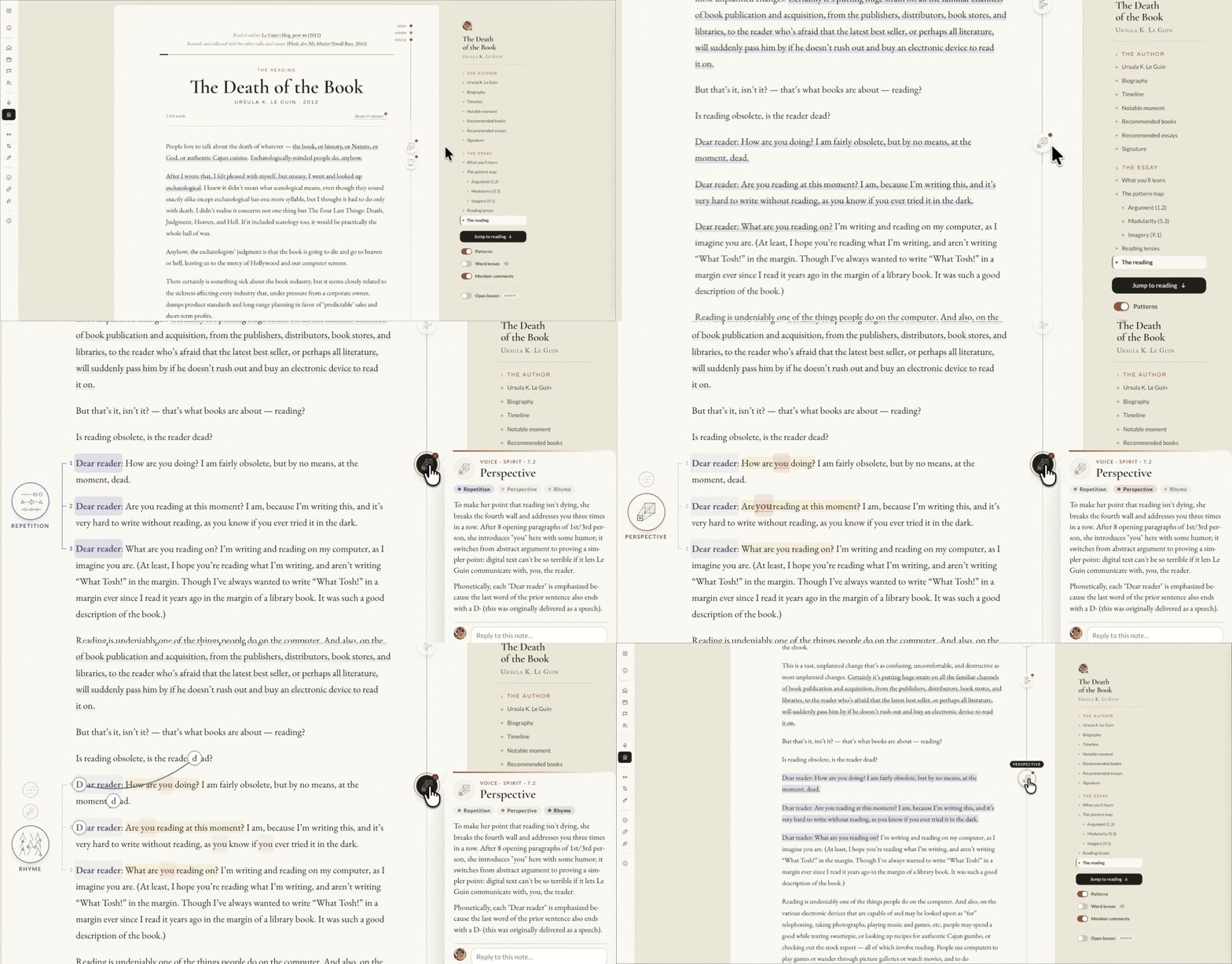
Playing with a new format for writing analysis. This is an Ursula K. Le Guin essay with a dozen or so annotations in the margin; when you click one, it opens a card and shows animated overlays on the text itself. For the years I’ve done this, the visuals were always standalone, but feels much better to have them in context of the full work.

When we read these live in Essay Club, everyone comments in the same doc as the annotations. It’s fascinating to watch other people react to the same passage you’re reading in real-time. We used to do this in Google Docs, but it would get chaotic with 15-20 cursors all highlighting at once. Now we have our own reading tool, which removes the noise, and has layers you can toggle, so you can choose when to focus or engage.

The vision is to build out a whole library like this. I’m about 20 in, but need to backfill to get everything in this new format.

→ source

Liner Notes to "Evil Thoughts From Good Men"

· 758 words

(Meta notes and principles re: Evil Thoughts From Good Men"):

  • Readiness: I procrastinated on this one for 2 years because I thought it would take months to write. I started on 10/29 and finished in 3 days. In contrast to last month, a simple idea went through 10 different revisions before I had to abandon it. There’s a lot to gain by developing my own heuristic for when an idea is “ready.”

  • Narrative: This probably came together so quickly because it was a narrative essay. The real-life experience had a beginning, middle, and end, so the essay basically wrote itself. Argument-led essays aren’t grounded in anything, so the structure can continuously shift as you evolve your thinking, making it hard to pin down. Maybe I won’t commit to something in long form until the basic narrative beats are there. (ie: the one essay per month that I give extra attention to should have a few core pieces of Material locked in).

  • Seasonal: I would likely have never published an essay about demons on the Essay Architecture account without Halloween as an occasion. I’m still sort of surprised I did it, but it was a fun way to break a slump. There’s probably something to coordinating an essay with the seasonal zeitgeist. It gives me a deadline, and also permission to experiment with a different aesthetic. What is a Thanksgiving, XMAS, New Years essay, etc? There are cliche answers to these, but there a million ways to answer any prompt. I don’t imagine myself writing horror too frequently, but maybe once per year.

  • Osmosis: We’ve been reading weekly classics in Essay Club, and only after publishing did I notice some of the patterns we studied show up in my own work. Most visibly, Annie Dillard shaped some of my opening sentences. There is also a lot of daydreaming / fantasy that I picked up from Virginia Woolf’s “Street Haunting"…

  • Daydreams: There are three daydreams in this piece: one was true but altered (in the church), another was a present-day daydream but inserted into the past (Thanksgiving), and the last one was triggered by the essay itself to help resolve the piece (what I imagined seeing in the Ring doorbell on Halloween night). The general idea is that I’m not strictly limited to what actually happened, I can conjure scenes that help add concrete moments to meet the emotional or logical needs of the essay. It’s not lying because it’s always prefaced by telling the reader, but if it’s tangible enough to blur the line.

  • Republish: As much as I like how this version came out, it’s missing a lot of what I originally imagined. I can always republish this in the future if it matters enough. My original vision for this essay had (1) more details on Bosch and others as they wrestled with similar themes, (2) more theory on how/why demons brew in the personal and collective psyche, (3) actual experiments from a typewriter. And also, publishing this has lead to some good talks/emails that are evolving my thoughts further. So maybe there’s a future version of this (in a publication or essay anthology) that is expanded/edited?

  • Change: After writing the final draft of this, it was around 10pm Halloween night, and costumes were everywhere, and I walked past a house that has this animatronic demon on the front lawn. Early in the week, I saw it, winced, and ignored it. I walked by it again, but stopped, turned around, and looked at it for a few minutes. It had a ghoulish face with red eyes, holding a dead infant, was speaking, etc. Typically I wouldn’t look at this, for not wanting that images in my mind. But after writing this, and internalizing ideas like “demons are just a personification of your concept of evil,” and “don’t give the devil providence,” I was able to look at it without fear. It was actually corny and tasteless (the next day, I even accidentally walked by the shop that sold these animatronic ghouls). I realize that it’s less about the image, and more about the emotional valence that you see/store it with. I was able to laugh it off. Isn’t that same lesson from Harry Potter? And what they recommend to do during bad trips? And is this the reason why Hindu demons in art often have smiles/laughing faces, as a reminder that laughter changes terror into something that doesn’t paralyze you? … Anyway, this is a good test for any essay. After writing it, do I actually see differently?

→ source

On avoiding sales

· 421 words

Essay Club, despite my on-and-off efforts this year, has been hard to grow (at least, not to the degree that it needs to). "On-and-off" is the likely culprit. I've made certain concentrated efforts, and those have worked to various degrees. But it's hard for me to keep "growth" the constant top priority, because it's a functional need instead of a creative one.

I fear that for years I’ve lacked a basic sense of business self-awareness. Of course, I’ve “worked on the business,” but that almost always means obsessive work on the product. If anything in the world of business, I'm a product guy. There will be an occasional one-time post to promote something, or even rarer, a campaign, but otherwise, I’ve operated with a “find it yourself model.” I make the thing, I give it a website, I’ll mention it in an email, and then I go back to product while you find it yourself.

So, I’ve been trying some new things. In October, I launched a weekly newsletter, an opportunity to speak about my projects regularly (the club, the software, the anthology). I also realized I need better “free previews” so people can try things. This is leading to about 1 new sale per week, which is good, but still not sustainable.

Ultimately, the thing I need to do, the thing I’ve been avoiding, the thing that really has nothing to do with making the work but everything to do with selling it: sales. “Will you buy this?” I probably need to be sending 3,650 sales emails per year (10 per day), where I very openly and explicitly try to convince interested prospects to buy, and I will mostly be rejected. Even if 90% of people say no, that would be 365 new members, bringing the club to ~435 people. This is the scale that makes it feel like a proper academy, the scale required for me to sustain this full-time for many more years.

(Again, not trying to “scale” this or make it a company that’s attractive to investors or anything like that. I simply want to run a one-person essay institute as my main job, and make enough to support my family while I do so.)

It will be fascinating if this works, because it’s so simple. It’s so simple, yet it’s been so completely avoided. I’ve tried so many permutations of scheduling and prioritization, and yet all of these seemed to avoid the actual constraint of the business: no one is being asked to buy the product.

X Without The Feed

· 366 words

I’m tempted to build myself a UI to get news from X without ever going on the X feed. Feels like my Notes feed is good for wholesome/timeless ideas, but X is a way better signal for the news.

I’ve previously thought it was fine to just tune out the news and focus on classics, but things are happening so rapidly that it feels worth being plugged in, somehow, without getting addled by a predatory X algo.

Goal is to be informed w/o getting addicted.

A few thoughts on how I’d design it:

  1. I would use Grokbot to grab all new posts from accounts I’ve followed/bookmarked (or maybe I’ve spend some time assembling a list). Funny how X released a product that will help me spend 95% less time on the main one.
  2. It would cluster posts by event/theme. When something happens, there’s usually only a handful of takes, but each one is reworded a hundred different ways, and so you waste a lot of energy context switching.
  3. It scores each cluster along 10-20 dimensions I care about (by topic, sentiment, whatever). I’d use Jev, so each one gets a 0-100 score, and it’s basically so cheap it’s free.
  4. I’d get to alter my algo by controlling sliders for each dimension: ie: slide AI down from 80 to 20% this week, and boost book releases to 100%, etc.
  5. There’s no feed or dashboard. It would just send me a newsletter every Friday, with maybe 10 stories, ranked by my own priorities. I guess it’s sort of like a personalized curation newsletter. It would synthesize the different reactions to an event, provide URLs to go to the source, and put it all in context to my own theses (which I guess I’d have to write—that would take the most time out of all of this… the rest can probably be built in 30 minutes).

This is a good example of a case where it makes sense to read AI writing: instead of spending 5-10 hours a week sifting through an adversarial feed, I could use that time to read more timeless essays written by people I know.

→ source

Stripping the devil of providence

· 806 words

A friend replied to my essay, "Evil Thoughts From Good Men," and here's an excerpt of my response:

I want to clarify the takeaway: I wouldn't say that I'm opening my imagination towards evil, but more so, opening my imagination despite the existence of evil in it. It's as if, from being spooked a few times, I've calcified my access to the numinous realm altogether. And so I wonder if there's a process of, not intentionally seeking evil and aligning with, but rather, to look at it directly when and if it comes, and to not cower from it (as say, Archangel Michael would).

Halloween really is the ideal time to be wrestling with all this. After I wrote the final version, I was walking up my block, and near my house I saw an animatronic cadaver in a maid dress with a deformed, stitched-up face, holding a crying infant doll, saying all sorts of creepy things. Early in the week, I saw it for a second and winced away. This time, I stopped and looked at it for minutes, and wasn't afraid or impressed by it, but found it cheesy and tasteless. "Welcome to the depths of the graveyard!" is a funny thing for it to say on the front lawn. Typically I would worry that looking it at it would etch the imagery into my psyche, but I was looking at it from a different perspective this time, with humor, so that it doesn't lodge itself in my mind with a charge of fear. (Arguably it's not just the image that registers, but the overall valence). I wonder if that experience is a microcosm of how I should react to internal phenomenon too.

To build off your quote above—if it's impossible to live within culture and completely eliminate exposure to evil, then isn't worth learning how to respond to it when it comes?

Curious to one day hear more about Jung and your interpretation of the shadow. Another insight from writing this, albeit materialist, has been helpful; the idea is that there are no external, independent demonic entities vying for my soul, rather, it's all a personification of my concept of evil. A personification doesn't make them any less "real" from the vantage of my own consciousness, but by seeing them as extensions, mutations, parts of myself, they are moldable, and ultimately under my control (ie: something to be corrected). The idea that "demons are the personification of my concept of evil" has been very helpful, and perhaps one of the instantly fear-reducing maxims I've ever conceived. This obviously doesn't jive with the theory that independent entities are waging a war to corrupt me...

I'm coming to another realization as I type this (Seneca can wait...): I'm trying to be more specific in my theology, so that when I use the word "God," I understand the concept as a series of traits/characteristics. Around 16 years old, I went through a brief period where I considered myself an atheist because I didn't believe in one of the attributes: providence. Now, I'm comfortable in defining God in my own idiosyncratic way, even if it doesn't align with the Easter Orthodox bundle of traits. Ultimately the core feature that caused my original doubt and still hasn't returned is providence: the idea that God is a conscious entity, intervening in my life and history to enact a plan. What's interesting here is that the 16-year-old me that became temporarily atheist is the same one that went to summer camp and became scared of demons. So in some way, my fear might have stemmed from stripping God of his providence, while assuming Satan still had it. And so the insight above ("demons are just a personification of my concept of evil"), is a maxim that strips the devil of any providence over me.

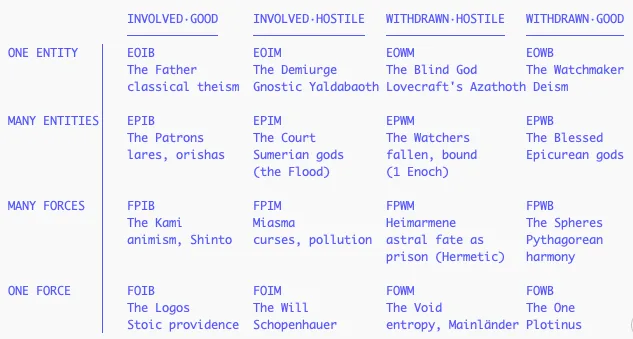
Back in September I made something like a Myers-Briggs for theology, and I see myself as generally FOWB (The One, Plotinus), or FPWB (The Spheres, Pythagorean harmony). This is still just a first pass, and needs work. I resonate with FOIB (the logos), but see that as separate from providence—ie: you can align with larger cosmic patterns, without those cosmic patterns having agency. Another way to slice it is that I believe in divine intelligence, but not in Gods or spirits with consciousness (I'm also, as of recently, falling away with the idea of the immortal soul, yet believe in "the immortal engine," yet still believe in an afterlife that's a karmic reflection of your life—I just think it's aeonic, not eternal). Based on this diagram, sounds like the idea of legions of demons coming for me falls in EOIM or EPIM (involved, hostile demons, whether one or many). What this chart probably misses is the paradigm where both good and hostile Gods co-exist and compete.

A life worth writing about

· 647 words

Can I experience four things per year that are essay-worthy? This is a different question than can I write four great essays per year? It's less about writing bandwidth or quality; it's about a novelty of experience. A good amount of essays can be anchored in the past or in abstract ideas, but part of writing is really just a way to capture living, then some attention should be paid to the living part.

Well, what constitutes "good" experience? What does it mean to live an "interesting" life? Should I make a point to travel to culturally-charged events, conferences, and concerts, to always dip into the cup of the zeitgeist? Or can it be more mundane, ie: can a monthly excursion upstate for a hike bring me Dillard-like observations? Is watching my daughter each day an endless well of experience that I'm overlooking? (related, and perhaps important: Why is she mostly off limits in my public writing?) Am I missing the walking distance mysteries?

I don't have a great answer to these questions right now. Should I? ie: Is it inauthentic to have heuristics on the range of experiences you want to have in a given year, and to then pursue them for the sake of having material to write about? This feels like a mode for journalistic essayists (DFW, Didion), but it always feels touristic; their attempt to show us the snarling and weirdening culture alienates us, prevents us from understanding what their life is actually like. Should I simply just let life happen? Look at it more closely?

I just read through my website from the year to refresh myself what I wrote about. It feels uneventful. Personally, I became a father, I vibe-coded a lot, and I worked on my Essay Architecture project. Of course, a ton happened, but it all feels too close to me to remark on. There's limited narrative. Culturally, I have movie reviews and event reactions. Do I live too much of an indoor existence as a father/computer-person? Of course, I frequent the nearby parks, but how many times have I ventured into Manhattan this year—four?

Looking back on my life, there are strange, meaningful experiences, filled with synchronicity. Consider the witch in the bar, the road trip car flip, the church hallucination. There's a plethora from my past of oddities that I can and should and will write about. But where are these experiences recently? The thing is, a truly notable experience isn't something you plan. In fact, none of them were. But in all of those cases, I was out, about: on a three-week road trip, on a quest in England, attending church on a rare night. These are things, as a new parent, I can't spontaneously do, at least for now.

Perhaps my head is on all wrong at the moment, and I do know all the answers, and I just need to remember some forgotten epiphanies. Maybe nothing has to change, and I just need to see things with freshness, with "agape" (loving potential). Or maybe I am tapping into something real, and haven't yet adjusted to the new situation. Maybe the urge to seek experiences stems from two wrong assumptions: one that great essays are built on phenomenal moments, and another one that I should even try to write great essays. Is clarity and observation all that matters? Is studying the classics planting bad ambitions in my head and corrupting my sight?

Nothing is too clear right now, and that's probably because I can only think in small pockets throughout the day, and I'm endlessly rotating between projects, getting whipped around by competing constraints, and it's hard for anything to compound.

It's probably cliche to say this, but it's all worth it. I love my daughter and love being a father. And so this is all simply the expected turbulence that everyone warns you about.