Stripping the devil of providence
A friend replied to my essay, "Evil Thoughts From Good Men," and here's an excerpt of my response:
I want to clarify the takeaway: I wouldn't say that I'm opening my imagination towards evil, but more so, opening my imagination despite the existence of evil in it. It's as if, from being spooked a few times, I've calcified my access to the numinous realm altogether. And so I wonder if there's a process of, not intentionally seeking evil and aligning with, but rather, to look at it directly when and if it comes, and to not cower from it (as say, Archangel Michael would).
Halloween really is the ideal time to be wrestling with all this. After I wrote the final version, I was walking up my block, and near my house I saw an animatronic cadaver in a maid dress with a deformed, stitched-up face, holding a crying infant doll, saying all sorts of creepy things. Early in the week, I saw it for a second and winced away. This time, I stopped and looked at it for minutes, and wasn't afraid or impressed by it, but found it cheesy and tasteless. "Welcome to the depths of the graveyard!" is a funny thing for it to say on the front lawn. Typically I would worry that looking it at it would etch the imagery into my psyche, but I was looking at it from a different perspective this time, with humor, so that it doesn't lodge itself in my mind with a charge of fear. (Arguably it's not just the image that registers, but the overall valence). I wonder if that experience is a microcosm of how I should react to internal phenomenon too.
To build off your quote above—if it's impossible to live within culture and completely eliminate exposure to evil, then isn't worth learning how to respond to it when it comes?
Curious to one day hear more about Jung and your interpretation of the shadow. Another insight from writing this, albeit materialist, has been helpful; the idea is that there are no external, independent demonic entities vying for my soul, rather, it's all a personification of my concept of evil. A personification doesn't make them any less "real" from the vantage of my own consciousness, but by seeing them as extensions, mutations, parts of myself, they are moldable, and ultimately under my control (ie: something to be corrected). The idea that "demons are the personification of my concept of evil" has been very helpful, and perhaps one of the instantly fear-reducing maxims I've ever conceived. This obviously doesn't jive with the theory that independent entities are waging a war to corrupt me...
I'm coming to another realization as I type this (Seneca can wait...): I'm trying to be more specific in my theology, so that when I use the word "God," I understand the concept as a series of traits/characteristics. Around 16 years old, I went through a brief period where I considered myself an atheist because I didn't believe in one of the attributes: providence. Now, I'm comfortable in defining God in my own idiosyncratic way, even if it doesn't align with the Easter Orthodox bundle of traits. Ultimately the core feature that caused my original doubt and still hasn't returned is providence: the idea that God is a conscious entity, intervening in my life and history to enact a plan. What's interesting here is that the 16-year-old me that became temporarily atheist is the same one that went to summer camp and became scared of demons. So in some way, my fear might have stemmed from stripping God of his providence, while assuming Satan still had it. And so the insight above ("demons are just a personification of my concept of evil"), is a maxim that strips the devil of any providence over me.
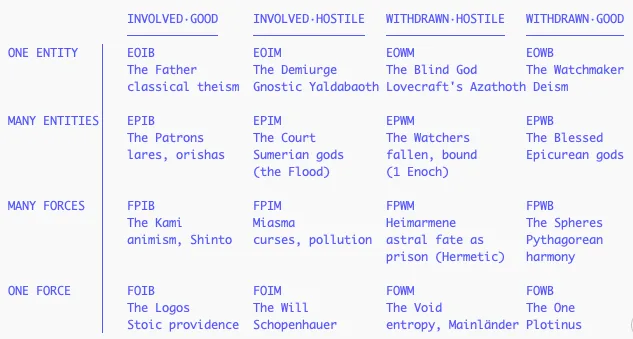
Back in September I made something like a Myers-Briggs for theology, and I see myself as generally FOWB (The One, Plotinus), or FPWB (The Spheres, Pythagorean harmony). This is still just a first pass, and needs work. I resonate with FOIB (the logos), but see that as separate from providence—ie: you can align with larger cosmic patterns, without those cosmic patterns having agency. Another way to slice it is that I believe in divine intelligence, but not in Gods or spirits with consciousness (I'm also, as of recently, falling away with the idea of the immortal soul, yet believe in "the immortal engine," yet still believe in an afterlife that's a karmic reflection of your life—I just think it's aeonic, not eternal). Based on this diagram, sounds like the idea of legions of demons coming for me falls in EOIM or EPIM (involved, hostile demons, whether one or many). What this chart probably misses is the paradigm where both good and hostile Gods co-exist and compete.