michael-dean-k/

Topic

digital-sovereignty

6 pieces

A personal labyrinth

· 1287 words

My personal website is “out of the bag.” Meaning, it’s not a private thing shared among 3-5 friends anymore; I excitedly shared it with Essay Club yesterday (60 people or so). I am leaking it prematurely because of the giddy hope, that personal websites are the new paradigm for writers, an escape from the enshittified commons. But I have to admit that I haven’t thought through two important questions yet, so here it goes:

1) Does this kill discovery?

If I were to instead publish all my ideas in real-time on Substack notes, would my audience grow more? Probably. The reality is we all self-censor ourselves in public feeds, in a thousand different ways, so it’s not like all of this could naturally emerge in feed. I tried this in January. I killed my logging practice with the goal of trying to just do it all on Notes. For two weeks, I was able to post spontaneously, but I find that if you ever stop momentum, it’s very hard to get back out of your head and into that groove. Overall, I just wrote less. I wonder if there’s truth to the idea that all writing practices grow/incubate/evolve better in semi-public spaces. It’s not that you should ignore the occasional blast. It’s that there’s a natural progression of nurturing ideas.

Another angle is, “I’m not interested in audience growth,” which is true because it’s not motivating for me, but I am in several ways entangled by growth, meaning, a complete lack of growth could threaten the sustainability of my writing. And so a middle ground is to incubate on my website and then selectively drip ideas through notes and newsletters. I could do a weekly or bi-weekly digest, Austin Kleon-style (“10 logs from last week” + essay visualization + updates, etc.). Not as sure how I would do it on Notes. Daily? Sporadically? Something else? Either way, this brings back the whole "public-to-private bridge" concept from Write of Passage. I think some people abandoned websites and just accepted the feeds. I know in 2023 I shifted entirely to Substack thinking it could be my entire digital home, but now it feels like rented land.

So my website gets maybe an A- in unlocking my writing practice, but only a C in growth, but maybe it’s a B in conversion? As in, if someone spends a lot of time on my site (and people have told me they’ve spent hours in my logs), they’re more likely to trust me—due to the sprawling, unoptimized, honest nature of things—and more likely to get a paid subscription or join Essay Club? Unexpectedly, personal writing could be a more honest and more effective form of “marketing” than strategic value-focused content (“Are you in hell? Well I’ve got the thing for you…”).

2) Is there risk in having all my ideas public?

Now that I’m in my own place, relatively unchained, saying what I want, and reading and writing about political science a bit more (I have a draft comparing Karp’s Technorepublic to Leviathan by Hobbes), I’m a bit paranoid to share ideas so openly. It’s hard to imagine facing any real-life consequences for the words I write; I’m just a nobody! It feels hubristic to think that I’d be considered a threat to the state for my thinking, but maybe these thoughts are natural, considering we’re being pleaded to accept an AI-powered surveillance state in exchange for security. (It's not that I think any of my writing is particularly rogue, but let's say I start thinking through a scheme to organize a million swing state voters to rally around a single-issue voting boycott in order to pass a bill on election campaign reform, you can see how democratic ideas might seem threatening to a state.)

It’s effortless for a state agency to scrape the Internet, build psychographic profiles on its citizens, and give them a “loyalty score.” Let’s imagine they also have an “influence score” too, determining how much sway you have over your citizens. If you have medium levels of loyalty and influence, you’re probably not being actively monitored; but if you have extremely low loyalty (L=5/100), it’s a threat even if you’re low influence (I=0) because you might be a terrorist; but also if you have extremely high influence (I=95), and even slight disloyalty (L=45), then that’s a risk too. And if it’s not the state absorbing my context, it could be independent actors scraping my site to clone me and do what they will…

I guess the point is that AI creates such a leverage over information, that you’re own personal data becomes extremely valuable. It can be leveraged not just by you, but anyone who has it. A personal website of an unfiltered nature is a higher-resolution signal than a social media profile where most interactions are shallow.

Grasping at a solution_

If all these concerns are justified (and maybe they’re not), then what are the practical methods of maintaining privacy? I’ve already written ideas about security gates and embedding-based encryption, and that’s all technologically neat, but it creates friction for the readers! Maybe that’s okay? But then this ignores the “entangled with growth” constraint from above…

And so maybe the Third and only way through is to make the encryption solution that is both an alluring and enjoyable UX for the reader.

This starts by understanding how websites get scraped, building solutions to avoid it, and then shaping them to be reader-first. You can only really do this by scraping yourself. I’ve scraped full portfolios from Substack in two different ways, and even a decade’s worth of Marginal Revolution posts. At a minimum this means avoiding RSS and HTML, which this (current) site already violates (ie: it’s ideally on a server and requires permissions to load).

Scrapers can prevent against automated gathering; but not against a person or agency that has already found your site and is willing to sit through slower and manual methods to extract information. A defense here would require gating and admin approval, another hinderance. There is something here about taking monetization dynamics (paywalls) but reinventing them for privacy’s sake. Maybe the way around this is to only encrypt a portion of the content, say 50%, with cryptic previews of what lies beyond (either through titles or redactions or chaos).

To try to synthesize this all together, what if a website were a video game?

Website as gamified maze?

As smart as today’s AI’s are, they still can’t beat Pokemon. They can transform text and code better than the world’s best engineers, but if you ask them to navigate an environment where vision and long-term memory are required, they bomb. Pokemon has very simple inputs too: 4 navigational directions and then a Click/Cancel boolean. If you were to make it more challenging, with inputs that required hand-eye coordination, that could solve two problems: it scrambles existing scrapers, and creates a novel UX.

I also sense there’s something to turning a website into a literal maze, not just an overwhelming sprawl of hyperlinks, but an actual video game you have to navigate through (it would be neat if somehow notes were semantically distributed across a map so there are “towns” of ideas). Can friction be made gamified, exploratory, enjoyable? Maybe it’s not only a matter of walking around, but solving puzzles/riddles at gates to advance deeper into the labyrinth to find more sensitive ideas. Maybe some gates require passphrases, or interactions with me. There could even be a minotaur at the center who holds my deepest memories, aspirations, and fears and if you can kill the Minotaur you get the passphrase to my Bitcoin wallet.

michaelDank.com

· 226 words

I was able to launch this website in <15 minutes. The setup is local and simple. I have a /writing file in my Obsidian vault, and then subfolders for /code, /publish, /working. /Code holds the site design, /publish my archive, and /working files have .gitignore to not push templates and notes and such. Claude Code handles the website, and different skills help me manage tags, do the menial ops stuff, and push to the Internet. All I have to do is sync a single folder to Github, and the changes are live (hosted on Netlify for free).

Compare this with my first website prototype. I was endlessly iterating on designs and fonts, and thought that I had to organize, filter, and polish my five year archive before I could get started. Probably spent hours on it before burning out on the haul. With this second version, the principle is essentially, "if it doesn't immediately produce something of long-term value, it's not worth systematizing." Now the approach is to move forward here, and slowly fill in the backlog as I'm inspired.

No need to widely share this yet. I'll make little changes day-by-day until it becomes my main place. So many things to consider. For example, I decided to add an initial on the name ("michael-dean-k"), but without hyphens ("michaeldeank"), my wife confused me with "Michael Dank."

Heuristics for systems

· 526 words

I declared to my wife this morning that DeantownOS is getting retired. It’s been 3 months since I spiraled into Claude Code for personal systems, and I’m at the point in the curve where the amazement has normalized and I’ve accepted the fact that I’m in a trough of disillusionment. The question now is revise or abort.

The case for aborting ties back to Oliver Burkemann’s Four Thousand Weeks, which popularized the idea that all systems are methods to procrastinate from making hard decisions. They give the illusion that you can do everything, and since AI can meaningfully leverage the volume and range of things you can do, it tempts you to build galaxy-brained systems. The thing I think we fail to realize while in a vibe coding frenzy is the psychic cost to remember and maintain the stuff you build. Yes, it is appealing to “reclaim my computer” and rebuild everything I use as personal software (from Obsidian to Gmail), and it’s even possible, but it’s a new breed of Sisyphean struggle. Once you can mold your own software around you, it’s too easy to endlessly mold, to lose sight of the work and just tinker on your exoskeleton.

I’m obviously skeptical, but I’m still a believer; if I were to revise, to rebuild my Claude stack from scratch, I would have to develop a few heuristics to help me from short-circuiting.

The first one that comes to mind is “will this matter once I’m dead?” Ie: writing an essay matters, because I imagine one day my daughter will read that and get to know me better, or at the very least, future Me in 35 years may enjoy reading words of my past self. But to create detailed daily files that get spliced into atomic “routing files” that then then get saved again to a new destination folder, which exist either as (a) just context for AI, or (b) require some manual effort to prune into something that matters once I’m dead, is to create waaaay too many layers of abstraction between the source and the Work. When I read back my writing from the last few months, only a small is valuable enough to be saved as "logs" in my archive. I was writing for AI, not for my future self.

I made this assumption that atomic daily files are the kernel of a system, and it was an axiom I could never undo. There’s maybe another principle on “don’t build load-bearing infrastructure on an unproven axiom.”

Another one could be “don’t assume future you will have bandwidth,” to do X every day/week/month. Every day I had to review how my AI system proposed to route my logs, and eventually I'd ignore it and get backed up. This means that if something isn’t truly automated, I should be very cautious of it. It's possible to do one little step forever, but not a hundred. Not every promise has brush-your-teeth-scale reliability.

What I’m getting at is that it’s not about maximizing or neglecting systems, but about understanding the right principles so you build something that is actually in service of your life.

Systems skeptic

· 380 words

I don't know if I buy the quote: "you don't rise to the level of your goals, you fall to the level of your systems." (And this is coming from a systems guy.) It's a beautiful piece of rhetoric. The rise/fall structure. The humility to stay grounded. But I just think when you really want to make sense of how to pull off hard things, it should be a little complex, a little more than what can be packaged into a meme.

Two opposite things need to happen at once: top-down destiny forging, and bottom-up monk-like routines. It's a negotiation: "What will I want to complete in 100 days?" is a very different question from, "What should I be doing today?" and you can try to force alignment, but that's not always easy, because what you feel like doing often diverges.

The quote above simplifies this whole dance into a blind trust in systems. A system is a servant, not a master! I write this to remind myself as I'm immersed in probably one of the biggest system rebuilds in my life (one where I'm suddenly able to fluidly create the containers I work within) ...

It is wild to think that probably 50% of my computer use these days are within GUIs I've designed for myself. To me, liquid GUIs are a bigger deal than autonomous agents. My whole conception of what personal computing can be is changing very fast, and it becomes alluring, almost addicting, to continuously evolve my own OS, to see what's possible. It's very easy now to get tangled in knots of systems and software that are all very impressive, lead nowhere, and become chores. What leads to aliveness, to your intentions?

An emerging maxim for me is to start with the goal and let the system emerge around it; otherwise, you feel the cold of the infinite tinker, especially if you are quarantining in the attic from COVID and you can't go touch grass because there appear to feet of snow outside and you are too achey to shovel out your car to go anywhere and so one way to relax when you're sick is to live-clone all incoming Substack posts into local JSON folders and redesign a better algorithm. But to what end?

Deantown OS

· 211 words

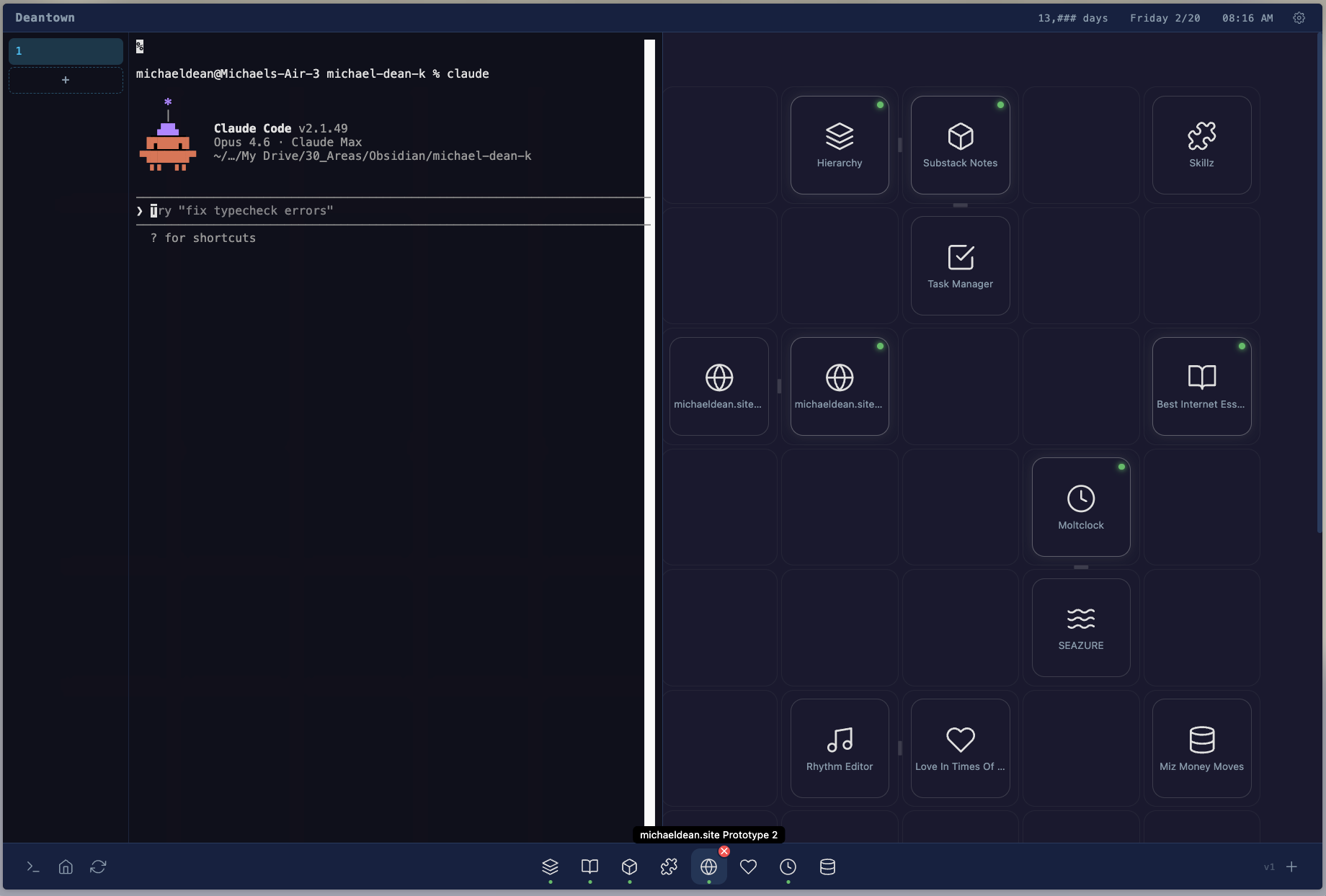
Weird post-midnight project: built myself an operating system. Not really, but really. It's just an app that finds all the other apps I've built in my 80_code folder, but then displays them as icons in a Mac dock + desktop GUI. It’s an easy way to see/use/remember what would otherwise be scattered. Lots of weird features, like the clock changes to a random time every 0.5 seconds, and instead of the date it tells me how many thousand days old I am. If you click the "Fun?" toggle, it lets snakes loose. What's trippy is I also built a multi-tab terminal inside of it, so I can Claude Code to code the code I'm coding (actually writing 0 code). Seriously though this is becoming my Notion replacement, a place to write/plan/do, except with complete interface flexibility, and all-local data. Currently writing this note from within the OS. The unlock for me was in realizing the power of local data over cloud apps. Feels like owning vs. renting. When you have everything in a single sandbox on your computer, you can spawn interfaces to help you with anything, and they can be far more idiosyncratic than anything you'd ever find in a mass-market product. Notion doesn't have snakes.

→ source

Do paid subscribers influence discovery on Substack?

· 546 words

Chris Best, founder of Substack, posted that they caught “President Plump,” the #1 growing account on Substack, for using fake subscriptions to boost discovery. I think this was intended to comfort everyone that they caught a scammer (justice!), but actually it confirmed what many were starting to notice: discovery is contingent on you making money. If you have paid subscribers turned off, no algorithmic wind will blow your way. But if you have a spike of paid subscribers in a month, suddenly your old posts will start to go viral, in hopes that even more paid subscribers will bring the platform 10% (this has happened to me before). This isn’t inherently bad. For every President Plump, there is an earnest person trying to finance their creative project.

But at scale I fear it creates a bad pattern, because the accounts that everyone sees will be the ones making the most, and generally these will be marketers and growth hackers more than artists. I think you will find better writing in the gutters of Substack than on their rising leaderboard. If authentic culture emerges outside of monetization, then there’s a real rift between what Substack wants to be (“an engine for culture”) and what it actually is (an algorithm that only rewards monetization).

I think the best we can do is use this information to our advantage. For example, I could have new Essay Club members pay directly through Stripe, but by handling payments through my Founding Members tier on Substack, I get a discovery boost, which is worth the 10% fee. Similarly, if you make small digital products, it might make sense to bundle them into a subscription instead of charging per item.

Should you use a credit card masking service to give yourself 20 paid subscriptions for $5 each? Depends. Basically, for $10/month, you can pay for a probably noticeable increase in discovery. The question is, will you get caught? Maybe they are on the lookout now, but my guess is they would only penalize it at a certain scale. Sam Kriss speculated that President Plump was paying himself around $5,000 per month to reach #1. I’ve never done this, and wouldn’t necessarily recommend it unless you have a hacker mentality and really need the growth. 

At the very least, you should consider having paid subscriptions turned on. Cate Hall found success in charging $1/month and getting to #1 rising. Our very own Yehudis Milchtein also set up $1/month subscriptions and is now #91 rising in literature.

However you approach this, it brings up a bigger question for me on how to build a real engine for culture. It seems like you can’t have an algorithm for a single reward (popularity or money) or else they will be gamed; instead you could give everyone curatorial power relative to their cultural reputation, however you measure that. For example, if we all trust Ted Gioia, then somehow Ted’s like should count more than 10,000 bot likes or $1,000 in fake subscriptions.

I hope this triggers more transparency from Substack on how their algorithm works, and also hope for a new generation of platforms where each person has visibility into and control of the thing that is routing them information.