michael-dean-k/

Archive

May 2026

11 pieces

How should an essay writer read?

· 2145 words

What and how you read should heavily depend on what your goal is. Outputs shape inputs. When someone insists you go back to read The Great Books, in order, in their entirety, they're giving you bad advice. It's not that those books aren't great—I hope to read Paradise Lost and Dante's Inferno and Finnegan's Wake and the Odyssey before I die— the problem is it's too generic a suggestion. To spend thousands of hours deep in the canon will obviously change you, but that's equivalent of throwing a beginner into the depths of the Atlantic Ocean, hoping they'll figure it out, with no sense of what their goals are.

If your goal is to write essays (every day, week, or month), then you're reading diet should look very different from a philosopher, professor, or researcher. You might not need to be a professional reader, but you should still strive to be a serious one. 3-4 hours a day might not be feasible, but 30-60 minutes per day through an intentionally selected list of sources will slowly build maps of material to fuse into your work.

If you're an essayist, you read so that concepts, forms, feelings, and words are always within reach from an idea of your own. It's no use quoting Aristotle from memory if you can't bend Aristotle to augment an original idea of your own.

It's time to make a syllabus. I've been guilty my whole life of haphazardly reading books and essays as I come across them, but now that I'm over 5 years into writing essays, I feel it's time to be more intentional. This essay is the artifact of me mapping out what, why, and how I'll be reading in the next 2-3 years. I've broken it into four practices: reading for ideas, reading for craft, reading for words, reading for feeling.

Reading for ideas

Since essays are so personal, it's very possible to draw from nothing else than the bank of your own life experience. Memory is absolutely one realm of material, but also, it helps to pull concepts from the world around you, in your time and in all times before. Anyone is exposed to some sliver of culture, and I suppose you could just rely on that. But there's another path which involves actively educating yourself.

Before I dive into the details of philosophy or history, I'm going to build a map. I want to go wide, not deep, because my existing maps are too fuzzy. ie: Who was Thomas Aquinas? Who influenced him, who did he influence, and could I hand write an essay on three of his big ideas? Until I can do that with 100 figures from antiquity to now, all interconnected in a web, I'm not prepared to dive into any Great Book. It would be a tremendous waste of time, for me at this moment in my life, to read The Leviathan by Hobbes in full, especially when I could read 30 pages on it from Alan Ryan, a philosopher-curator, whose prose is 400 years more modern, and who can contextualize old ideas into the full history. In the time I could finish one book from Hobbes, I could read Ryan's entire textbook and know 30 different thinkers at much higher resolution than I know now. By the end, I'll have an updated index on the history of political philosophy, and maybe I'll know that—based on my current writings—it makes more sense to dive into Rousseau in full.

How would my mind be different if I found and read the best curator across every field?

There's a specific kind of book I'm looking for to update my maps. It's not a textbook. It's similar in it's encyclopedic range, except it is slanted by a thesis, animated through a fervent voice, and concerned with the psychology behind the person known for an idea (instead of just biographical facts). Each chapter focuses on a figure for 25-50 pages, which feels like the right level of immersion. It might take 2 hours, compared to 20 hours for the source, and 20 seconds for Claude. While AI can surface historical ideas perfectly suited for your working draft, the problem is you outsourcing your recall. The recommendations are mechanical, impersonal, and worst of all, disembodied: you can't do it in your own head. By reading a sharp longform essay on Aquinas, his ideas will crystallize in my head and load into my subconscious; I'll know when he's relevant to my ideas at the layer of thinking itself.

The nudge to read all of Aquinas from scratch, on principle, is like asking a software developer to derive Internet standards from scratch instead of using libraries and plug-ins. For any thinker that matters, there's at least one person who spent a good deal of their life deeply understanding the source and distilling the concepts for you.

I'm going to share my working list, but the main caveat here is I'm not going in any particular order, and it's not necessary to read cover-to-cover. In any given month I'll be reading 1-2 chapters from 10 of these 24 books. In 45 minutes per day, I can get through most of this by the end of 2028 (2.5 years from now). Everything was published within the last one hundred years, and the whole thing costs $327.

You'll notice that all the links above are Kindle. This is because I want to have my highlights as atomic markdown files. The goal is not to read, but to write! Mapping and reading is just the setup so that I can read through and find highlights that spark original reactions. Montaigne's whole idea was to talk to his library, to be in conversation with the past through his books. And so the goal here is not to finish X books per year, but to produce original material. This is close to sounding like a Zettlekasten, but I should clarify that I don't plan to meticulously arrange my private highlights. A highlight is simply a prompt for an original paragraph that will immediately live on my website.

Other ways to read

I haven't spent as much time mapping out the other three modes, so I'll cover them briefly below, knowing I'll expand them later.

  • Reading for craft: If you writing essays, then reading them is how you learn through osmosis. It's where you pick up on the patterns on form and voice, consciously and subconsciously. My thinking here is to pick one essayists per week, read as much I'm inspired to, and move on. It's important to cycle here, because hanging too long on any one writer might lock you into a particular influence without realizing. I'm planning a summer syllabus for Essay Club so we can do this as a group.
  • Reading for words: Two years ago, I got really into reference books: dictionaries, usage dictionaries, the thesaurus, etymology, and even specialized dictionaries (on architecture, philosophy, scientific concepts). Sometimes I'd read cover to cover (futile), and others I'd practice words in ANKI. Expanding your vocabulary is seen is a pretentious thing to do today, when so much is geared towards simplicity and accessibility. Won't a rare word alienate the average user in your audience? No, because in the right context, ambitious words can increase the resolution in how you describe something. There's a joy in searching for words, but again, this comes back to returning to them repeatedly until it's actually coming through your prose.
  • Reading for feeling: Novels and poetry are less about collecting bits to synthesize into your work. This is more an act of expanding your understanding of how words can make you feel. Less about analysis, more about immersion.

A personal labyrinth

· 1287 words

My personal website is “out of the bag.” Meaning, it’s not a private thing shared among 3-5 friends anymore; I excitedly shared it with Essay Club yesterday (60 people or so). I am leaking it prematurely because of the giddy hope, that personal websites are the new paradigm for writers, an escape from the enshittified commons. But I have to admit that I haven’t thought through two important questions yet, so here it goes:

1) Does this kill discovery?

If I were to instead publish all my ideas in real-time on Substack notes, would my audience grow more? Probably. The reality is we all self-censor ourselves in public feeds, in a thousand different ways, so it’s not like all of this could naturally emerge in feed. I tried this in January. I killed my logging practice with the goal of trying to just do it all on Notes. For two weeks, I was able to post spontaneously, but I find that if you ever stop momentum, it’s very hard to get back out of your head and into that groove. Overall, I just wrote less. I wonder if there’s truth to the idea that all writing practices grow/incubate/evolve better in semi-public spaces. It’s not that you should ignore the occasional blast. It’s that there’s a natural progression of nurturing ideas.

Another angle is, “I’m not interested in audience growth,” which is true because it’s not motivating for me, but I am in several ways entangled by growth, meaning, a complete lack of growth could threaten the sustainability of my writing. And so a middle ground is to incubate on my website and then selectively drip ideas through notes and newsletters. I could do a weekly or bi-weekly digest, Austin Kleon-style (“10 logs from last week” + essay visualization + updates, etc.). Not as sure how I would do it on Notes. Daily? Sporadically? Something else? Either way, this brings back the whole "public-to-private bridge" concept from Write of Passage. I think some people abandoned websites and just accepted the feeds. I know in 2023 I shifted entirely to Substack thinking it could be my entire digital home, but now it feels like rented land.

So my website gets maybe an A- in unlocking my writing practice, but only a C in growth, but maybe it’s a B in conversion? As in, if someone spends a lot of time on my site (and people have told me they’ve spent hours in my logs), they’re more likely to trust me—due to the sprawling, unoptimized, honest nature of things—and more likely to get a paid subscription or join Essay Club? Unexpectedly, personal writing could be a more honest and more effective form of “marketing” than strategic value-focused content (“Are you in hell? Well I’ve got the thing for you…”).

2) Is there risk in having all my ideas public?

Now that I’m in my own place, relatively unchained, saying what I want, and reading and writing about political science a bit more (I have a draft comparing Karp’s Technorepublic to Leviathan by Hobbes), I’m a bit paranoid to share ideas so openly. It’s hard to imagine facing any real-life consequences for the words I write; I’m just a nobody! It feels hubristic to think that I’d be considered a threat to the state for my thinking, but maybe these thoughts are natural, considering we’re being pleaded to accept an AI-powered surveillance state in exchange for security. (It's not that I think any of my writing is particularly rogue, but let's say I start thinking through a scheme to organize a million swing state voters to rally around a single-issue voting boycott in order to pass a bill on election campaign reform, you can see how democratic ideas might seem threatening to a state.)

It’s effortless for a state agency to scrape the Internet, build psychographic profiles on its citizens, and give them a “loyalty score.” Let’s imagine they also have an “influence score” too, determining how much sway you have over your citizens. If you have medium levels of loyalty and influence, you’re probably not being actively monitored; but if you have extremely low loyalty (L=5/100), it’s a threat even if you’re low influence (I=0) because you might be a terrorist; but also if you have extremely high influence (I=95), and even slight disloyalty (L=45), then that’s a risk too. And if it’s not the state absorbing my context, it could be independent actors scraping my site to clone me and do what they will…

I guess the point is that AI creates such a leverage over information, that you’re own personal data becomes extremely valuable. It can be leveraged not just by you, but anyone who has it. A personal website of an unfiltered nature is a higher-resolution signal than a social media profile where most interactions are shallow.

Grasping at a solution_

If all these concerns are justified (and maybe they’re not), then what are the practical methods of maintaining privacy? I’ve already written ideas about security gates and embedding-based encryption, and that’s all technologically neat, but it creates friction for the readers! Maybe that’s okay? But then this ignores the “entangled with growth” constraint from above…

And so maybe the Third and only way through is to make the encryption solution that is both an alluring and enjoyable UX for the reader.

This starts by understanding how websites get scraped, building solutions to avoid it, and then shaping them to be reader-first. You can only really do this by scraping yourself. I’ve scraped full portfolios from Substack in two different ways, and even a decade’s worth of Marginal Revolution posts. At a minimum this means avoiding RSS and HTML, which this (current) site already violates (ie: it’s ideally on a server and requires permissions to load).

Scrapers can prevent against automated gathering; but not against a person or agency that has already found your site and is willing to sit through slower and manual methods to extract information. A defense here would require gating and admin approval, another hinderance. There is something here about taking monetization dynamics (paywalls) but reinventing them for privacy’s sake. Maybe the way around this is to only encrypt a portion of the content, say 50%, with cryptic previews of what lies beyond (either through titles or redactions or chaos).

To try to synthesize this all together, what if a website were a video game?

Website as gamified maze?

As smart as today’s AI’s are, they still can’t beat Pokemon. They can transform text and code better than the world’s best engineers, but if you ask them to navigate an environment where vision and long-term memory are required, they bomb. Pokemon has very simple inputs too: 4 navigational directions and then a Click/Cancel boolean. If you were to make it more challenging, with inputs that required hand-eye coordination, that could solve two problems: it scrambles existing scrapers, and creates a novel UX.

I also sense there’s something to turning a website into a literal maze, not just an overwhelming sprawl of hyperlinks, but an actual video game you have to navigate through (it would be neat if somehow notes were semantically distributed across a map so there are “towns” of ideas). Can friction be made gamified, exploratory, enjoyable? Maybe it’s not only a matter of walking around, but solving puzzles/riddles at gates to advance deeper into the labyrinth to find more sensitive ideas. Maybe some gates require passphrases, or interactions with me. There could even be a minotaur at the center who holds my deepest memories, aspirations, and fears and if you can kill the Minotaur you get the passphrase to my Bitcoin wallet.

Notes on the permanent underclass

· 2006 words
  1. A HYPE TERM: "Permanent underclass" is a dramatic mutation of an old term: class inequality. "Underclass" was coined in 1963 (Gunnar Mydral in Challenge to Affluence) and captured the anxiety of automation destroying common jobs. Now that AI is here in a real way, we can't help but imagine the irreversible evisceration of all jobs. When people say "you have 2-3 years to escape the permanent underclass," they mean that this is your last chance to build wealth, because in post AGI-economics, humans don't have economic relevance anymore. Employers employ agents (and eventually robots) instead. And so what will we do with all the meat bodies? The speculation has shades of darkness that start with mass employment, and spiral into feudalism, slavery, and even genocide. The uncertainty is real, but it gets delirious, and often ignores history, and also the many self-stabilizing mechanisms that get triggered on route to a collapse.
  2. MIDDLE CLASS ANOMALY: The real fear here is "the collapse of the middle class," which sounds like a news headline. But separate from AI, my generation is certainly already feeling it. My wife's grandfather was a painter (of houses) and got a million-dollar house (in today's terms) for $10,000. Now people are saying $100k/yr is the new poverty line. While this certainly feels like "the system has screwed us," middle classes are an anomaly, and a mass middle-class—what we had post WW2—is extremely rare. They existed in Athens, Rome, Byzantium, etc. but they were often in isolated cities (ie: Florence at 70,000 people), compared to the Han China Dynasty (100,000,000 people in a two-tier system). The total number of human-years in a middle class is probably around 5%. The relative size of our middle class is even more rare: pre-Industrialization, it was 10-30% of society, where ours is 50-70%. And finally, a middle class rarely persists: it either disintegrates back into an two-tier king/serf system, or, it's forced to transform it's method of work.
  3. FROM WORK TO PERSONAL WORKFORCE: AI will force a change in how next generation's middle class works: from employment to entrepreneurship. I think this is the unspoken tension between elites (who are not concerned with the future being filled with new opportunities), and the normal person (who have never earned a dollar outside of a W2 job). Entrepreneurship is maybe the greatest force for class mobility. This is where "new money" comes from. A poor person could become a billionaire if they know how to work the OS of the market. That is an anomaly and not going away! What's changing though is the economic mobility of non-entrepreneurs. The rising tide is reversing (92% of children born in 1940 earned more than their parents, and it's shifting the other way now), and the rapid automation of jobs via AI certainly won't help. I personally don't doubt that most jobs will get automated away, because I run a small business and I don't have the financial abundance to hire humans at the price they need. I've hired graphic designers, editors, and almost software designers, but found that today's AI models were able to do equal or better work, for a fraction of the cost, and are way more nimble to evolve with my evolving needs. Won't every rational business make this tradeoff? The consolation is that the "end of the work," brings a new era where every person has a personal workforce. It may be hard to find a job, but for $100/month you'll have 10-100 agents on hand, and so do you have a vision? So, no, no one will be in a permanent underclass, so long as they can succeed as an entrepreneur. It's as if the rise of AI has taken the startup/entrepreneur model of Silicon Valley, which once was and still is a minority, and scaled that up to become the new paradigm of work. That is better than nothing, but the odds aren't good. Only 0.05% of startups get funding, maybe 20% get a return; small businesses—the more likely path for the average person—also only have a 20% survival rate after 20 years. So again it's not the decimation of a middle class, but a contraction of the rare post-war middle class (and most middle-classes do emerge after wars) from 60% down to the historical norm of 20%.
  4. REVOLUTION UNLIKELY: The relative size of the lower class isn't necessarily associated with unemployment or risk of revolution. Consider how Mexico has ~70% lower class but only 3% unemployment. I guess the important question for stability in America is if, after AI automation, gig jobs can sustain people who lose their current jobs. 10-20% unemployment would lead to political instability, and 20-30% would create the situation where a revolution could form. If you read Tocqueville (or Brinton or Goldstone, who I haven't read), he says that beyond economics, a few things are required for revolution: an under-utilized but educated youth, elite extraction during widespread suffering, failed reform attempts, defection of intellectuals, coordination capacity... we seem to have all of these. He also notes that revolutions don't come from a collapse of the middle class, but from a perceived sense of being excluded from a new economic order (ie: massive gains from AI, hoarded by a few companies). But Tocqueville also says that the original American Revolution succeeded because we were able to retreat to open space, where the French Revolution failed because it was an open clash within the territory of the aristocracy. If there were a revolution here, it would almost definitely be thwarted, considering NSA surveillance, military power, geographic dispersion, and how most conflict is absorbed into left-right political feuds instead of up-down class feuds. So instead of class war, what's more likely in America is political warfare (underway), which in the worst case leads to authoritarian capture and state fragmentation. A civil war is a distraction from a revolution. The eeriness of all this is that it's right on schedule according to the Strauss-Howe theory; they mapped revolutions going back in 80 years cycles (American Revolution > Civil War > WW2), and predicted 2026 as a crisis that would spawn the next world order.
  5. PROPHETS OF REDISTRIBUTION: So if there is massive job loss and social strife, but no potential for revolution, how will the elites respond? The cynical view is that they will retreat into their already-constructed drone-protected bunkers and let the mess sort itself out. The optimistic view is that the entrepreneurs who are triggering the AI revolution are actually problem solvers at heart, and once or if the AI race is ever "over," they will be unimaginably wealthy and eager to play the role of utopian planners to restructure society in their image. Will elites side with the common man? It's happened. Voltaire was a French intellectual who died a decade before the French Revolution, but through his salons he injected ideas of equality, liberty, and reason into the aristocracy. It was like a Trojan Horse, because the elites became enamored with ideas that undermine aristocracy without realizing, and so they were quick to defect and enable the revolution. In terms of the Strauss-How cycle, Voltaire was a Second Turning "awakening prophet" that laid the spiritual grounding for the Fourth Turning of that time. The parallel to our time is the 1960s, where counter-cultural ideas about communal living, redistribution, and the end of work were forged; and also the very fabric of computing, the Internet, and AI all came out of the consciousness revolution—the sway of egalitarian-minded intellectuals could determine how the elite allocate their trillions. What we're facing is something like a crisis in capitalism. If the market is left to its own terms, with everyone on Polymarket "trading the madness," then it could turn Landian (re: Nick Land's vision for markets as inhuman alienating forces). Or, hyper-capitalism pushed to it's limits just turns into Marxism, and the counter-cultural ethos of the 60s gets fully mainstreamed (it's already in progress: hitchhiking turned to Uber, free love to Tinder, pad crashing to AirBnB, freak foods to Whole Foods).
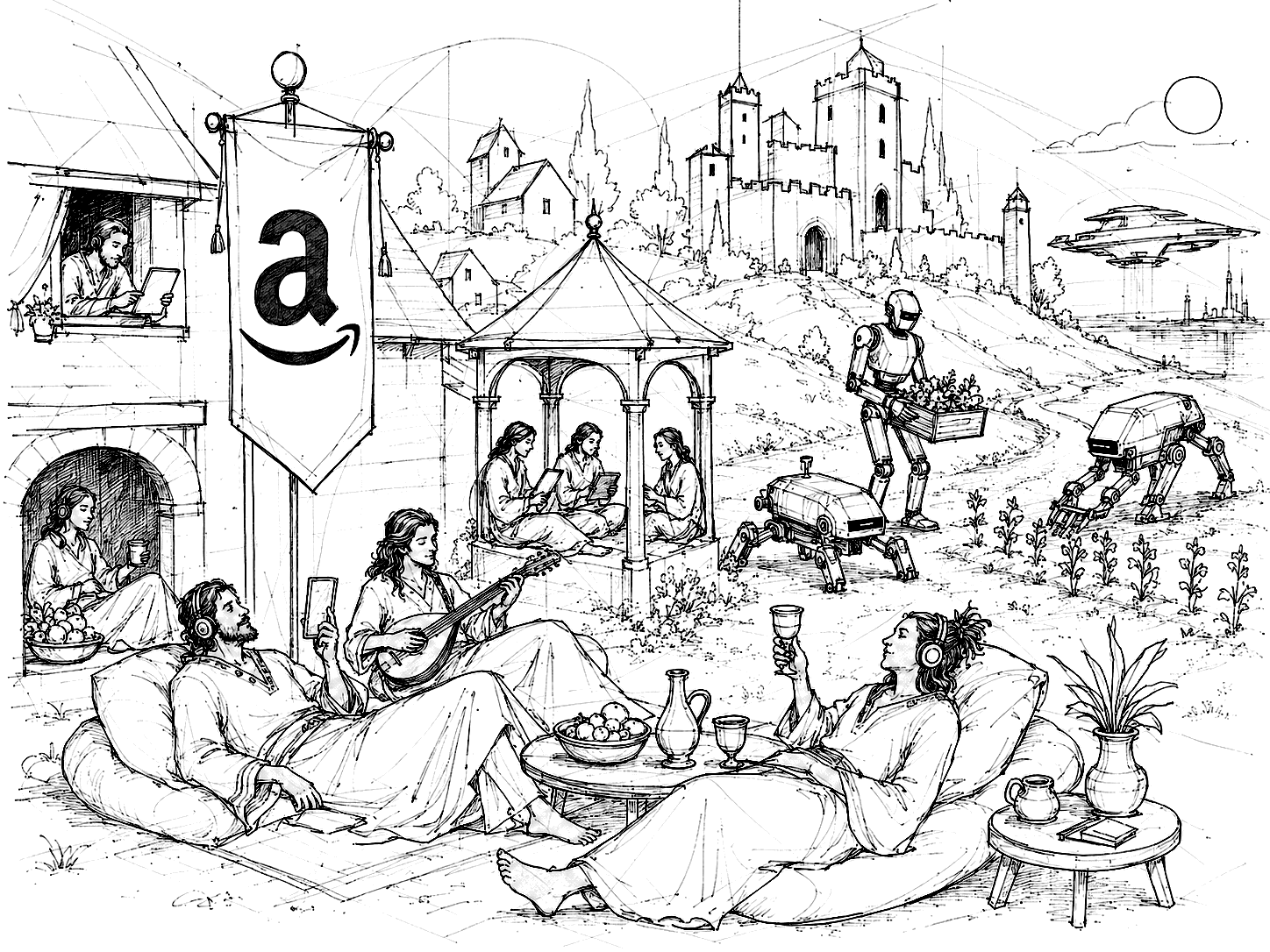
  6. PAID TO SCROLL: But who will be doing the redistribution and why? I'm skeptical of a "universal basic income," which implies a world government (if you take "universal" seriously). Each country will have different policies on distribution (aka: welfare). We'll likely see a range of implementation, some being highly dysfunctional welfare states, and others being prototypes of a modern democratic socialism. Realistically though, governments will only have the means to redistribute any wealth if they seize and nationalize the AI companies (which Palantir's Karp is suggesting needs to happen). But if we go the way of The Sovereign Individual (where Thiel wrote the forward), it means that companies will replace governments, and lead us to a kind of lawless "anarcho-capitalism." And so in this model, what would elites do? Bunkers or philanthropy? Will Anthropic be anthropic? (We already know OpenAI didn't live up to their name). I think there's a more practical middle, where companies will be incentivized to provide "UBI" themselves. Assuming everything doesn't collapse into a singleton-powered mono-corp, there will still be 3-10 big companies competing, but now with massive budgets. What they used to spend on employees is now automated for a fraction of the cost, and so they might chose to re-allocate that budget to paying citizens, or really, their users. Attention is the last scarce resource, and so by paying users to lock in to their platforms (using their feeds, apps, cars, etc.), they hold that advantage over their competitors. I know that sounds extremely circular, but is not the current AI economy already circular? Is NVIDIA not paying OpenAI to buy their chips? And so why wouldn't OpenAI pay users to pay for their AGI?
  7. NOT SERFS, BUT HIPPIES: If AGI/ASI does bring upon all the sci-fi advances we dream of, then we could see a dramatic cost collapse in everything: materials, medicine, food, energy. It could be trivial for a company to provide all the basic luxuries of living for little or no cost, but in exchange for loyalty. So to bring this back to the permanent underclass: the elite-backed companies, in order to prevent revolution and to beat competitors, could be rationally incentivized to offer a luxury quality of life to its users. What's strange though is that it's luxury without mobility. Meaning, the average person could be provided a sweet apartment and unlimited Grubhub, in exchange not for labor, but loyalty. They might not have the discretionary freedom to do things outside of what's in "the contract" (rings of indentured servitude, but with air conditioning!). ie: Your plan might include a free train and bus pass, but if you want to fly to Europe, you need to grind at gig work for 6 months to get actual money, since the plan offers only amenities. Different communes, I mean... companies... will offer different deals, and if one offers a yearly international vacation (possible by some fuel breakthrough), the others will follow. The citizen will have the freedom to pledge freely, which would make this not like socialism, but the first ever manifestation of communism. We confuse those terms: socialism is when all power is absorbed by the state, where communism is actually stateless and decentralized. North Korea, the USSR, and Maoist China were not communist, but socialist. Communism was Marx's ideal, and he would've never conceived that the path to the first instance of communism was through hyper-capitalism (though of course an alien bastardized version that he would probably hate). And to bring this back to the spirit of the 1960s, heavily anchored in communal ideas: the "permanent underclass," will be a lot less like being a serf and a lot more like being a hippy. Except more like a state-sponsored, highly-surveilled, find-your-meaning-through-our-menu-of-options hippies, with of course competing hippy factions, the permaculturists, the hedonists, the transhumanists, the bloboids, the transcendentalists, the academics, but shared among all of them is a new identity that is decorrelated with their economic value, and more anchored to new social systems of vainglory that are hard to imagine.

Avoid shipping logistics

· 466 words

I resonate with the vision of Metalabel—artists collaborating and splitting royalties—but after finishing a project with it (The Best Internet Essays 2025), I’m not sure if I’d use it again for a self-published print book. I imagine this works so much better with a digital product, but for a physical deliverable, I found the convenience of automating the royalty split to not be worth the friction of handling shipping. (I’ll describe my process, and if I did something wrong, please correct me.)

All purchases happen through the Metalabel storefront, and from there you can export a CSV that you can bulk upload into a tool like Lulu (an online printer). I decided to offer the anthology (The Best Internet Essays 2025) for a limited window, otherwise I’d have to handle shipping logistics at a daily/weekly level. But even with a single shipment, I ran into trouble. The first issue is that a lot of countries require a phone number for shipping. Metalabel didn’t collect that, so I had to put 1-111-111-1111, which got flagged for some countries, requiring me to use my personal cell phone. Other countries required a tax ID, and I’m still waiting to hear back from the buyers so I can ship them their copy. Another thing I didn’t think through is the return addresses. I assumed that the printer would provide their own address, but instead they used the name/address from my credit card, which I did not intend to share! I’ve been writing under a pseudonym, and this doxxed my last name to anyone who purchased.

The other problem was that so many people—in real life and online—were confused why the sale had an end date. Books don't typically have deadlines. Even those who knew the deadline procrastinated, and were bummed when they remembered they forgot. Again, my decision, specifically because I do not want to be regularly porting over CSVs and manually handling the edge cases that are inevitable.

In the future, I’ll likely set up a storefront where a reader can purchase it themselves, input their address and any required information for their country, and then get their own unique tracking ID. And, considering so much effort goes into making a book, I wouldn't want to limit it to a one-month window; I'd want it open forever, or for years, at least. If I do a royalty split again, I can set some interval, maybe once per quarter or year, and then ask the contributors to invoice me. None of my friction above was specific to Metalabel functionality (the whole platform as it is was very pleasant to use, and it's Lulu that I'm frustrated with), but because they aren't integrated with a shipping platform, it requires logistics that are annoying and avoidable.

The vitality of a vital person vitalizes

· 1172 words

It’s amazing how many tricks the mind can play to prevent you from picking and prioritizing The One Thing. I can declare I’ll do one thing per area, which is pretending to focus when I’m 9x overbooked. I can say “one hard thing per day,” but if each burst moves in random directions, then the average of those vectors may leave me where I started. I can write, print out, then pin it up and prayer to a single 3-year goal each morning, but if every task can loosely ladder up to it (through some round about way, because everything relates to everything), then there’s no hard decision being made.

A few months ago I wrote that my one goal was to hit $250k in ARR through “mission-driven creative work” by 2028 (via Essay Architecture). If something didn’t directly support that, I’d have to cut it. If you achieve your One Thing, theoretically, then most of your other problems are solved: my wife could stop working to spend more time with our daughter, I’d have more space to work on creative projects, we’d be closer towards getting a house, etc. This makes it easy to say no to personal projects that are obviously unrelated (ie: record an album, read the dictionary, hike 40 mountains), but even within what seems like the limited scope of “a writing business,” it is tricky to define the arrow from which everything else follows.

I am in many ways over-extended. On the business side, I have a curriculum, editing software, an anthology, and a community of practice. Then there’s of course my own essay practice. I’m able to juggle these five things, but each is held back from the sprawl. I focused on The Best Internet Essays from November 25 - March 26, and in that time I couldn’t iterate on the software, I couldn’t grow Essay Club, and most of my writing revolved around the prize & anthology. And, importantly, the decision to juggle meant that the core thing (the anthology) was probably executed at only 50% capacity.

So why am I resisting prioritization? I see as Essay Architecture as a “micro-institute,” a range of inter-connected pillars that work together towards a civic and personally-aligned mission. Software without a curriculum feels unanchored in learning science. Software without the literary prize angle could easily turn mercenary. Software without community loses the personal touch. If I’m not writing myself, how could I even know what the software needs to be? If I really wanted to double-down on the software, I’d raise money and build a team, and the incentives would require me to make software for knowledge workers, which would turn it into an auto-complete tool, my anti-mission.

I have been part of and observed companies where the personal writing practice of the founder was slowly neglected until total abandonment when empire building hit a certain velocity. This warning feels etched into me. The core reason I started Essay Architecture in the first place was to create something that was aligned with my own essay practice. I’d much rather be writing essays for 50 years with a modestly growing company than build an extremely successful and impactful company that doesn’t let me write until I retire in 50 years.

If everything should be in service of my own essays, shouldn’t that be my One Thing?

The reason I haven’t given myself permission to do this is because true, self-driven essay writing is hard to monetize. So it comes down to financial anxiety. But I don’t think I’ve honestly doubted my premise: is financial growth actually necesasry for me right now? Between the ARR I already have, a new part-time consulting gig I just started, and my wife’s income, we’re actually not far from my goal. It also turns out that my wife now enjoys her job after maternity leave (because she’s working part-time, not overtime), so even if my business took off, she might still want to work.

This feels selfish for at least two reasons: selfish because I’m not taking the path to best support my family, and selfish by putting my own needs over what paying customers of the Essay Architecture system might want. However, if you are focused on the Right thing, and are properly prioritizing and focusing, then you become a gravity well and matter bends in your favor. Paradoxically, but obviously, you can only build something useful for others (and, thus a company), if you are selfishly operating in your zone of genius. For me, that is not marketing, but essay writing itself. When I dial into and optimize for attention, growth, and revenue, it strips me of my vitality, and it doesn’t seem to work; might I get objectively better metrics if I were locked in and oblivious to the stats?

Craig Mod is a good example here. He’s a writer/photographer known for 300-mile walks through Japan, and runs a successful membership program that’s in serve of his personal work. A few lines from his rules stand out: “you are building a community,” but not managing it, instead “you must have faith that the work itself is strong enough to be a binding agent,” and “if the work isn’t strong enough, work more on the work.” This inverts how a traditional business-builder, or even solopreneur might think. It is you, the artist, at the middle; you are obsessed with your craft, but opening different pathways so others can work alongside you. There’s a way in which every part of my micro-institute benefits from doubling down on my own essay practice. If I write inside my own software, the software will naturally evolve. If I’m trying to become a master, then the curriculum is just the trail of what I’m already learning. If I’m publishing each month, then Essay Club is the tribe I do it with.

A friend and fellow acolyte of The One Thing, Matt Svarcs-Richardson, recently shared a paraphrased line from Joseph Campbell that resonates: “the vitality of a vital person vitalizes.” 1 You will not inspire anyone into action unless you are operating at the edge of your flow, a flow that is very distinct to you, a secret flow you can get lost in for 10 hours where others don’t even know how to enter. This doesn’t mean to burrow into longform essays and ignore Essay Architecture. This means that my own writing is the spearhead from which the institute follows (even Emerson said that an institute is the shadow of one man). The software, the curriculum, the club, and the anthology are not separate businesses to grow and optimize for, but critical components of my One Thing, my essay practice.

This inverts the typical time-scale. Usually you focus on growing a business and then decades later, assuming it works, and assuming you still have the fire, you can begin working on the thing you’d work on if resources were no issue. Instead I want to start with the fire, and use that to slowly build an institute over decades.

Footnotes

  1. The original quote is "the influence of a vital person vitalizes." Here is more context, sent from Matt:

    "Bill Moyers: “unlike the classical heroes, we’re not going on a journey to save the world but rather to save ourselves.”

    Joseph Campbell: “And in doing that you save the world. You do. The influence of a vital person vitalizes. There’s no doubt about it. The world is a wasteland. People have the notion of saving the world by shifting it around and changing the rules and so forth…No, any world is a living world if it’s alive. And the thing is to bring it to life. And the way to bring it to life is to find in your own case where your life is and be alive yourself."

The Semantic Press

Reimagining Tocqueville's remedy to tutelary power in the age of AI

· 500 words

Submitted to an essay prize by the Cosmos Institute. The prompt: Tocqueville warned of a “tutelary power” that would keep citizens in perpetual childhood. How have Tocqueville’s concerns migrated from institutions to algorithms, and does AI fulfill or transform this fear?

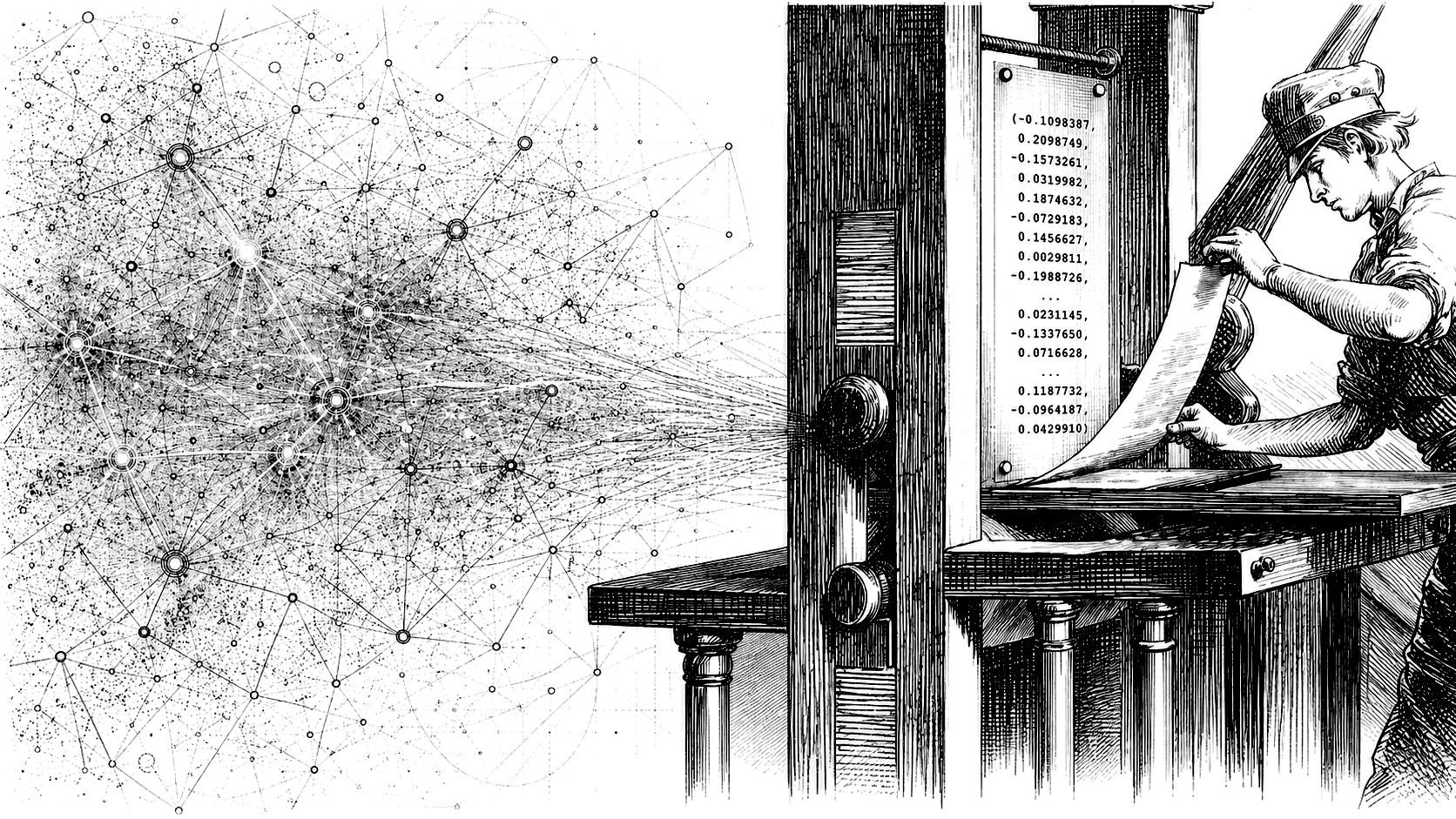
"Equality isolates and weakens men, but the press places at the side of each[...] a very powerful arm that [...they...] can make use of. [... It] permits him to call to his aid all[...] fellow citizens and all who are like him. Printing hastened the progress of equality, and it is one of its best…

read essay →

The bottlenecks to greatness

· 970 words

Where do I have to grow? Not just as a writer, but a thinker, and more importantly, a person? It’s dangerous to stop asking this question; it’s too easy to see yourself as fully matured, individuated and at your edge. Even the self-labeled "curiosity seekers" may unknowingly confine themselves to a shape. We identify with our skills and clumsiness, our knowledge and gaps, and assume these as static traits of our nature. From the other end, someone once told me there’s nothing they could learn from fiction, since they have no doubts on who they are. Can you not have both? To propel forward with confidence on your proven strengths, but also with the humility that you have much to learn? I am grateful for how architecture school set off an explosive inner drive in me, and certainly do feel I've cultivated a unique way of seeing things, but surely I'm blind in ways I can't see, with some habits I must have gotten very wrong, and if continued unfixed, will clamp me down from greatness.

Greatness! I shouldn't be shy to admit what I strive for, to feel the subtle pressure to play down my quest for complete, utter, spine-chilling mastery as a cool and casual endeavor. What is the root of this? Maybe I can tell you but I will likely be guessing and justifying.

One guess is that I've been receptive/perceptive to feel the viscerality of great works—in architecture, music, writing—and it feels to me there's no greater ability than being able to do that myself. This isn't unique to me of course, it's possibly what drives at least half of artists, but I imagine many people are content experiencing art in all its fullness with no desire of making it themselves (no desire to make, or to recreate that experience in others).

I know it’s vain (and dangerous) to want extrinsic fame, and more measured to do things for the love of it, intrinsically. But if it were purely intrinsic, would I not just journal and take my words to the grave? I could riffed on the intrinsic benefits—ie: it simply feels like great to pick something you enjoy and commit to improving through your whole life—but also, if you take that idea seriously, it’s not enough to just enjoy it uncritically, because your blind spots may prevent you from reaching your greatest internal heights.

This makes it worthwhile to understand the caliber of the minds and lives around you, and throughout history, to estimate yours in relation to theirs. Of course, "comparison is the thief of joy," but there's a way to get feedback without letting it consciously or subconsciously crush you. I imagine a reasonable person just makes an assumption, that someone they're inspired by is just made differently. Instead, we each have a range of extreme and unreasonable actions available to us, that if we act upon consistently for years, can evolve us out of one head and into another.

There’s a level of contradiction here, where I’m totally happy writing in obscurity as a suburban dad, and it’s fine if no one but my daughter ever reads my work, and also I want to unblock all my obstacles so that it increases the odds and eliminates the luck of becoming “a figure,” someone beyond my local Dunbar limits, outside my audience, and if I'm being honest, outside the 21st century. I realize this might be a confession of vanity, but I don’t think it’s for the sake of being known or idolized, for I’d do the whole thing anonymously or pseudonymously if that’s what it took. I’m an introvert and very much appreciate my solitude. But to rise above the filter of obscurity from great work is to offer others the experience that triggered me to make stuff in the first place. There's a sense of paying it forward.

Again, I'm not sure here if I'm trying to justify an inner, hidden vanity of mine, or if there really is a paradox worth sitting with. A different and possibly wiser point of view is to be indifferent to outcomes. Mastery is all you need: sometimes it gets recognized and sometimes it doesn't. Figures without mastery are idols, influencers, farces. What matters is the inner quest to transcend your limits.

So back to the original question, what are my limits? I am under-studied compared to Huxley, under-lived to Kerouac, unexplored compared to Pessoa, inarticulate to Woolf, unwise to Christ. And so half the battle is in trying to sustain conversations with these people, through their work, for a full decade, until you absorb their particularities into your own essence; but also book knowledge is useless unless you live and integrate it; that involves courage, which is not something you absorb in prose.

That is the bottleneck to everything, to life and art: courage. We each have to overcome our sheepishness and strive to live in Third ways. And while I have extreme courage in some areas, I am a coward in many others (I will spare you the accounting). How do you wring that out of your nerves? It is the limiting constraint in everything. It is the weakest link. In each sport I played as a kid, I had one trait of excellence that was rendered useless by a handicap: the hardest shot in soccer but I could not dribble; the best rebounder who could not lay up; the golden glove with a wimp’s arm; lightning legs but Super Mario sprinting form. Likewise, I can’t write or live without courage.

And so really I’m six years into writing, the same length of time I spent in architecture school, but as if I built my own curriculum. I am only at square one with everything ahead of me.

Catastrophic bug

· 284 words

Claude Code just deleted all the files in my writing folder from 2026! All I wanted it to do was rename file names so we have a consistent dating format—YYYY.MM.DD-title-title.md to YYYY-MM-DD_title-title.md—but it thought the simplest way to do this was to write new files with the new file name, and then delete the old ones. That is fine, except there was a bug in the renaming script, causing it to name every file “.md”. This means instead of making 21 new files, it kept rewriting the same file, so all the data was deleted except the last one.

Catastrophic bug — the mv loop produced the same target name for every file because BASH_REMATCH doesn’t populate in zsh. I overwrote 20 files. Stopping immediately to recover.

This is bad. I need to be straight with you: What happened—My bash script used ${BASH_REMATCH[1]} for regex captures. That works in bash but not in zsh.(your default shell on macOS), where the captures live in $match instead. Every iteration produced an empty target name —.md, and each mv overwrote the previous file at that name. Result: 20 of your 21 logs were destroyed. The surviving —.md contains only the content of 2026.04.15.institutes-vs-institutions.md (the last one processed).

This happened despite the guardrail I put in my CLAUDE.MD file: “NEVER delete or overwrite existing log entries, daily pages, or essays.” In this case, it didn’t think it was deleting, but following my command to rename. Fortunately, I had that same folder backed up to Google Drive (and most of them were on Substack anyway), but still, I’ll now be extra cautious with file operations.

The many yous of yourself

· 510 words

In response to Alex's post here (it is neat that we can go back and forth with two independent sites) ... I also find myself using "you" a lot when I'm writing for myself.

My guess as to why this happens is that a person isn't really a static singular self. Of course we know on some level that we all evolve and change through life. But writing is something that accelerates the sharding, forking, splitting, becoming. When I write "you shouldn't check your email when you wake up" (which I did today), it's as if the person who realizes this (me, now) is different from the person from an hour ago who did not. How could that person lack the clarity and values that present me has?! And so the writer, "the I" of the moment, is something like a parental superego that emerges to steer/synchronize the past/future self. The writer is an insight implementation personality.

There's probably also something to "you" being more abstract and generalizable. Even though personal and relatable grounded writing is anchored in "I," the I also acts as a a blinder, only seeing from a limited, narrow vantage point. And so you can levitate above yourself to see the "yous" and "wes" and how this thing you need to internalize is actually a general principle that anyone could ingest. A "you" is more abstractable.

(...I can still recall this moment in my childhood home, maybe at 18 years old, slightly high, where I remembered, deep in the pantry, that I wasn't thinking, but watching myself think. And maybe that dissociative power of weed is what enables/unlocks abstract thinking...)

The irony here is that this inverts traditional advice. If you're writing personal essays with an audience in mind, the tip is "no second person sermons!" (as in, don't use "you" because it's preachy and it infers that you are lecturing and therefore above your audience). I get that. But when I write purely for myself, I find myself using "you" all the time.

If I really am I collection of selves, then shouldn't I write to myself in "we"? Was Smeagol/Gollum onto something? This is the logical extension of my whole theory above, and that makes me question it. It feels wrong. It also points to the Pessoa/Jung divide. Pessoa saw himself as a cabinet of 70 pseudonyms, each with their own personality and literary voice and fictional backstory. Jung's main concept was "individuation" that all the selves should strive to integrate into a single higher Self, a unified personality.

What if I framed it as, "I won't check email in the morning anymore"? Is this preferable? Does framing it in "I" mean that the current you is the same you that sinned not long ago? Does this framing require you to take responsibility? And so is that act of framing the past self as a "you" actually an act of avoiding responsibility? Was Pessoa just a shifty bastard, a brilliant coward to not be emulated?

Beyond hustle and vibes

· 247 words

It's a mistake to think of effort as a single spectrum between a Gary Vaynerchuk grind-till-you-die flip-slop-on-Facebook-marketplace vibe and a Wu-Wei, non-effort, sabbatical-brained, Netflix-and-chill vibe. Something not on that spectrum is obsession. It's not work for work's sake, or work for status climbing, but work by seduction, by tinkering, by vision, by purpose or duty or whatever. It often can look like grind work in terms of focus and intensity and prolificness and hours spent, but it feels different because it comes from a different place.

I framed this question to my cousins: would you rather work hard for 8+ hours a day on something you feel compelled and intrinsically motivated towards, or, go into an office for 8 hours a day for a bullshit job that only requires 1-2 hours of simple work, mindless and purposeless work, and then spend the rest of the time socializing?

The word "work" itself is a bit tainted, because there's a sense of obligation ("I have to do this to get paid"), sacrifice ("I'm doing this at the expense of things I love to support us"), and utility ("I'm making things that are functional for other people"). The work that I'm most drawn to is something like the inverse of this. It's pleasurable ("I lose track of time doing this"), primary ("There's nothing else I'd rather do"), and visionary ("I'm doing this because I see the value in it, and even if others can't see it now, they may eventually.")

michaelDank.com

· 226 words

I was able to launch this website in <15 minutes. The setup is local and simple. I have a /writing file in my Obsidian vault, and then subfolders for /code, /publish, /working. /Code holds the site design, /publish my archive, and /working files have .gitignore to not push templates and notes and such. Claude Code handles the website, and different skills help me manage tags, do the menial ops stuff, and push to the Internet. All I have to do is sync a single folder to Github, and the changes are live (hosted on Netlify for free).

Compare this with my first website prototype. I was endlessly iterating on designs and fonts, and thought that I had to organize, filter, and polish my five year archive before I could get started. Probably spent hours on it before burning out on the haul. With this second version, the principle is essentially, "if it doesn't immediately produce something of long-term value, it's not worth systematizing." Now the approach is to move forward here, and slowly fill in the backlog as I'm inspired.

No need to widely share this yet. I'll make little changes day-by-day until it becomes my main place. So many things to consider. For example, I decided to add an initial on the name ("michael-dean-k"), but without hyphens ("michaeldeank"), my wife confused me with "Michael Dank."

Archive